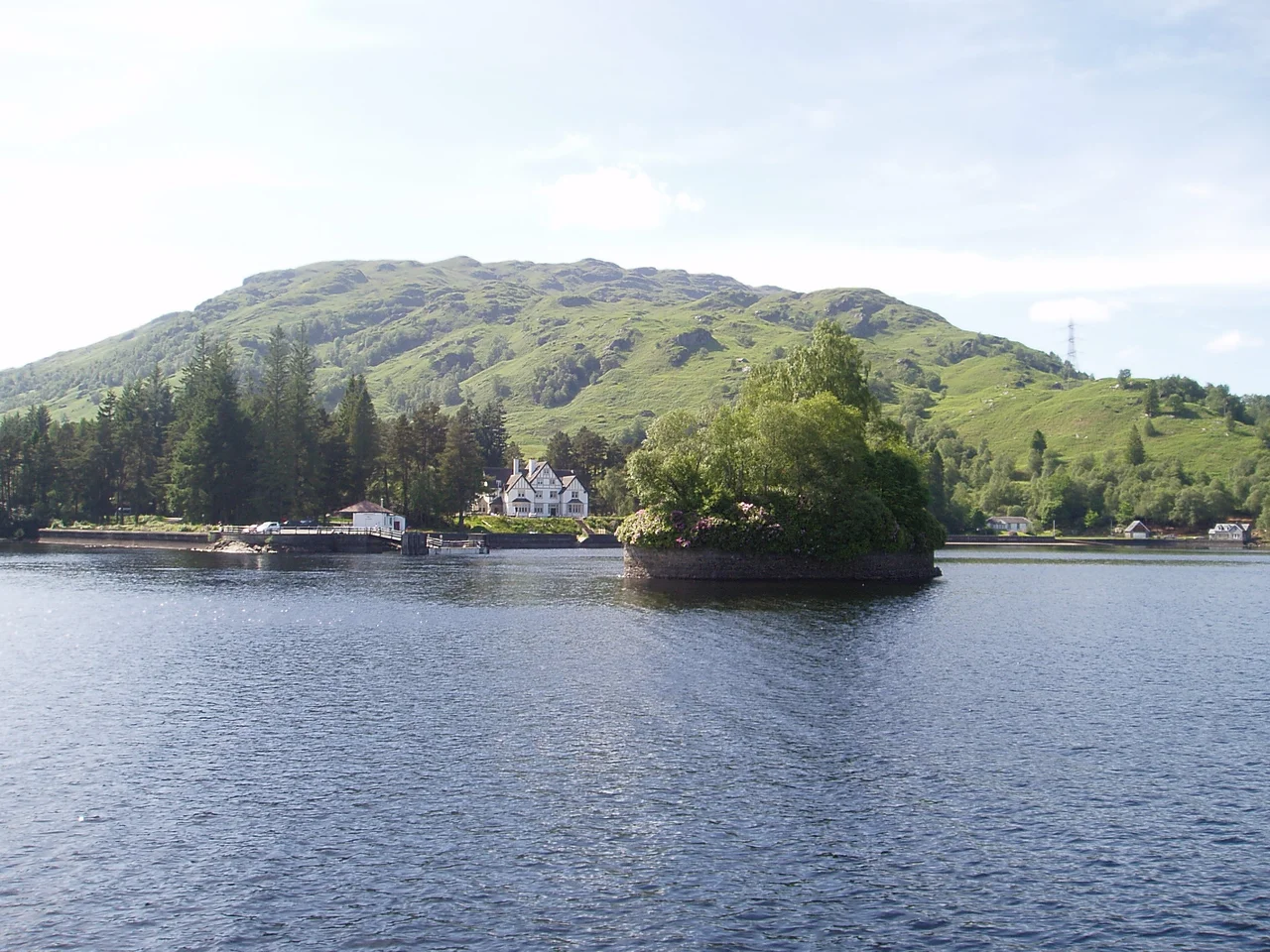

Loch Katrine
In 1810, Walter Scott published a long narrative poem called The Lady of the Lake, set on a loch in the Trossachs that almost no Englishman had ever heard of. Within months, Loch Katrine was a tourist destination. Within a year, Rossini had begun adapting it into the opera La donna del lago. Within a generation, Queen Victoria was opening the works that piped its water 26 miles south to taps in Glasgow. Today the loch still holds the same dark water it has always held, fed by burns running off Ben A'an and Glengyle, and Glasgow still drinks it, delivered by gravity through aqueducts that run uninterrupted since 1859. Rob Roy MacGregor was born at the head of the loch in 1671. The Pictish name for the place means dark, gloomy place. It is darker and gloomier than that, and more beautiful.
A Pictish Name for Dark Water
The place-name scholar William Watson judged Katrine to be thoroughly Pictish, derived from the ancient Celtic root ceit, meaning dark or gloomy place. The name refers to the heavily forested shores that crowd the water, casting reflections that turn the surface near-black even in summer. A competing theory traces the name to cateran, from Gaelic ceathairne, a collective word for cattle thief or peasantry, fitting for a glen that had been working pasture and contested cattle-raiding country for centuries. Rob Roy MacGregor, the outlaw cattleman whose memory Scott later romanticised, was born in 1671 at Glengyle on the loch's western end. The loch lies in the Trossachs, the bristly country where the Highland line meets the Lowland edge, in what is now the Stirling council area but historically part of Perthshire.
Walter Scott Invents Highland Tourism
Before 1810, the Highlands were a difficult, dangerous, recently pacified region most southern Britons preferred to avoid. Walter Scott changed that almost single-handedly. The Lady of the Lake, set on Loch Katrine, made the loch and the surrounding peaks fashionable overnight. Coaches began arriving from Glasgow. Inns opened on the shore. Rossini, in Naples, read the poem in translation and produced La donna del lago in 1819, taking the loch's fame to continental Europe. The mountain at the loch's eastern end, Ben Venue, and the smaller, sharper Ben A'an above the north shore both became staples of Romantic-era engravings. Ellen's Isle, the small wooded island that Scott placed at the centre of his story, still sits where he put it. Visitors still try to identify it from the boat trips that run from Trossachs Pier.
Glasgow's Water Supply
By the 1850s, Glasgow was the second city of the British Empire and a public-health disaster. Cholera epidemics killed thousands. The Clyde was a sewer. The city needed clean water and the surrounding lowland sources were exhausted or polluted. The civil engineer John Frederick Bateman proposed Loch Katrine, 26 miles north in the Trossachs, as the solution. Construction began in 1855. On 14 October 1859 Queen Victoria opened the works in person. The aqueduct ran 41 kilometres south to Milngavie water treatment works on the city's northern edge, including 21 kilometres of tunnel. Crucially, the system runs entirely by gravity. Loch Katrine sits high enough above Glasgow that no pumping is needed even today. A second aqueduct opened in 1901 doubled the capacity. The combined system delivers up to 230 million litres a day.
The Reservoir Glasgow Trusts
Loch Katrine is owned by Scottish Water and protected accordingly. The water level is artificially raised by 1.8 metres above natural, and can be drawn down by up to 2 metres in dry years. Loch Arklet, a smaller reservoir between Katrine and Loch Lomond, was added in 1914 to top up flow during droughts. A longer tunnel beneath Ben A'an, completed in 1958, brings water from the Glen Finglas Reservoir to the north, and a dam at Glen Finglas was finished in 1965. Trout fishing is permitted from spring to autumn, fly and boat only, and the steamer Sir Walter Scott still runs sightseeing trips from Trossachs Pier as it has since 1900. Photographs of the original 1859 aqueduct construction were found in a skip in Possilpark in 2018. Old loch, old water, old infrastructure, still doing exactly what it was built to do.
From the Air
Loch Katrine sits at 56.254 degrees North, 4.516 degrees West, in the Trossachs about 25 miles north-northwest of Glasgow. The loch runs roughly 8 miles WNW-ESE between Strath Gartney mountains. The nearest airport is Glasgow (EGPF) about 25 nautical miles south-southeast. Edinburgh (EGPH) is 45 nautical miles east-southeast. Best viewed at 3,000 to 5,000 feet AGL to see the full length of the loch, the surrounding Trossachs peaks (Ben Venue, Ben A'an), and the relationship with Loch Lomond a few miles west. The southern shore road ends at Stronachlachar; the steamer Sir Walter Scott operates from Trossachs Pier at the eastern end. Weather is highly variable; this is the Highland edge with frequent cloud.
Nearby Stories
- Crieff 4.2 km away
- Buchanan Castle 4.9 km away
- Benmore Botanic Garden 6.5 km away
- Shira Hydro-Electric Scheme 6.7 km away
- Coire Gabhail 7.3 km away
- Falkirk Wheel 8.4 km away
- Pitlochry Festival Theatre 13 km away
- Rannoch Railway Station 15 km away