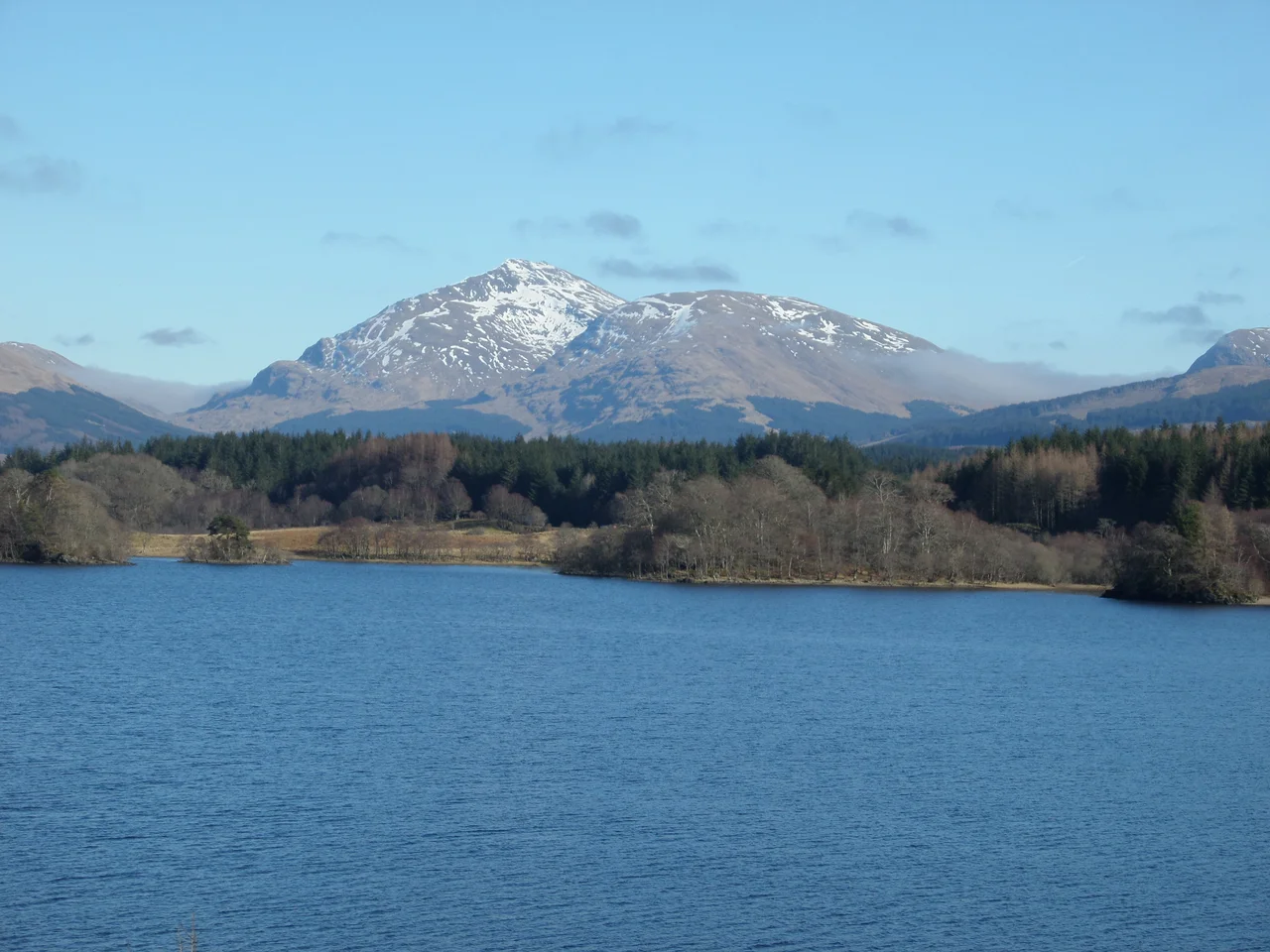

Loch Awe
Twenty-six miles long and barely a mile wide. Loch Awe runs like a knife cut between two parallel sea lochs - Loch Etive to the north, Loch Fyne to the south - and at its head the bulk of Ben Cruachan rises three and a half thousand feet straight out of the water. Inside that mountain, in a cathedral-sized cavern hollowed from the granite, four turbines spin: a pumped-storage power station that can deliver 440 megawatts in under two minutes. Outside, on a low island at the far north tip of the loch, the burned-out walls of Kilchurn Castle are reflected in some of the most photographed water in Scotland. Robert the Bruce won a battle here in 1308 that broke the Clan MacDougall. The loch keeps a lot of stories.
The Long Loch
Loch Awe is Scotland's third-largest freshwater loch by surface area - 38.5 square kilometres - and its longest by length, stretching 41 kilometres from the head at Kilchurn to the Ford end. The water drains north-west through the River Awe and the Pass of Brander into the salt water of Loch Etive, then to the Atlantic. At the narrowest section, around Kilchrenan, the Taychreggan Hotel marks the historic North Port and the Portsonachan Hotel marks South Port - a ferry ran between them for centuries, carrying cattle drovers heading to the markets of the south. The 1955 Transatlantic Cable crosses the loch at the same narrow point. There is now an aquaculture site at Braevallich. The shape of the loch matters: long, narrow, deep, with a single drainage outlet, makes it ideal for hydroelectric storage.
Robert The Bruce And The MacDougalls
Loch Awe was Clan MacDougall country, with Macarthurs, MacGregors, Campbells, and Stewarts living in close proximity around its shores. After Bannockburn was still six years off, Robert the Bruce came west to settle accounts with the MacDougalls of Lorn, who had backed John Comyn and Edward of England against him. In 1308 he caught them at the Battle of the Pass of Brander, downstream from the loch, where the gorge of the River Awe narrows and the slopes of Ben Cruachan crowd in. The MacDougalls held the high ground and waited to roll boulders down on Bruce's troops as they came through the pass. Bruce sent men up over the mountain to take them from above. The MacDougalls broke. The Campbells, who had backed Bruce, came out of the battle with their Highland fortunes made - and went on to dominate Loch Awe for the next four centuries.
Kilchurn Castle
The castle that gets photographed sits at the north end on a small island that becomes a peninsula when the water is low. Kilchurn was built by Sir Colin Campbell of Glenorchy in the 15th century, expanded into a barracks for two hundred troops by 1693, and abandoned after lightning damage in the 1760s. Its ruined silhouette - jagged towers reflected in the still water of the loch, with the bulk of Ben Lui rising behind - has appeared on so many postcards, calendar covers, and travel posters that the actual building can come as a slight disappointment after the picture. In summer a small boat trip runs from Loch Awe village; in winter you can walk to it from a tiny car park just over the bridge from the River Orchy. The Chapel of St Fyndoca on Inishail and the ruined castle on Innis Chonnell stand on other islands further down the loch.
The Hollow Mountain
Two hydroelectric facilities draw power from Loch Awe. The conventional Inverawe power station, built in the late 1950s and early 1960s by the North of Scotland Hydro-Electric Board, dams the River Awe at the Awe Barrage in the Pass of Brander and feeds water through a submerged tunnel to a 30.5 MW Kaplan turbine before returning it to the river above Loch Etive. The barrage itself runs two small bulb turbines on its compensation flow. The other facility is Cruachan - one of the world's most striking pieces of energy infrastructure. Built inside Ben Cruachan with a visitor centre that takes you on tours into the heart of the mountain, Cruachan is a pumped-storage station with 440 MW of installed power and 7 GWh of energy capacity. At night, when grid demand is low, surplus electricity pumps water from Loch Awe up to a reservoir in a corrie above. At peak demand, the water rushes back down and the turbines spin in reverse, releasing the stored energy in minutes. ScottishPower owned it for decades; Drax Group bought it in January 2019. A third, much larger project at Balliemeanoch is planned to store 45 GWh.
Lochawe Village And St Conan's Kirk
At the north tip, where the railway crosses, sits the small village of Lochawe - confusingly spelt as one word, while the train station is two. The village grew up around the Loch Awe Hotel of 1871 and the railway station opened in 1880 when the Callander and Oban Railway pushed through. A pleasure steamer used to call here, stopping at Portsonachan, Taycreggan, Eredine, and Ford. The village's strangest building is St Conan's Kirk, begun in 1881 and rebuilt and extended over decades by Walter Campbell and his sister - a peculiar Gothic-Romanesque hybrid of a church incorporating columns from Eton College, glass from Glasgow Cathedral, and a tomb that purportedly holds a finger bone of Robert the Bruce. The novelist Mary Stewart, author of The Crystal Cave and The Moon-Spinners, lived at House of Letterawe overlooking the loch for the last decades of her long life.
From the Air
Loch Awe runs from 56.291 N, 5.231 W (around the Cruachan area) for 41 km south-west to the Ford end. From cruising altitude the loch is unmistakable: a long thin freshwater body running south-west to north-east, parallel to the sea lochs Etive (to the north-west) and Fyne (to the south-east), with Ben Cruachan rising sharply at the north end. The Cruachan pumped-storage upper reservoir is visible as a small dam-held water body high in the corrie on the south flank of Ben Cruachan. Kilchurn Castle stands at the north end. Oban Airport (EGEO) is 10 nm west-north-west; Glasgow (EGPF) 50 nm south-east. The West Highland Line railway hugs the north shore. Loch Awe Hotel and the village mark the north tip. Highland weather is volatile - the loch frequently sees rapid changes when Atlantic fronts move in over Mull and Lismore.
Nearby Stories
- Easdale 5.5 km away
- Buchanan Castle 6.2 km away
- Cowal 6.8 km away
- Clachaig Inn 7.4 km away
- Loch Katrine 9.9 km away
- Lochaber 23 km away
- Ben Alder 25 km away
- Jura Distillery 34 km away