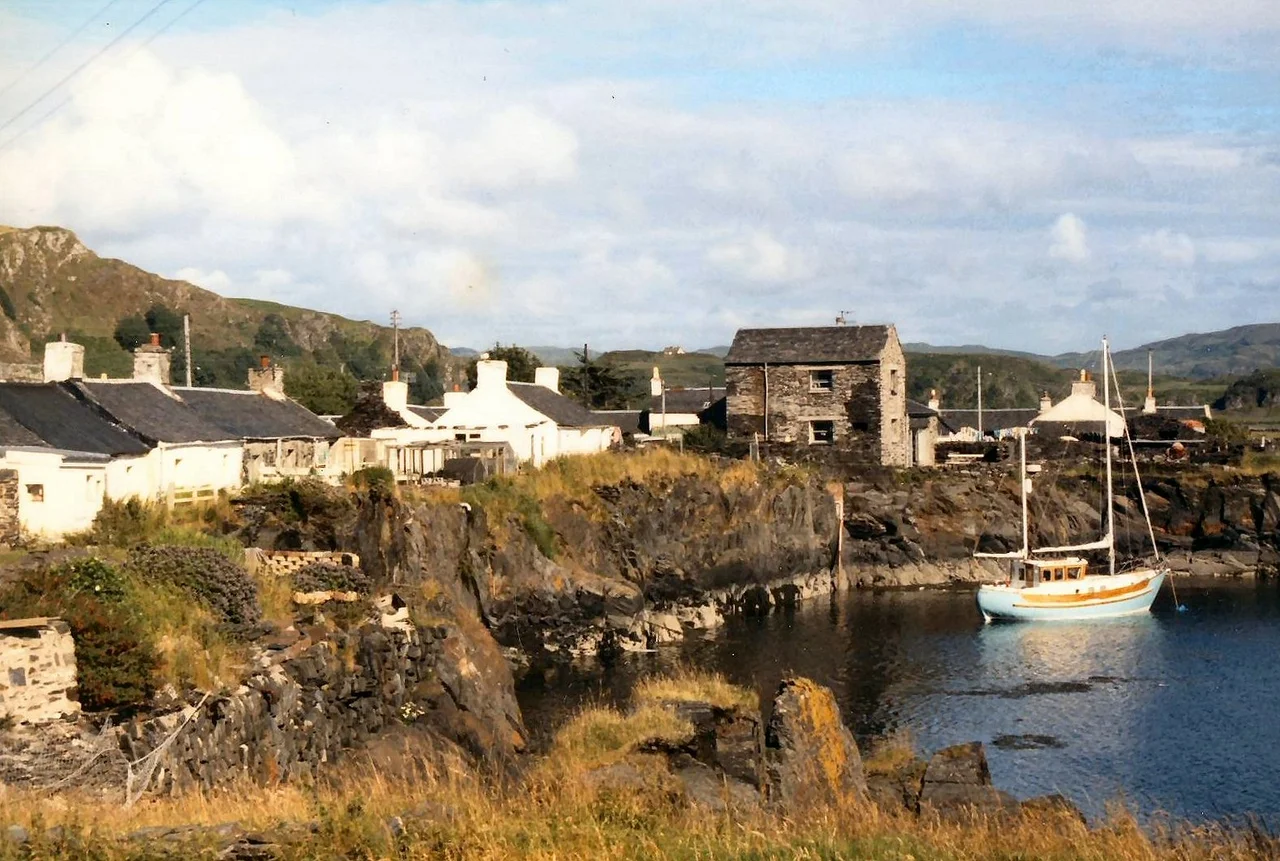

Easdale
Every September, several hundred people gather on a tiny island in the Firth of Lorn to throw flat stones across a flooded slate quarry. The rules are strict. The stone must skip at least three times. It must remain inside the marked quarry boundaries. The longest skim wins. The World Stone Skimming Championship has happened on Easdale every year since 1997, and it is the kind of event that small islands invent to give themselves a reason to exist when their original industries vanish. There are no cars on Easdale. No streetlights. The whole island measures less than a kilometre across. The stones are slate, broken from the quarries that once roofed half the world.
Slates That Roofed the World
Easdale was once the centre of the Scottish slate industry. The quarries on this island and nearby Seil sent roofing slate across Britain and to Australia, the Americas, the West Indies. The industry peaked in the nineteenth century. Then on a night in November 1881, a great storm broke through the outer rim of a neighbouring quarry, Eilean-a-beithich, which had been dug 75 metres below sea level. The sea poured in. The quarry, and effectively the small island it had hollowed out, was lost. Easdale's own quarries kept working at reduced capacity until the 1950s, when the last slate was cut. What remains is a network of still pools where the quarries used to be, providing habitat for flora and birds and, by accident, a perfect arena for stone skimming. The Conde Nast Traveller has called Easdale one of the twenty most beautiful islands in Scotland.
Listen Yonder
The etymology of Easdale is genuinely unclear. In 1549 the cleric Donald Monro, Dean of the Isles, recorded the name as Eisdcalfe, in a phrasing whose meaning has been argued over ever since. The reference book Gaelic Place-Names of Scotland states the first element is obscure. Haswell-Smith proposes eas, the Gaelic for waterfall, plus dal, the Norse for valley, though Easdale is low-lying and has no waterfall. Local folk legend favours a more poetic derivation from the Gaelic èist thall, listen to that yonder. None of the explanations satisfies the linguists. All of them survive locally. The nearby village of Ellenabeich on Seil takes its name from Eilean nam Beathach, island of the animals, or possibly an older Eilean nam Beitheach, island of the birch trees. The Hebrides specialise in names that mean two things at once.
Stamps and Stewardship
Easdale is privately owned by Jonathan Feigenbaum, who runs the Easdale Island Company. He inherited the island from his father Clive Feigenbaum, former chairman of the philatelic firm Stanley Gibbons. The Feigenbaums have issued their own local Easdale stamps, a small enterprise that suits an island with no roads and a population that, by most counts, hovers around sixty. Day-to-day life is organised by Eilean Eisdeal, a development trust run by residents. The trust operates the award-winning museum, runs the community hall whose pyramid roof Mike Scott of the Waterboys called magical, and works to keep the island viable. In 2012 the stone-skimming championship nearly collapsed when Feigenbaum requested £1,000 for use of the quarry. The Press and Journal newspaper paid the fee, the event went ahead, and conversations about a community buyout have continued ever since. The MSP Mike Russell put it carefully: not every community will achieve it, but it remains a live issue.
A Pyramid Roof and a Bridge That Wasn't
The community hall on Easdale sits at the heart of island life. Its distinctive pyramid roof and arced frontispiece are visible from the short ferry crossing from Seil, the kind of building that makes a small community legible from a distance. The hall hosts concerts, weddings, the stone-skimming after-party, and most of the events that keep an island of sixty people interconnected. The disused quarry pools have become known among open-water swimmers as perfect for wild swimming, the water cold but clean, the slate walls protecting bathers from open-sea conditions. In 2005 Argyll and Bute Council proposed a bridge between Easdale and Seil that would have connected the island to the mainland road network, despite there being no roads on Easdale to connect to. The bridge was never built. The brief ferry, the absence of cars, the slate-paved paths, and the pyramid-roofed hall remain the defining features of an island that has stayed itself partly by accident, partly by stubborn collective effort.
From the Air
Coordinates 56.292°N, 5.658°W in the Firth of Lorn, separated from Seil by a narrow channel. Best viewed at 1,000-2,000 feet AGL with Easdale's flooded quarries visible as dark blue pools against the slate-grey island, Seil to the east, and the Garvellach islands and Scarba to the southwest. Nearest airports: Oban (EGEO) 10 nm northeast on the mainland, Glenforsa Airfield (grass) on Mull 25 nm northwest, Tiree (EGPU) 50 nm west. Atlantic frontal weather can move in rapidly from the southwest; the narrow Firth of Lorn can funnel winds.
Nearby Stories
- Iona Abbey 3.9 km away
- Loch Awe 5.8 km away
- Cowal 11 km away
- Ballachulish 12 km away
- Coll 15 km away
- Tobermory Lifeboat Station 16 km away
- Colonsay 26 km away
- Bruichladdich Distillery 34 km away