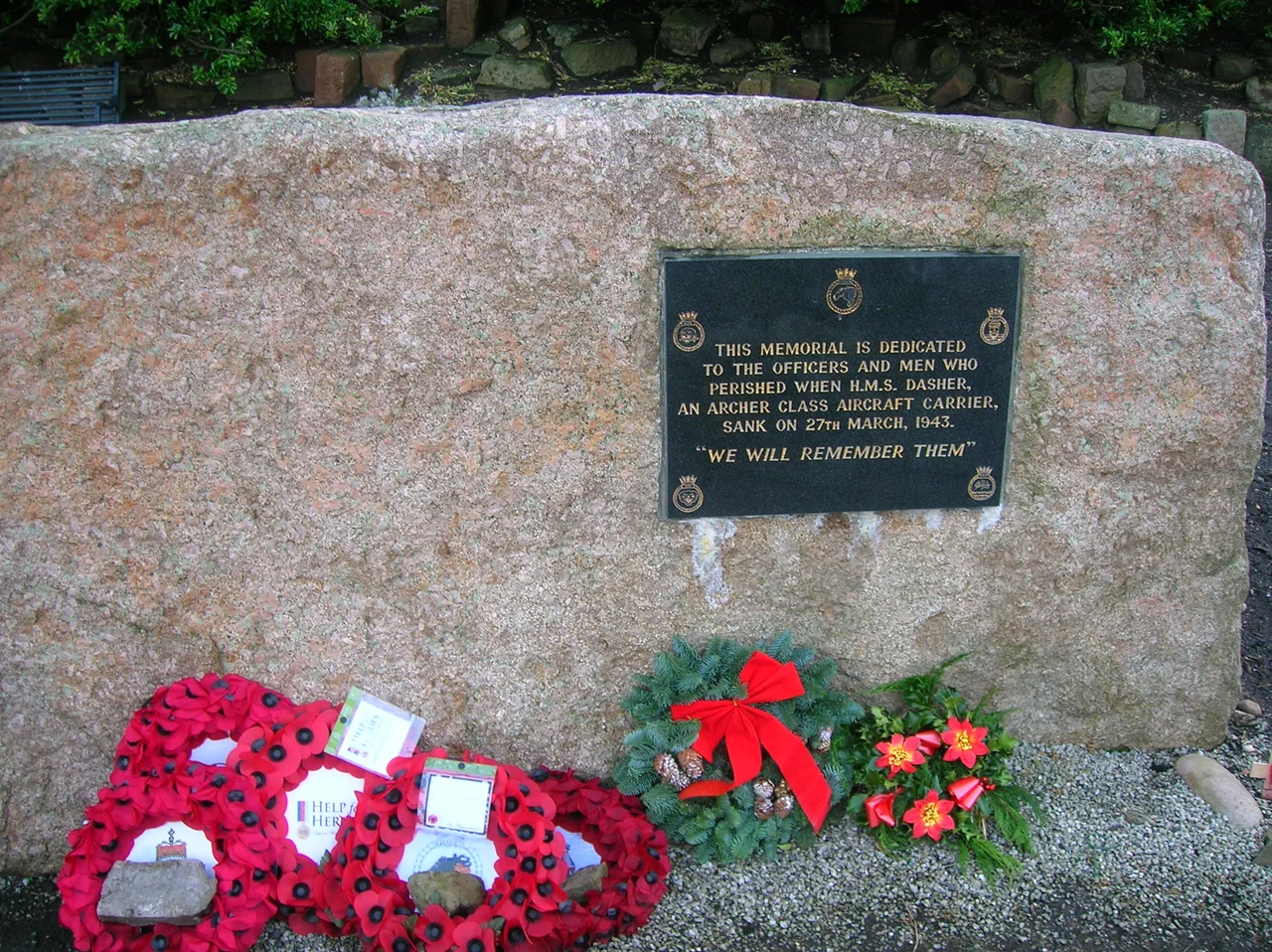

HMS Dasher (D37)
On 27 March 1943, HMS Dasher exploded in the Firth of Clyde and went to the bottom in minutes. She was an escort carrier - one of the converted American merchant ships that the British called the Avenger class - and the wartime government had urgent reasons to keep what happened to her quiet. The local press was instructed to make no reference to the tragedy. Families were told their men had died on service but not where, not how, not in any way they could grieve cleanly. The cover-up was successful enough that the cause of the explosion was not officially confirmed for nearly seven decades. The men who died are still on the bottom of the Clyde, in waters their loved ones could see from the shore.
An American Hull, a British Flag
Dasher was not built as a warship. She started life as a U.S. Maritime Commission type C3 merchant vessel - a sturdy, ordinary cargo hull of the kind that made up the backbone of mid-century American shipping. As the Royal Navy ran short of escort carriers, the United States agreed to convert a number of these C3 hulls into small flight-deck ships capable of operating a handful of aircraft. The work was done at the Tietjen & Lang shipyards in New Jersey. To distinguish the converted British ships from American escort carriers, the Royal Navy designated theirs with a 'B' prefix - BAVG. Dasher was commissioned into the Royal Navy on 2 July 1942. She had a complement of 555 men, a small island bridge, one aircraft lift, an aircraft catapult, and nine arrestor wires above a wooden flight deck. Aircraft were stowed in a half-hangar below.
The Explosion in the Clyde
On the afternoon of 27 March 1943, Dasher was in the Firth of Clyde on training operations. Witnesses on shore and on nearby vessels saw a sudden explosion. The flight deck lifted, fire broke out, and the carrier sank quickly. Many men were trapped below. Those who reached the water faced cold and burning fuel. The official cause of the explosion was not confirmed in any public document for nearly seventy years. In August 2011, the Shetland Times reported that the cause - a build-up of petrol vapour ignited in the lower deck - had finally been formally identified. Until then, families had been left to draw their own conclusions from rumour, inference, and the silence of officials who had been told not to talk.
What the Censor Did
The government of the time, eager to avoid damage to morale and anxious to avoid any suggestion that the American-built carriers were structurally unsound, tried to cover up the sinking. The local media were ordered to make no reference to the tragedy. There were persistent rumours - never substantiated by any official record - that the dead had been buried in an unmarked mass grave. The Royal Navy has said such a grave would have been against Admiralty policy and that all relevant sources are in the public domain. In 2021, a BBC News report quoted a witness recalling that survivors had spoken to her of a mortuary where about fifty bodies had been laid out: 'just dumped.' People living nearby saw the bodies over a high wall, 'then they all disappeared.' Whatever happened, the families never had what they needed. They were given a place to grieve only later, when relatives organised commemorations and laid wreaths at the war cemeteries at Ardrossan and Greenock.
The Man Who Never Was
There is one further strand in the Dasher story, contested and unresolved. In 2002, John and Noreen Steele published 'The Secrets of HMS Dasher,' arguing that one of the corpses from the carrier's sinking was used in Operation Mincemeat - the famous British deception that floated a body off the coast of Spain carrying false invasion plans to mislead the Axis powers. The case is presented carefully in the book but is not generally accepted. The body actually used in Mincemeat was identified in 1996 by Roger Morgan as Glyndwr Michael, a Welsh vagrant who had died after ingesting rat poison. His name has since been added to the deception's official records. The Dasher theory remains a footnote, but it persists - perhaps because the men who died on the carrier had been so thoroughly denied any honest accounting that even an alternative story carried, for a while, the comfort of meaning.
What Remains
Pieces of Dasher's wooden flight deck washed up on the Firth's beaches in the days and weeks after the sinking, riddled with the small tunnels of burrowing teredo worms - shipworms that had bored through the wood while it lay on the bottom or floated half-submerged. A section of this wood was later featured in the 'Flotsam and Jetsam' exhibition at the Millennium Dome. Another piece is held by the North Ayrshire Heritage Centre in Saltcoats. The wreck itself remains in the Clyde, designated as a protected site under the law that governs war graves. The men aboard have headstones in the Commonwealth War Graves Commission cemeteries at Ardrossan, Greenock, and Chatham. Their families spent decades trying to make sense of what the censor had taken from them. The Clyde, broad and dark, holds the rest.
From the Air
Wreck site located at approximately 55.629°N, 5.018°W in the Firth of Clyde, off the east coast of Arran near Ardrossan and Saltcoats. From altitude the area shows as open water between the Ayrshire coast (to the east) and Arran (to the west). Best viewed from 2,000-4,000 ft on clear days; the towns of Ardrossan, Saltcoats, and Stevenston are the most recognisable shoreline features to the east. Nearest aerodromes: Glasgow Prestwick (EGPK) approximately 15 nm to the southeast, Glasgow (EGPF) about 25 nm to the northeast.
Nearby Stories
- Kilmaurs 2.6 km away
- Siege of Dumbarton 4.2 km away
- Dunaverty Castle 7.2 km away
- Tighnabruaich Lifeboat Station 8.5 km away
- Achamore House 8.6 km away
- Ailsa Craig 13 km away
- Jura, Scotland 22 km away
- Battle of Glen Trool 32 km away