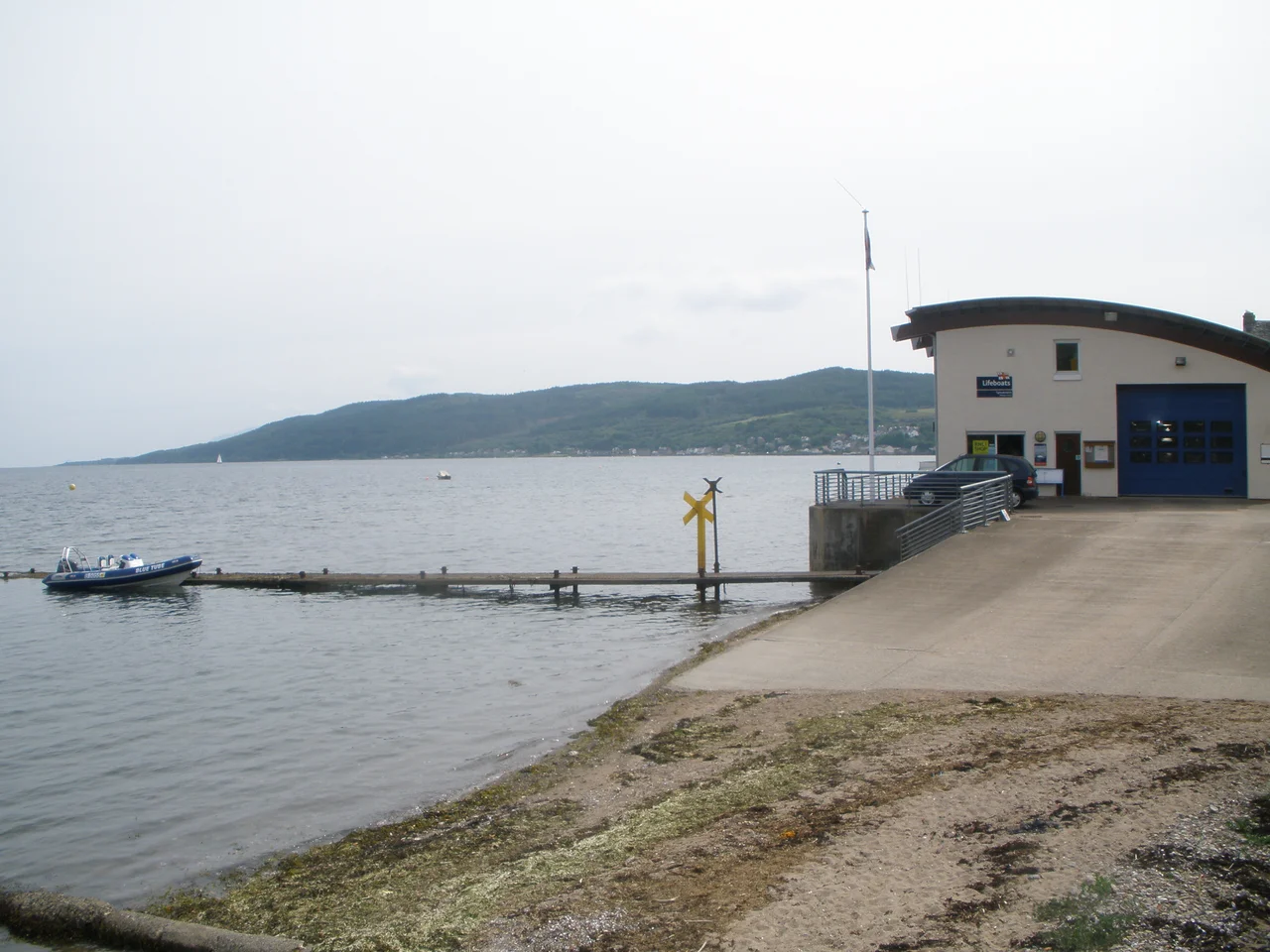

Tighnabruaich Lifeboat Station
In 1962, the Royal National Lifeboat Institution counted 98 rescues or attempted rescues by its all-weather lifeboats during the summer months alone, saving 133 lives. The institution's leaders looked at those numbers, noticed that more and more of the casualties were ordinary people in small leisure boats rather than commercial seafarers in distress, and tried something new. In 1963 the RNLI began trials of small, fast inshore lifeboats: light enough to launch with just a few crew, quick enough to reach a capsized dinghy before the cold killed the person clinging to it. The trials worked. By summer's end the institution counted 226 rescues and 225 lives saved. A few years later, in May 1967, one of those new inshore boats was placed on service at a small harbour on the Kyles of Bute, in the Cowal village of Tighnabruaich.
A Station on the Kyles
The Kyles of Bute are a narrow, twisting strait separating the southern tip of Cowal from the Isle of Bute. They are popular with yachts, kayakers, and dinghy sailors, and the surrounding lochs draw small boats in increasing numbers each summer. The station at Tighnabruaich was opened to serve exactly this kind of leisure traffic. The first boat to go on station was an inshore lifeboat designated D-134, the type that had only just proven itself in the trials a few years before. Volunteers, drawn from the village and the surrounding farms, ran the station, as they still do. A Lifeboat Ladies Guild, founded in the late 1960s, raised the money that kept the operation going through its first decades.
Naming the Boats
Lifeboat naming ceremonies follow a particular ritual. After a service of dedication and the cutting of a ribbon at the new boathouse, the donors of the boat, Mr and Mrs Preston of Lancashire, travelled up to the station for the formal naming. Mrs Preston christened the lifeboat Alec and Maimie Preston, with a splash of whisky against her hull. The boat was launched immediately for a demonstration and a mock rescue involving the paddle steamer Waverley, which still visits Cowal's piers in summer. A separate ceremony marked the 20th anniversary of the Ladies Guild: Miss Aja Lushington accepted the framed record of thanks and the Scottish Lifeboat Council's plaque, and longtime crew member Andy Sim received his long service badge. Sim later cut the ribbon at the opening of a new boathouse.
James and Helen Mason
In 2012 a new Atlantic 85 class inshore lifeboat replaced the older boats on station. The James and Helen Mason, given the operational designation B-862, was funded from the legacy of Mrs Janet Wilson Smith of Helensburgh in memory of her parents. This is how the RNLI builds most of its fleet: not from government money but from individual gifts, bequests, fundraising raffles, and the donations of people who will never see the boats their money buys. The Atlantic 85 is a rigid inflatable that can launch quickly, run at speed in rough water, and turn sharply enough to come alongside someone in the water within seconds of arrival. It has been the workhorse of inshore stations across the British and Irish coasts.
The People Who Go Out
The honours awarded at Tighnabruaich tell a small story about what crews face. In 2005, crew member Craig Allen received a special framed certificate signed by the institution's Surgeon Rear Admiral F. Golden and Chief Executive, recognising a particular case. In the same year, framed Letters of Thanks signed by the Chairman of the RNLI went to Andrew Fulton, Jonathan Pilkington, and Catherine McVeigh. The pattern of awards is the pattern of every small lifeboat station: long stretches of routine training broken by sudden, difficult night-time calls when a casualty's life depends on volunteers who got out of bed, drove to the boathouse, and launched into weather they would normally avoid. The James and Helen Mason still waits at the harbour, fuel topped up, ready to go.
From the Air
Tighnabruaich Lifeboat Station sits at approximately 55.907 north, 5.233 west, on the western arm of the Kyles of Bute at the village of Tighnabruaich. From altitude the station is a small structure at the village harbour, with the Kyles winding north and east around the Isle of Bute. EGPF Glasgow lies about 40 nautical miles east; EGPK Prestwick is roughly 35 nautical miles south-southeast. Recommended viewing altitude 2,000 to 3,500 feet to take in the village, the strait, and the Bute coastline opposite. Maritime weather is highly variable; the lifeboat exists because conditions in these sheltered-looking waters can turn quickly.
Nearby Stories
- Loch Katrine 3.4 km away
- Dumbarton 4.4 km away
- Easdale 5.1 km away
- Stewarton 5.9 km away
- Gigha 9 km away
- Loch Awe 9.4 km away
- HMS Dasher (D37) 12 km away
- Jura, Scotland 13 km away