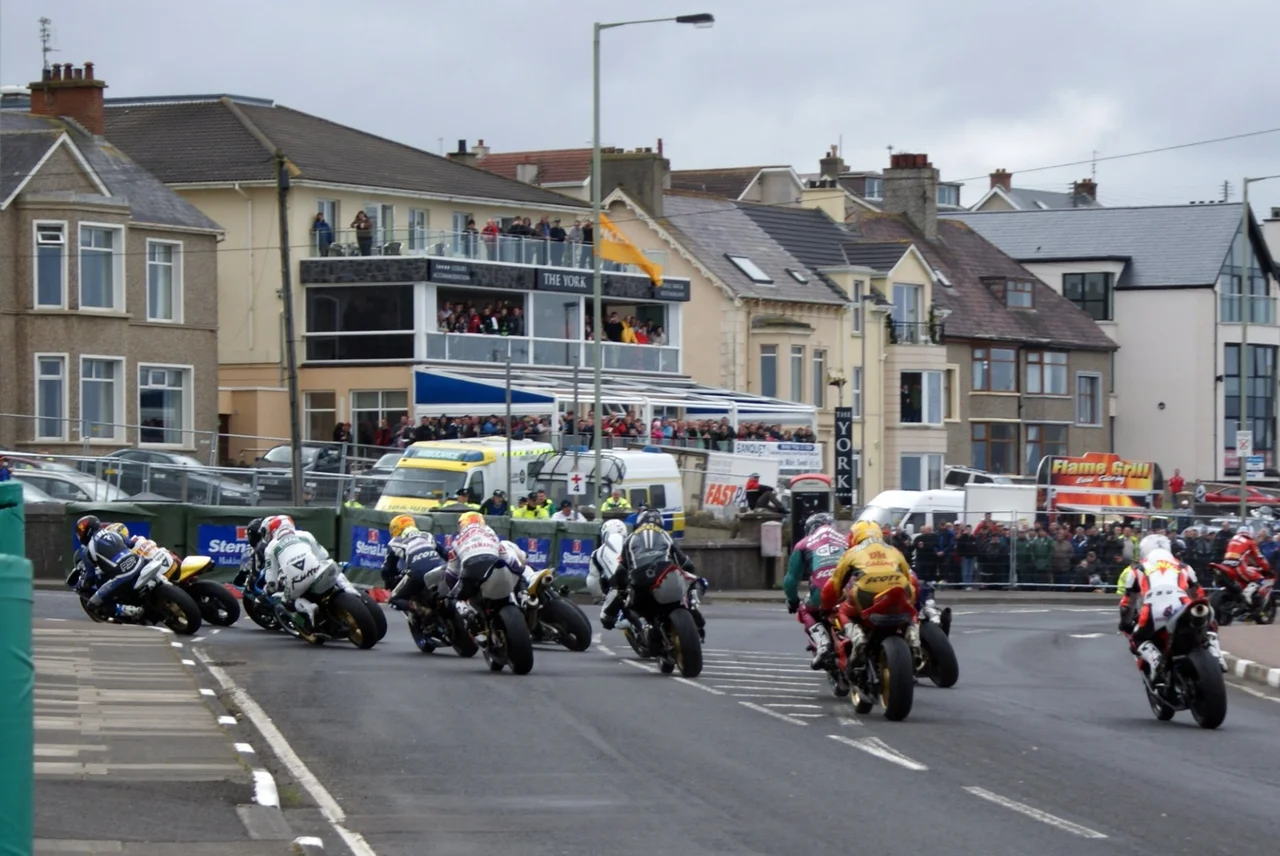

North West 200
On the approach to University Corner in 2012, during practice for the North West 200, Martin Jessopp's speedometer hit 208 miles per hour. That is two hundred and eight miles per hour on a public road in Northern Ireland - a stretch of the A2 that motorists drive every day with their dogs in the back seat. For one week each May, the road network of Portstewart, Coleraine, and Portrush closes to ordinary traffic and becomes one of the fastest closed-roads racing circuits in the world. Hay bales wrap the bases of lampposts. Spectators stand in their front gardens watching superbikes flash past at impossible speeds. Over 150,000 people come from across the planet. It is the largest annual sporting event in Northern Ireland, and one of the most lethal.
The Triangle
The circuit is called the Triangle for the obvious reason - three towns at its corners, connected by 8.97 miles of mostly public road. The race runs anti-clockwise. Riders launch from the start line on the Portmore Road in Portstewart, blast along the A2 toward Coleraine, navigate the streets at Mather's Cross and University Corner, then thread through Portrush at Metropole Corner and the Magherabouy stretch before completing the lap. Three speed-reducing chicanes break up the longest straights to keep speeds (theoretically) survivable. Average lap speeds run around 120 mph. Top speeds exceed 200 mph. The route was first laid out in 1929 by the City of Derry & District Motor Club, who intended a race "somewhere in the north west of Ireland" and ended up moving it to the north coast. The name stuck. Since 1964 the Coleraine and District Motor Club has organised the event.
What the Spectators See
Unlike the Isle of Man TT, which is run as a time trial with riders going one at a time, the North West 200 is wheel-to-wheel circuit racing. Three to four dozen riders launch together, and the chaos of overtaking happens at 180 mph between hedgerows and stone walls. Spectators watch from gardens, fields, pub car parks, and dedicated grandstands. Street signs are removed before race weekend. Hay bales protect every lamppost and telegraph pole on the racing line. The smell of petrol and burnt rubber rolls through Portstewart for two days. Hawkers sell helmets and leathers in tents. The pubs open early. Local people who normally drive to work past Mather's Cross now stand on the verge watching their road disappear beneath spinning rubber. The combination of intimate setting and outrageous speed gives the North West 200 a character that no permanent circuit can match.
Black Saturday and Other Losses
The danger is not theoretical. The first recorded death at the event was Norman Wainwright in 1939. The darkest single day in the race's history came on what is still called Black Saturday in 1979, when crashes claimed Tom Herron, Brian Hamilton, and Frank Kennedy (who died months later from his injuries). Robert Dunlop - the great Northern Irish road racer, brother of Joey Dunlop and father of Michael and William - died in practice on 15 May 2008 when his 250cc bike seized at around 160 mph on the approach to Mather's Cross. Mark Young, a 22-year-old in his first appearance at the race, died in 2009. Mark Buckley, 35, died on Millbank Avenue in 2012. Simon Andrews died in 2014 of injuries from a crash near Metropole Corner. Malachi Mitchell-Thomas, 20, died in 2016. Road racing remains lethal in ways that purpose-built circuits have largely eliminated. The North West 200 continues anyway. So do the riders.
Records and Riders
Jack Brett recorded the first 100 mph lap on a 500cc Manx Norton in 1957. Tom Herron set the absolute lap record at 127.63 mph in 1978 - the year before he died. The outright lap record for the four-chicane configuration belongs to Glenn Irwin at 125.799 mph, set during the 2024 Superbike race, breaking Peter Hickman's previous record of 124.799 mph set in 2022. The fastest single speed ever measured on the circuit was Martin Jessopp's 208 mph in 2012, the year speed traps first started recording figures above the 200 mph barrier. Northern Irish riders have always dominated. Phillip McCallen once won five races on a single day - a feat no one has matched. The 2022 event returned after a two-year COVID-19 cancellation, rebranded as the fonaCab & Nicholl Oils North West 200. In early 2023 the race was nearly cancelled by an unaffordable insurance premium; a sizeable donation from a businessman and a revised quote brought it back.
Why It Still Happens
Permanent circuits are safer. Riders make more money in MotoGP. Health and safety officials worry every May. And yet the North West 200 continues, year after year, because road racing in Northern Ireland is a culture with deep roots. It produced the Dunlop dynasty, the McGuinness era, the riders who turn up to win at the Isle of Man and the Ulster Grand Prix as well as at the Triangle. The race is now broadcast live on the BBC iPlayer, with highlights on BBC Northern Ireland presented by Stephen Watson. BBC commentators include MotoGP veteran Steve Parrish. The audience watching from sofas worldwide has grown larger than the crowd lining the hedgerows. The 150,000 who turn up in person still come for the smell of petrol, the impossible noise, and the unrepeatable feeling of watching motorcycles travel at telephone-pole-blurring speed past the same garden gates you walk past on a Sunday afternoon.
From the Air
The Triangle is centred approximately 55.19°N, 6.70°W between Portstewart, Coleraine, and Portrush on the County Londonderry/Antrim coast. The 8.97-mile street circuit follows the A2 (mostly), B185, and A29. Nearest airports: City of Derry (EGAE) 16 nm west; Belfast International (EGAA) 30 nm east-south-east. From cruising altitude the triangular layout is immediately recognisable in summer when grandstand markings are visible. The race takes place each May; expect significant ground-level traffic and restricted local access during the event.
Nearby Stories
- Armoy 2.6 km away
- Buncrana 5.7 km away
- Strabane 5.8 km away
- Plantation of Ulster 14 km away
- HMS Audacious 19 km away
- Castle Upton 22 km away
- German submarine U-218 30 km away
- Port Ellen Distillery 30 km away