
Armoy
In the late 1970s, four young men from this village - Joey Dunlop, his brother Jim, Mervyn Robinson, and Frank Kennedy - rode motorcycles fast enough to embarrass riders from anywhere in the world. The press called them the Armoy Armada. Joey would go on to become a five-time Formula 1 world champion and the most decorated road racer in Irish history, killed on a circuit in Estonia in 2000 still wearing his trademark yellow helmet. He learned his nerve on the lanes outside Armoy, a small village of just over a thousand people sitting at the foot of two of the nine Glens of Antrim.
Saint Patrick's Monastery
Long before motorcycles, the village had another kind of fame. A monastic settlement, founded in the 5th century by Saint Patrick himself according to local tradition, once stood northeast of the present village where St Patrick's Parish Church sits today. Archaeology has dated the site to the 6th century at the latest, and the only above-ground trace is the stump of an Irish round tower, about eleven metres high and divided into three storeys. The land was reputedly granted to Patrick by Fergus Mor MacEarca, the chieftain said to have become the first Christian king in Ireland. One of Patrick's followers, a local man named Olcan, was baptised at Dunseverick on the coast and became Bishop of Armoy. Fifteen centuries later, one of the village primary schools still carries his name.
The Lagge and the Giant
The river that runs through Armoy is the same River Bush that ends up in Bushmills whiskey, but it has not always taken this route. During the last Ice Age, a wall of glacial debris called the Armoy Moraine was dumped across its old channel north to Ballycastle, forcing the river to swing west through the village instead. The tradition that grew up around this event is more entertaining than the geology textbook version. A giant, the story goes, lifted an L-shaped section of land at Lagge Cross and flung it into the sea, where it became Rathlin Island. The word Lagge means hollow in the old language, and the ground around the church is honeycombed with oval tunnels said to run all the way down to the River Bush, an escape route in case the monastery ever needed one.
The Race of Legends
Every summer at the end of July, the village fills up with the smell of fuel and the howl of high-revving engines. The Armoy Road Race, billed as 'The Race of Legends', has run on a three-mile circuit of closed public roads through the village since 2009. Up to twenty-seven riders grid up grand prix style on the A44 Hillside Road, just north of the village, and then disappear over the hill in a single chord of noise. The race is direct heir to the Armoy Armada legacy. In the small park beside the river, the paths are laid out in the shape of the North West 200 and the Isle of Man TT circuits, the two big road races that the Armoy riders made their own in the 1970s and 1980s. A mural painted in 2020 by Belfast artist Oliver McParland shows the four young men together, frozen in the moment before they became famous.
A Loss in 1978
Not every story from the village is celebratory. On 15 April 1978, an RUC officer named John Moore was killed by a Provisional IRA booby-trap bomb attached to his car. He was one of more than three thousand people who died in the Troubles, the long and grinding conflict that scarred Northern Ireland for thirty years and reached into villages this small. Armoy carries that history quietly, the way places like this carry a lot of things, woven into the fabric of ordinary life. The bomb was a brief and brutal interruption of a community that has always been mostly about farming, fishing, the bend of the river, and the rumble of bikes coming down Hillside Road.
The Eiffel Tower in Miniature
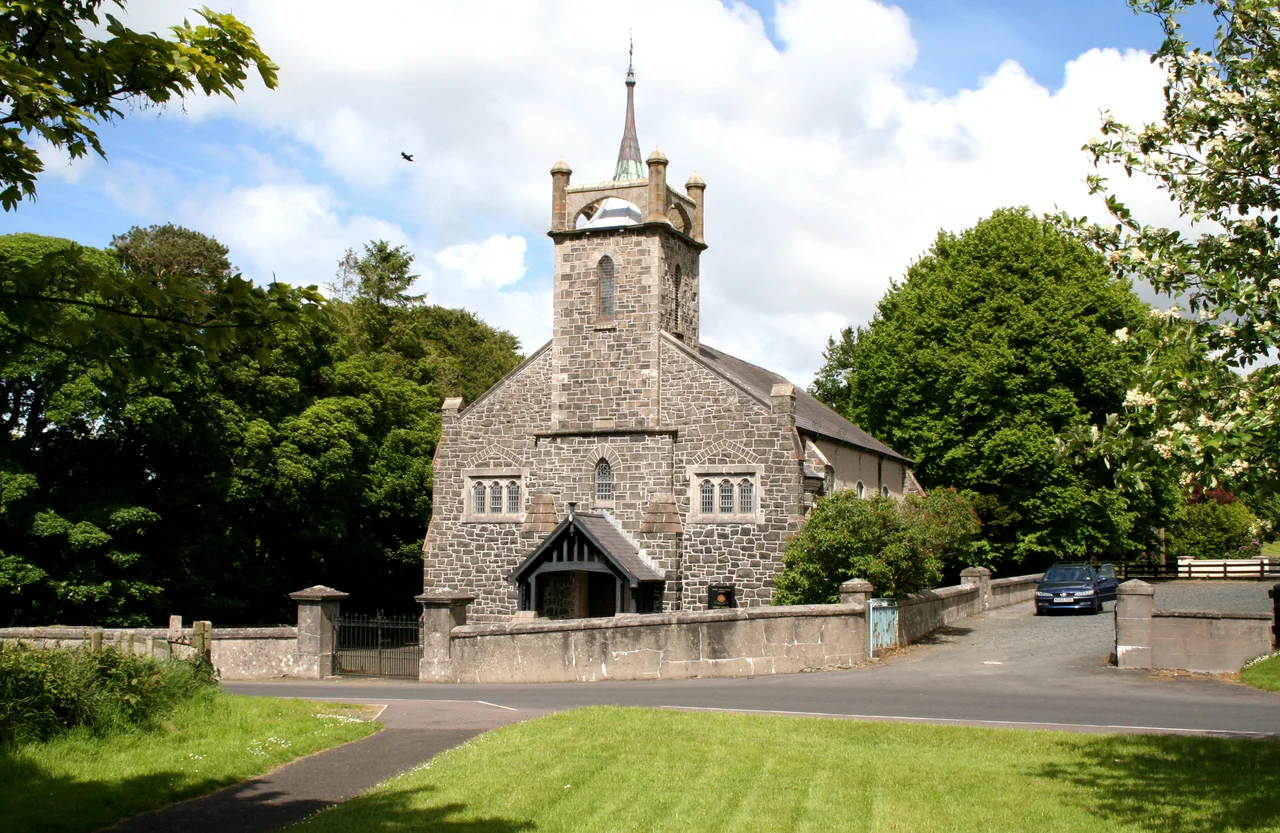
If you arrive looking for tourist landmarks, the round tower is the obvious one, but the Presbyterian church near the river has its own quiet claim to fame. Its spire is topped by a Viking ship weathervane and has been described, by people willing to stretch a metaphor, as 'a miniature replica of the Eiffel Tower'. Up the road sits Gracehill House, a 1775 Georgian residence with its own 18-hole golf course winding through ponds and woodland. And a few miles to the west stand the Dark Hedges, the spectral avenue of beech trees that became the King's Road in Game of Thrones and now draws coachloads of visitors who often have no idea that the small village down the lane gave the world one of the greatest motorcycle racers who ever lived.
From the Air
Armoy sits at 55.131 N, 6.327 W in the Glens of Antrim, about 9 km southwest of Ballycastle and 13 km northeast of Ballymoney. Best viewed from 1,500 to 3,000 feet. From above, look for the River Bush running west out of the village, Knocklayd Mountain rising to the northeast, and the Glens of Glenshesk and Glentaisie opening to the north. The Dark Hedges are visible as a dark linear feature about 3 miles to the southwest. Nearest airports: City of Derry (EGAE) about 30 nm west, Belfast International (EGAA) about 38 nm south. Maintain MSA over the Antrim Hills to the south.
Nearby Stories
- Coleraine Academical Institution 3.2 km away
- Campbeltown 5.9 km away
- Ulster 12 km away
- Beaufort's Dyke 15 km away
- Castle Upton 16 km away
- Machrihanish 27 km away
- Campbeltown Lifeboat Station 35 km away
- German submarine U-218 41 km away