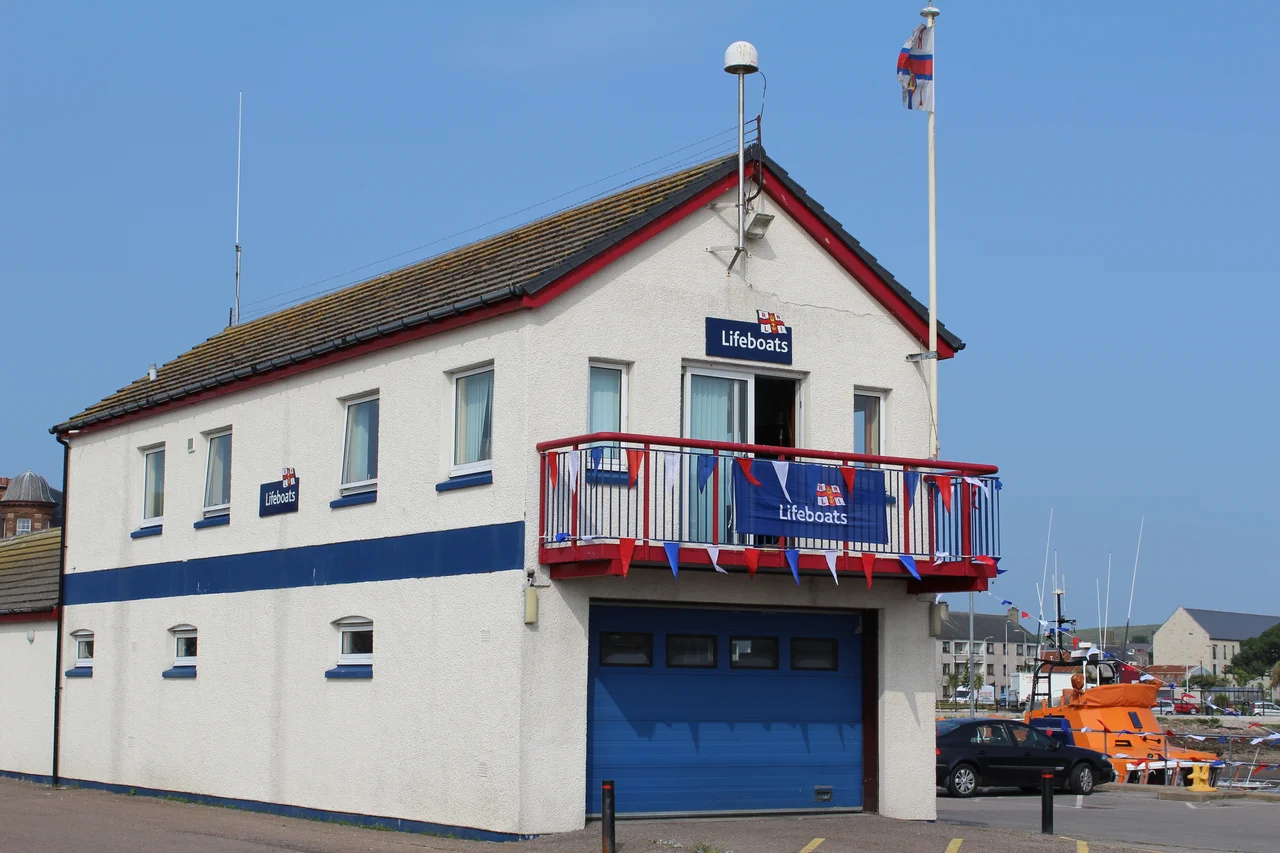

Campbeltown Lifeboat Station
The shortest distance between mortal danger and rescue, on a wild night off the Kintyre coast, has often been the length of cable between a stranded ship and a boat from Campbeltown. The Royal National Lifeboat Institution has kept a boat here since 1861, paid for that first year by Lady Murray of Edinburgh — boat, carriage, and boathouse together for £431. Since then, in fog and in war and in Force 9 winter storms, Campbeltown crews have rowed, motored, and twice in three months in 1946 navigated by radio relay from fishing boats they could not see. The names on the medal citations — Thomson, Newlands, Black, Gilchrist, Stewart, McPhee — are the names of men who knew exactly what the Kilbrannan Sound could do.
Wartime, January 1942
On 19 January 1942, the Dutch ship Mobeka was in trouble off Kintyre. The Campbeltown lifeboat went out. They brought back 44 of her crew alive. Coxswain James Thomson was awarded both an RNLI silver medal and the British Empire Medal. Bronze medals went to the rest of the crew: Duncan Newlands, Duncan Black, Hubert Lister, Joseph McGeachy, Duncan Mclean, Neil Speed, and James Lang. Their names appear together in the station record like a small honour roll. Newlands was Second Coxswain at the time, but in March 1946, by then Coxswain himself, he led a second extraordinary rescue. The lifeboat — with a damaged rudder and an engine that broke down during the service — took 54 people off the American freighter Byron Darnton after she ran aground on Sanda Island. Newlands earned a second bronze medal for that night. Duncan Black, the mechanic, received the Thanks of the Institution inscribed on vellum for keeping a wounded engine alive long enough to finish the job.
Fog Off Sanda Island
The ss Gracehill went aground on Sanda Island in fog on the night of 8 March 1957. Visibility was less than the lifeboat's own length. Two fishing boats nearby could see the lifeboat on their radar even when no one on board could see anything else, and so they guided it in by radio, calling course corrections through the murk. The Gracehill's ten crew had already taken to their ship's boats and were sheltering in the lee of the wreck when the lifeboat reached them. The lifeboat took them all aboard and crept back to port through the fog, arriving roughly seven hours after she had set out. Duncan Newlands — the same coxswain who had won two bronze awards during the war — received another Thanks of the Institution on vellum. A man could grow old in this work, and Newlands had.
The Erlo Hills, October 1981
A trawler called the Erlo Hills, with 14 people on board, broke down and was blown towards shore in a Force 9 storm on 2 October 1981. When the Campbeltown lifeboat was already at sea, it became clear the casualty had drifted close to Rathlin Island, off Northern Ireland — technically in another lifeboat's area, but the Campbeltown boat was already committed. The Erlo Hills was towed away from the rocks. Her crew, understandably reluctant to leave a vessel that was still afloat, eventually transferred to the lifeboat in waves that made transfer extremely difficult. All 14 were brought to Campbeltown. Coxswain-Mechanic Alexander Gilchrist received an RNLI silver medal. He would receive a vellum-thanks again in 1988 for taking three men off the John Hannah VC in a Force 6.
The Sincerity, November 2001
The fishing boat Sincerity's engine failed on the night of 29 November 2001, and the wind drove her onto rocks off Ardlamont Point, 30 miles from Campbeltown. The two men aboard tried to launch their life raft. The wind tore it away from them. Closer lifeboat stations could not respond — their inshore boats could not survive the seas — so Campbeltown's all-weather boat set out into the dark. Once on scene, it took over an hour to effect the rescue, working in pitch blackness against high waves. Coxswain John Stewart was awarded a bronze medal. The same Stewart had been given a framed letter of thanks ten years earlier, in 1991, for leading the search for the yacht Ra in thick fog. In 1995, Coxswain Jim McPhee was given a vellum for rescuing the single person trapped on the Gille Brighde when she capsized. The medals span generations, but the work is recognisably the same work.
The Boats Themselves
The roll of Campbeltown lifeboats reads like a quiet history of the service itself. The pulling-and-sailing James Stevens No. 2 (ON 413, 1898 to 1912). The William MacPherson (ON 620), Campbeltown's first motor lifeboat in 1912. The City of Glasgow (ON 720, 1929 to 1953). City of Glasgow II (ON 899, 1953 to 1979). The Walter and Margaret Couper (ON 1059) which served 1979 to 1999 and was eventually sold as a pleasure boat in Russia. Today the station operates Ernest and Mary Shaw (ON 1241, 17-19), an all-weather Severn-class boat on station since 1999. The boathouse itself dates from 1996, replacing the 1898 station which in turn had replaced the original 1861 boathouse. The boats keep changing. The work does not.
From the Air
Campbeltown Lifeboat Station sits on Campbeltown Loch on the east side of the Kintyre Peninsula at 55.43 degrees north, 5.60 degrees west. The all-weather lifeboat berth is at the inner harbour. Visual landmarks include Davaar Island just outside the loch mouth, Sanda Island to the south, and Ailsa Craig in the outer Firth of Clyde. Campbeltown Airport / RAF Machrihanish (EGEC) is roughly 3 nautical miles west. Glasgow (EGPK Prestwick and EGPF Glasgow) is the larger commercial alternative across the firth. Weather on this coast is exposed and changeable, with frequent low cloud, fog in summer, and Atlantic gales from autumn through spring.
Nearby Stories
- Great Cumbrae 5 km away
- Dunure Castle 12 km away
- Islay 12 km away
- Cushendall 14 km away
- Dunyvaig Castle 22 km away
- Tighnabruaich Lifeboat Station 25 km away
- Ballantrae Lifeboat Station 30 km away
- Battle of Glen Trool 30 km away