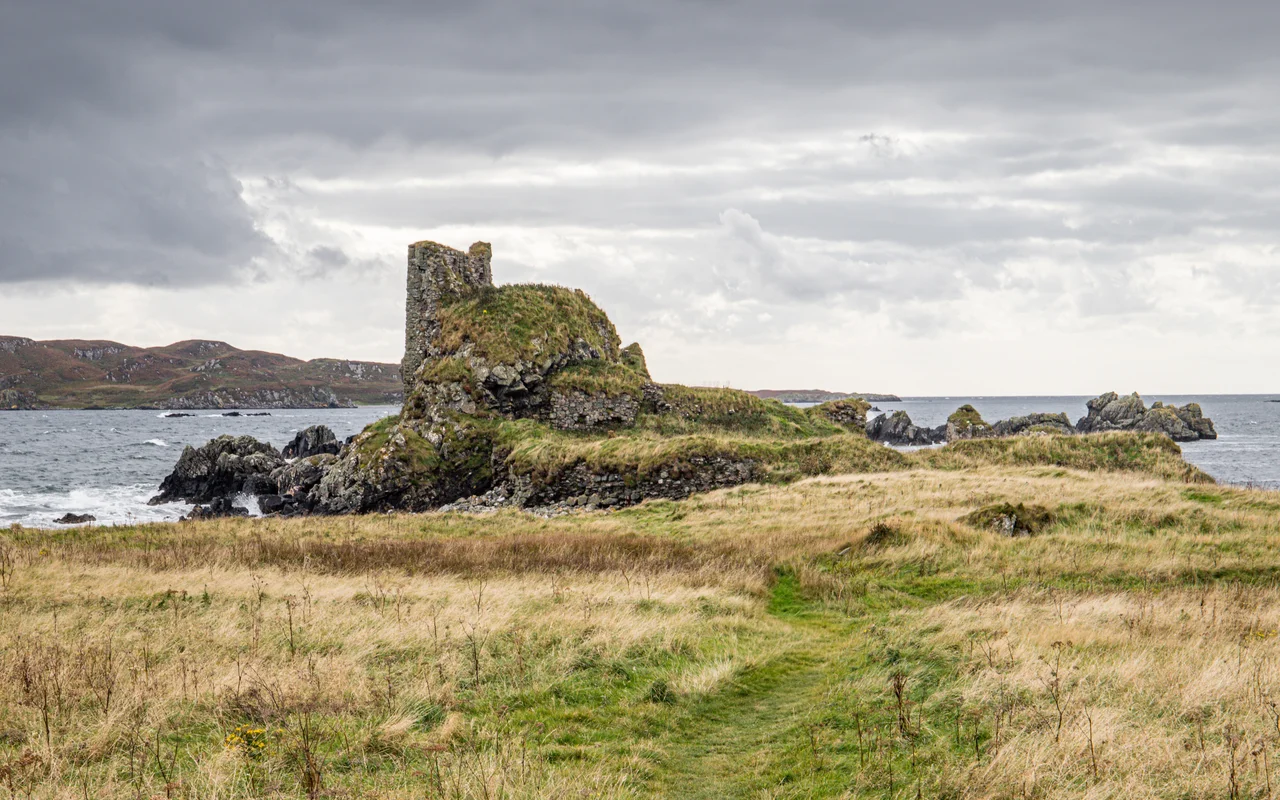

Dunyvaig Castle
Walk down to the shore at Lagavulin on Islay's south coast and the castle is right there, ruined and stubborn on a rocky promontory above the bay. The Lagavulin distillery sits just behind it - the same name, the same hollow in the land - and between them runs the small road from Port Ellen to Ardbeg. The castle's Gaelic name, Dun Naomhaig, means the Fort of the Galleys. That tells you almost everything about what this place was. Whoever held Dunyvaig held the southern approach to Islay, and whoever held Islay held the most populous and prosperous island in the Lordship of the Isles.
The Fort of the Galleys
The original purpose was simple. A galley was the long, low, oar-and-sail warship that the Norse and the Gaels both used in Hebridean waters from roughly the eighth to the seventeenth century. Faster than a modern sailboat under oar power, manoeuvrable in inshore channels, capable of carrying fifty to a hundred armed men. The MacDonalds of Islay - branch of Clan Donald descended from John, younger brother of Angus Og MacDonald who had sheltered Robert the Bruce - kept their fleet drawn up on the beach at Lagavulin. The castle defended the harbour. From here, in any decade between 1300 and 1600, you could put thirty galleys in the water in an afternoon. The Lordship of the Isles ran on this kind of mobile sea power. So did the clan wars that filled the years after the Lordship's collapse in 1493.
The Year Nothing Held
Between August 1608 and October 1615 Dunyvaig changed hands at least five times. In 1608 Angus MacDonald, eighth of Dunnyveg, surrendered the castle to Andrew Stuart, Lord Ochiltree, and Andrew Knox, Bishop of the Isles, who had arrived with a thousand men and a royal naval squadron. Knox brought MacDonald aboard the ship Advantage to celebrate Gowrie Day - the anniversary of James VI's escape from kidnap at Perth in 1600 - and installed a royal garrison. In 1614 Ranald Og MacDonald took the castle back. His cousin Angus Og MacDonald then took it from him. Knox returned with seventy men, was defeated by the MacDonalds, and had to leave his own son Thomas and his nephew John as hostages. In January 1615 Sir John Campbell of Calder and Oliver Lambart retook the castle with artillery brought up in the ship Phoenix; Coll Ciotach, a Catholic MacDonald commander whose nickname meant the left-handed, escaped through a postern gate into a longboat with twenty-one men. In June 1615 Sir James MacDonald and Coll Ciotach took the castle again, killing the captain and most of the garrison. On 13 October 1615, with cannon being landed from the ship Charles, Coll Ciotach finally surrendered to the Earl of Argyll. After all of that, the result was a Campbell win.
The Letter Knox Wrote
When the dust settled on the 1614 disaster, Andrew Knox sat down to write a long letter explaining himself. He was at Brodick Castle on Arran, his son and nephew still held hostage on Islay, and accusations of sloth and incompetence were reaching Edinburgh. The letter survives, and it is one of the more candid pieces of administrative correspondence from the period. He couldn't get boats during harvest. The MacLeans and the MacLeods of Harris refused to serve under him. He could raise only seventy men, of whom fifty were paid soldiers and twenty followers of two lairds. When he landed at Islay, Clan Donald cut him off from his boats and looted them. By the next morning he was being told to hand over the hostages or all his remaining men would be executed. He also reported, almost in passing, that some of his men had heard Angus Og MacDonald say he was actually working for the Earl of Argyll - that the whole insurrection was being managed by the Campbells, who would then receive the castle and the lands of Islay as their reward for cleaning up. Within a year, that is exactly what happened.
After
The Campbells held Dunyvaig until 1647, when the Covenanters seized it during the Civil Wars. It passed to the Campbells of Cawdor, who held it until 1677. In that year Sir Hugh Campbell pulled the castle down and moved his household to Islay House, the more comfortable Georgian seat on the other side of the island that Islay's landlords have used ever since. Dunyvaig was finished as a working stronghold. Its stones were robbed for buildings in Port Ellen; the harbour silted partly in; the promontory eroded. What remains is mostly the lower courses of curtain wall and a section of inner gatehouse, weathered to the colour of the surrounding rock. The Lagavulin distillery, founded in 1816, took its name from the bay and sits next door. The first thing most visitors see when they arrive at the distillery is a ruin they assume is part of the brewery's romantic dressing. It is a thirteenth-century castle that decided the politics of the Hebrides for three hundred years.
From the Air
Dunyvaig Castle stands at 55.63°N, 6.12°W, on the south coast of Islay overlooking Lagavulin Bay, 4km east of Port Ellen. From the air the castle ruin appears as a small dark promontory just east of the white Lagavulin distillery buildings. Islay Airport (EGPI) sits 3nm to the west. The Mull of Kintyre is 18nm to the east across the channel; the Mull of Oa is 5nm to the southwest. Expect strong westerly winds and rapid weather changes off the open Atlantic. Beautiful low-altitude run along Islay's distillery coast: Ardbeg, Lagavulin, Laphroaig all visible within 3nm of the castle.
Nearby Stories
- Rathlin Island 8.9 km away
- Saddell Abbey 14 km away
- Oronsay 14 km away
- North West 200 20 km away
- Tighnabruaich 24 km away
- Ailsa Craig 35 km away
- German submarine U-218 43 km away
- Skerryvore 54 km away