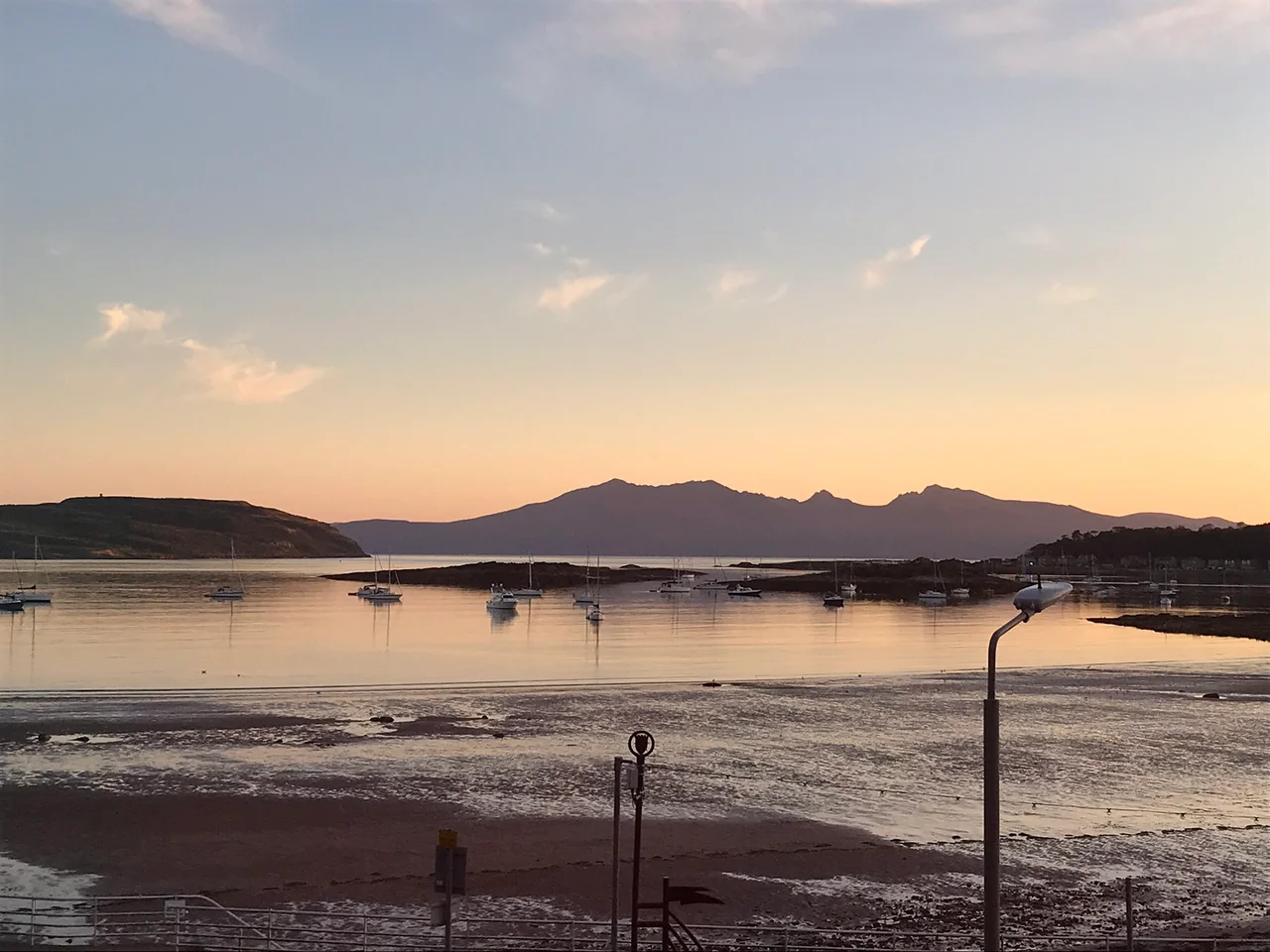

Great Cumbrae
There are no snakes on Great Cumbrae, and the islanders have a saint to thank for it. Legend places St Mirin on these shores around AD 710, fresh from Ireland, banishing serpents in imitation of St Patrick before sailing on to found the religious community at Paisley. The story sounds tidy, the way legends do. The fact remains stubbornly true: thirteen centuries later, no snakes. Four kilometres long, two wide, and barely 127 metres at its highest point, this small green disc in the Firth of Clyde has been gathering stories at this rate ever since.
The Painted Coast
Cyclists tracing the eleven-mile coastal road around Great Cumbrae meet creatures the geology never intended. Crocodile Rock crouches above Millport Bay, its eye and grin freshly painted each season. Lion Rock rises ten metres beside the road in the southeast, the work of a Palaeogene-era igneous dyke that an islander long ago decided looked more like a beast than a wall of stone. There is an Indian's Face and a Queen Victoria's Face, all sandstone and mudstone enhanced with colourful paint over many decades. The sober geology of the island, late Devonian and early Carboniferous bedrock cut by north-south dykes, has been recruited for whimsy. The B896 coastal road runs along a raised beach that sits eight metres above the modern sea, a quiet record of ice-age rebound that few cyclists notice as they pedal past.
Doon the Watter
For generations of Glaswegians, Great Cumbrae was where the city went on holiday. The phrase was "Doon the Watter for the Fair," and during the Glasgow Fair weeks the Clyde steamers carried families south from the smoke of the shipyards to the salt air of Millport. The pier dates to 1833 and the Largs pier to 1845, an industrial-age scaffolding for a holiday tradition that long outlasted the steamers themselves. The Caledonian MacBrayne ferry still runs the short hop from Largs, now in a larger vessel built at Ferguson Shipbuilders in Port Glasgow and in service since 2007. The summer population swells by several thousand every weekend, and the island's 1,300 or so year-round residents share their cafes and bike-hire shops with people who came for the day and discovered, again, that the day is not enough.
The Smallest Cathedral
On a wooded rise above Millport stands one of the smallest cathedrals in Europe. William Butterfield, one of the great Gothic Revival architects, designed it. Construction finished in 1849 and the Cathedral of the Isles opened in 1851, funded by George Frederick Boyle, 6th Earl of Glasgow. The College of the Holy Spirit was attached as a seminary, briefly affiliated with the University of Durham in the 1860s, and in the 1970s and 1980s the buildings hosted a Benedictine-influenced community of artists and musicians called the Fisherfolk. Elsewhere in Millport, a private house known as The Wedge has the smallest frontage in the UK, the width of a single front door. These superlatives sit easily on the island. Smallness, here, is a quality cultivated and not regretted.
Battles and Biology
In 1263, Haakon IV of Norway may have anchored his fleet along Great Cumbrae's eastern shore before the inconclusive Battle of Largs. Place-names hold the memory: Ballochmartin Bay and Portrye, the latter from Gaelic elements meaning "king's harbour." Centuries later the island acquired a different kind of fame, when Sir John Murray and David Robertson founded the Millport Marine Biological Station in 1885. Its buildings opened near Keppel Pier in 1897 and the station served the universities of Glasgow and London until it closed in 2013. Since 2014 the Field Studies Council has run the site, refurbished into FSC Millport with an aquarium of Firth of Clyde creatures. Just south of the ferry slip lies the most-dived site on the Clyde: a Second World War Catalina flying boat, settled into the seabed for divers to circle and read.
Notes from a Small Island
Cumbrae was the source of the elm wood crafted into the baton handle for the 2014 Glasgow Games' Queen's Baton Relay. The island appears in the BBC Radio 4 comedy Millport, written by and starring Lynn Ferguson, and was featured in a BBC documentary Seaside Stories. The Guardian once ranked it number eight in British online property searches in 2021, an effect attributed to pandemic-era city escapism. A flood protection scheme is in development for the south of the island, with a marina proposed alongside, and a new town hall is under construction. Notable residents have included the actor Duncan Macrae, who appeared in Whisky Galore, and the puffer Saxon that inspired the TV series The Vital Spark. Like many small islands, Great Cumbrae has produced more story than its size would suggest possible.
From the Air
Great Cumbrae sits at approximately 55.77°N, 4.92°W, in the lower Firth of Clyde off North Ayrshire. A clear visual landmark from cruise altitudes of 3,000-6,000 feet, the island appears as a green elongated disc roughly 4 km long, separated from the mainland at Largs by a narrow channel. Millport's red roofs cluster around the south-facing bay. Nearest controlled airports are Glasgow Prestwick (EGPK) to the south and Glasgow International (EGPF) to the northeast. Arran rises dramatically to the southwest and the Isle of Bute lies to the north. Coastal Firth of Clyde weather is reliably overcast; visibility windows between Atlantic fronts offer the best viewing.
Nearby Stories
- Machrie Moor Stone Circles 2.6 km away
- Murder of Kriss Donald 3.7 km away
- Troon 5.5 km away
- Luss 6.8 km away
- HMS Vandal 11 km away
- Doune Castle 16 km away
- Knockshinnoch Disaster 17 km away
- Gulf of Corryvreckan 28 km away