.jpg)
Doune Castle
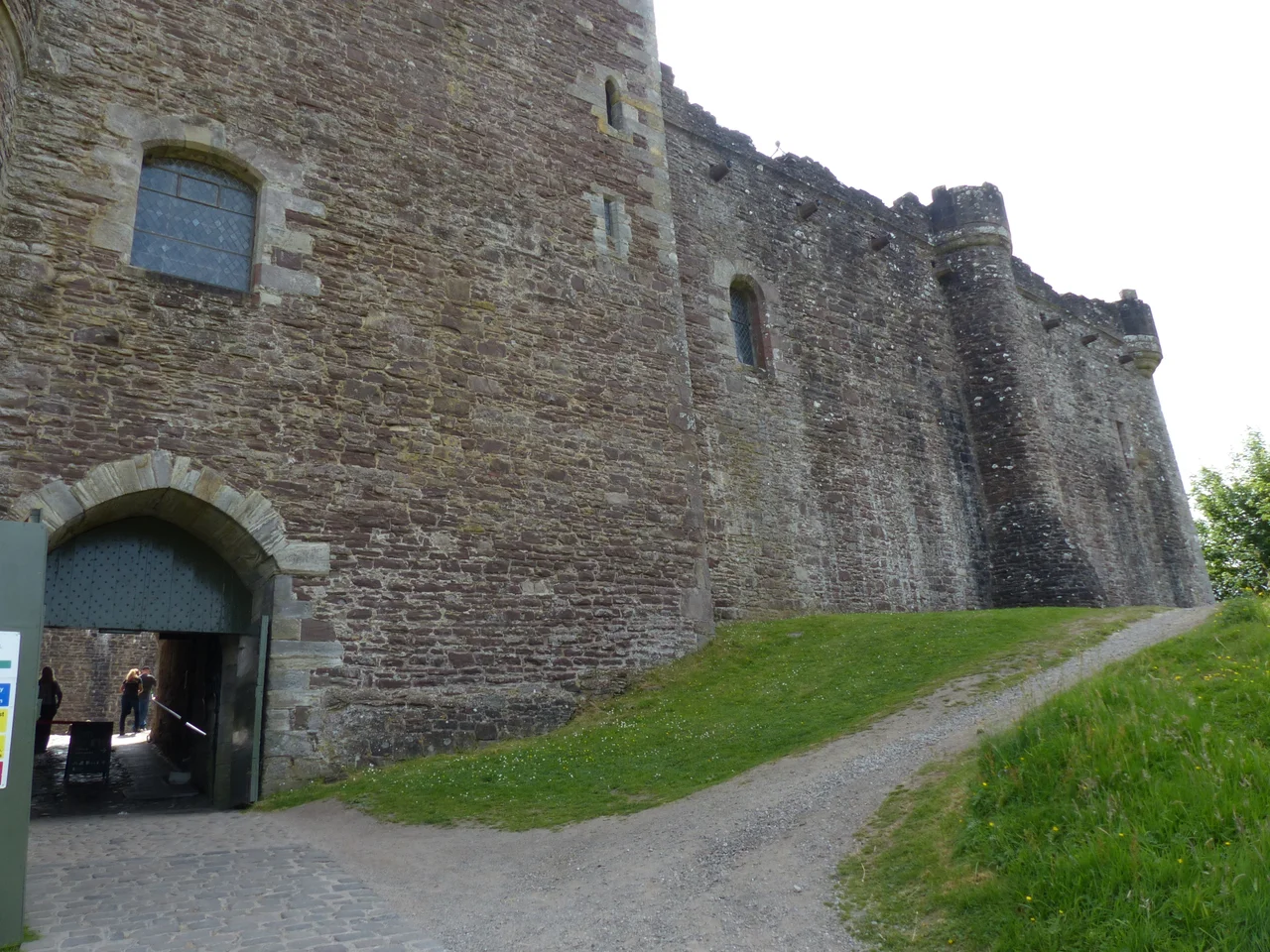
There is a moment near the start of *Monty Python and the Holy Grail* when King Arthur and his servant Patsy clatter their imaginary coconut horses up to a castle wall and are insulted in French by a man in chainmail. The wall they ride up to is the east curtain of Doune Castle. Forty years later, the same stones became Winterfell, the home of House Stark in the first season of *Game of Thrones*. A few years after that, the courtyard played Castle Leoch in *Outlander*. Hollywood keeps coming back because Doune has the look that camera operators dream about: a single, almost untouched medieval stronghold sitting on a wooded bend where the Ardoch Burn meets the River Teith, eight miles northwest of Stirling.
The Regent's House
Doune was the work of one man and one ambition. Robert Stewart, Duke of Albany, was the third son of King Robert II of Scotland and brother to Robert III. From 1388 until his death in 1420, he was Regent of Scotland in all but name, the most powerful man in the country while his frail king kept court. The lands at Doune had been granted to him in 1361, and the great courtyard castle that rose here was meant to announce, in stone, exactly who he was. The original plan called for buildings on all four sides of the courtyard. Only the north and northwest ranges were ever finished: a massive tower-house over the entrance containing the Lord's private rooms, a separate kitchen tower with guest accommodation, and between them a great hall, all linked, all of a piece, all built in a single push of late-fourteenth-century stone. Romans had fortified the same confluence in the first century AD; an earlier 13th-century castle stood here too, but it is Albany's stronghold that survives.
Crown, Ruin, Restoration
When Albany's son Murdoch was executed by James I in 1425, Doune passed to the crown. The Stewart kings used it as a hunting lodge, a dower house for their queens, and an occasional bolt-hole. Doune was held briefly for Mary, Queen of Scots, after her abdication in 1567, surrendering to the Earl of Lennox after a three-day blockade in 1570. King James VI visited and authorised three hundred pounds for repairs in 1581. In 1593 he surprised a plot against him here, the conspirators including the third Earl of Montrose and the third Earl of Gowrie. The Wars of the Three Kingdoms and Glencairn's Rising saw fighting around its walls. The Jacobites used it as a prison during the 1745 Rising. By 1800 it was a roofless shell. The 14th Earl of Moray, George Stuart, began the careful restoration in the 1880s, replacing roofs and floors that had vanished but leaving the late-medieval stonework essentially untouched. That conservative restoration is why filmmakers love the place. You see what Albany built.
The Holy Grail Problem
In 1974, the Monty Python team had a problem. They had spent years writing their Arthurian parody, secured permission from the National Trust for Scotland to use several castles, and then the Trust withdrew permission at short notice. With production schedules looming, the producers asked Lord Moray if they could film at Doune. He said yes. So they went to Doune and shot almost the entire film in one castle, pretending it was many. The east wall became the French castle where Arthur is insulted. The Great Hall hosted the song-and-dance number for Camelot. The servery and kitchen became Castle Anthrax, where Sir Galahad is pursued by Zoot and her sisters. The courtyard hosted Lancelot's wedding-disrupting massacre. The Trojan Rabbit rolled into the same gatehouse. Only Castle Stalker, briefly Kidwelly, and a glimpse of Bodiam appear elsewhere. The film made Doune a place of pilgrimage. For years the castle hosted an annual Monty Python Day. On the audio tour today, the narrator is Terry Jones.
Winterfell and the Kitchen
The medieval kitchen at Doune is one of the best preserved of its date in Scotland, a vaulted chamber on the hall level above a cellar, with massive fireplaces and a serving hatch that fed the great hall directly. When HBO arrived in 2009 to film the pilot of *Game of Thrones*, they shot Winterfell exterior scenes against the same walls, and the courtyard where Bran Stark first sees the direwolf pups is the same courtyard where John Cleese knifed his way through the wedding. *Outlander* came next, casting Doune as Castle Leoch, seat of Clan MacKenzie. *Outlaw King*, the 2018 Robert the Bruce film, used Doune as another location, fittingly, since the castle stood in Bruce's lifetime. Walter Scott had brought his hero Edward Waverley here in the novel *Waverley* of 1814, describing a 'gloomy yet picturesque structure' with 'half-ruined turrets.' Centuries of writers and filmmakers and tourists, all reaching for the same stones, and Doune just keeps standing on its bend in the Teith, looking like itself.
From the Air
Doune Castle sits at 56.185N, 4.050W on a wooded promontory where the Ardoch Burn joins the River Teith, about 8 miles northwest of Stirling and 8 miles southeast of Callander. From altitude the castle is best identified by the river's tight bend and the wedge of forest enclosing the courtyard. Best viewed at 2,000 to 4,000 feet for the moat-like geography. Nearest airports: Glasgow (EGPF) 28 nm south, Edinburgh (EGPH) 33 nm east-southeast. Watch for low-level westerly winds funneling through the Teith valley.
Nearby Stories
- Murder of Alesha MacPhail 3.1 km away
- Ben Lomond 5 km away
- Lochleven Castle 8.8 km away
- Battle of Dunsinane 15 km away
- Pentland Hills 16 km away
- Breadalbane Hydro-Electric Scheme 17 km away
- Beith 17 km away
- Rannoch Moor 24 km away