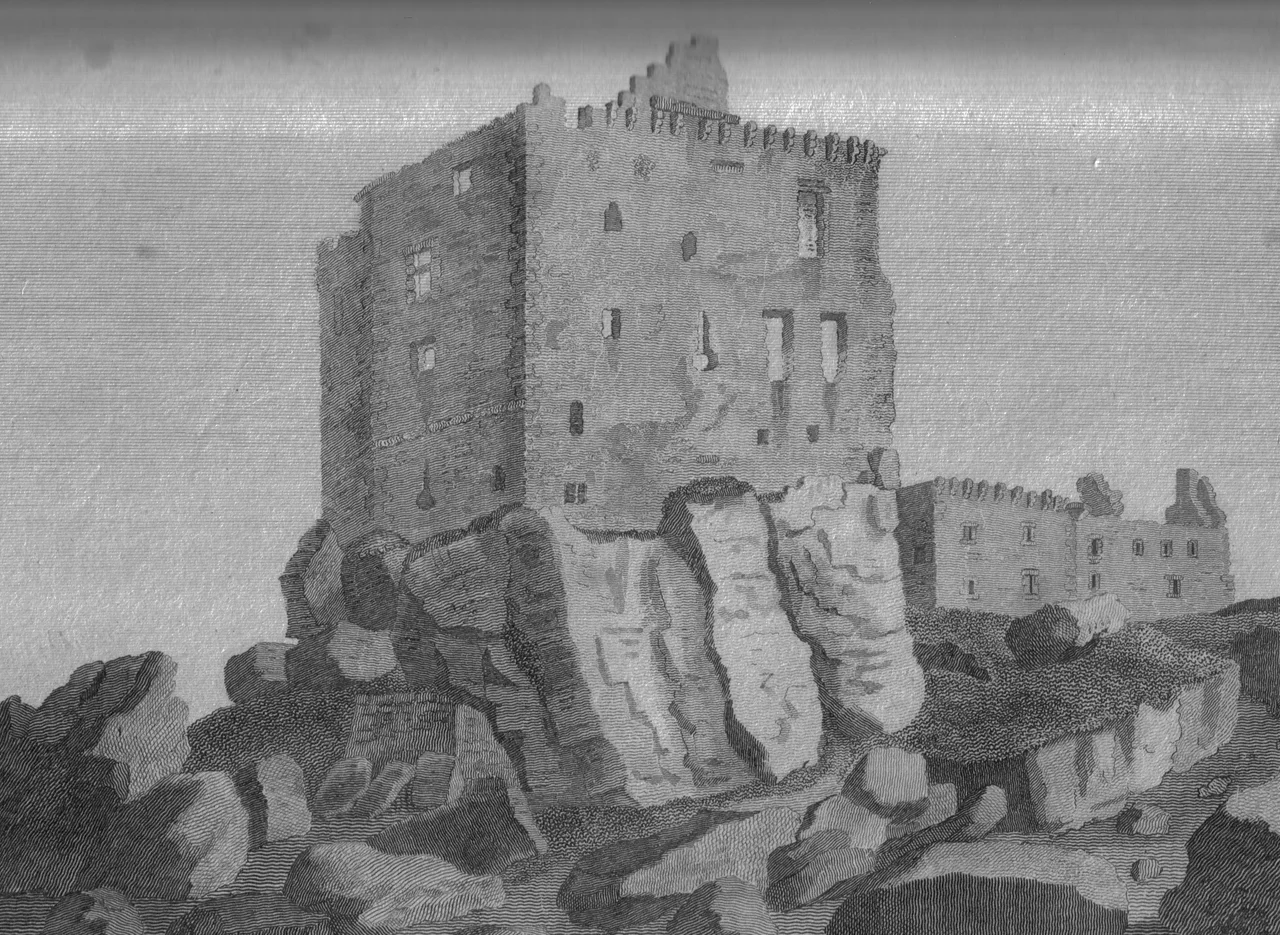

Dunure Castle
Allan Stewart was the lay Commendator of Crossraguel Abbey - the post-Reformation administrator of what had been one of the great medieval religious houses of south-west Scotland. He held the title because his relative Captain James Stewart of Cardonald had pulled strings to get him appointed. He held it instead of Gilbert Kennedy, 4th Earl of Cassillis, who had expected to inherit it from his uncle Quintin, the last true abbot. Gilbert took it personally. In the late summer of 1570, with sixteen armed men at his back, the Earl caught Allan Stewart unexpectedly in Crossraguel Woods, where Stewart was a guest of the Laird of Bargany. They took his horse. They took his weapons. They took him to Dunure Castle.
The Black Vault
What happened next was deliberate and prolonged. Allan Stewart was confined and guarded by six of the Earl's men. For two days, Gilbert left him to think about his situation - to consider, the chronicles say, his fate - and to sign over the abbey lands and their rental income to the Kennedys. Stewart refused. So on the first of September 1570, in a room beneath the keep known as the Black Vault, the Earl had Stewart's feet and body roasted and basted over a brazier - a torture supervised, the records note clinically, by the castle's cook, baker, and pantrymen. Stewart still refused. The Earl tried again on the seventh of September. This time Stewart signed. The rights to the abbey lands passed to Gilbert Kennedy as a matter of legal record. The cost of those signatures was a man's body.
The Rescue
Allan Stewart's brother-in-law, the Laird of Bargany - whose home Stewart had been visiting when he was abducted - did not let the matter rest. He gathered a body of armed men, hid first in the castle chapel, then stormed the keep and got Stewart out. The Earl's reprisals came later, but they were political rather than physical. The Privy Council in Edinburgh declined to bring Gilbert Kennedy fully to book; the Kennedys were too powerful and the Privy Council too pragmatic. A settlement was reached: Allan Stewart received sufficient funds from the Earl to live, in the period's careful phrasing, comfortably, for the rest of his life. He needed it. Allan Stewart never walked again. He had been roasted in the Black Vault of Dunure, and the marks of those two days never left him.
Before the Cruelty: Kings and Queens
The site at Dunure predates the Kennedys by centuries. The earliest land charter dates from 1256, though the visible remains are 15th- and 16th-century. One tradition says the Danes built it. Another says the Mackinnons held it for Alexander III as reward for their valour at the Battle of Largs in 1263. The Kennedys themselves arrived in 1357, when the lands were granted to them; from there they grew into the Earls of Cassillis, dominating Carrick and much of south-west Scotland. Sir James Balfour called Dunure "a grate and pleasand stronge housse, the most ancient habitation of the surname of Kennedy." In 1429, a meeting here between James Campbell, representing King James I, and John Mor MacDonald, representing the Lord of the Isles, ended with MacDonald dead and an uprising brewing. In August 1563, Mary, Queen of Scots, stayed at Dunure for three days during her royal tour of the west, on her way from Ardmillan Castle to Glenluce Abbey and Whithorn Priory. She was Gilbert Kennedy's guest. Seven years later, the same man would torture Allan Stewart in the same building.
The Demise
By 1694 Dunure was described as "wholly ruined." The cause is uncertain. Local tradition says it was burnt and blown up during the Civil War period; a major collapse of the south-eastern keep might support that. But the more prosaic answer is also documented: the castle was systematically dismantled for building materials. Slates, stone, and glass were removed in orderly fashion. Lead was stripped from the windows and smelted on site - the traces of localised fire and coal deposits are still detectable. Some of the stone may have gone to the Cromwellian citadel in Ayr. The people doing the demolition seem to have lived in part of the building during their work. A range of castle structures to the south remained occupied until about 1860, often by fishermen; a large midden of mussel shells gave evidence for cod-line baiting. The keep walls are about five feet thick. The basement vaults survive remarkably well. Most of the superstructure is gone.
Browney's Cave and Kennedy Park
Beneath the castle is a cavern called Browney's Cave, which may have been a sally-port - a secret tunnel for the garrison to use when an enemy held the front. There is a folk tale called "The Brownie of Dunure" in which Sir Thomas Kennedy of Dunure adopts the son of his neighbour and kinsman Reginald Duff, Laird of Dunduff, hoping the boy will marry his illegitimate daughter. The O'Neils of Ireland are competitors for her hand, and the legend of the Brownie is invoked to engineer a love match, with mixed results. The castle today has been excavated and consolidated for public access. It dominates Kennedy Park, with visitor facilities below it. Local tradition speaks of secret ley tunnels connecting Dunure to Greenan Castle further north along the coast. You stand on the headland now in ordinary weather, looking at the ruins, and the cliffs are quiet. It is hard to picture what happened in the Black Vault. It is also hard not to.
From the Air
Dunure Castle stands at 55.405 N, 4.762 W on a rocky promontory of the Carrick coast, about 5 mi south of Ayr. From the air the ruin is visible on a dramatic headland above the small harbour of Dunure village, with the Firth of Clyde stretching west to the Isle of Arran. Glasgow Prestwick (EGPK) lies about 10 nm to the north. Best viewing from 1,000-2,500 ft AGL; the coastal road passes the castle and the Ayrshire Coastal Path runs along the cliffs. Ailsa Craig is visible to the south on clear days.
Nearby Stories
- Kilbirnie 4.2 km away
- East Kilbride 5.4 km away
- Knockshinnoch Disaster 7.3 km away
- Machrie Moor Stone Circles 9.4 km away
- Kenmure Castle 16 km away
- Ballantrae Lifeboat Station 20 km away
- Loch Fyne 38 km away
- SM UB-85 46 km away