
Ballantrae Lifeboat Station
Harriot Richardson of Greenwich left a legacy with conditions. The boat purchased with her money was to be named for both her late husband and herself. So when the Royal National Lifeboat Institution decided in December 1869 to establish a new station on the rocky south-west Scottish coast, the 33-foot pulling-and-sailing lifeboat that arrived at Ballantrae in January 1871 carried the names William and Harriot together on its bow. It cost £284 and 15 shillings. It had ten oars and a small set of sails. And for the next 48 years, it and its successor waited at the village of Ballantrae, 17 miles north of Stranraer, for the moments when the sea would demand their use.
How a Lifeboat Got to Ballantrae
Getting the boat to the village in 1871 was itself an undertaking. The London and North-Western Railway and the Glasgow and South Western Railway shipped the lifeboat and its carriage as far as Girvan, the latter company waiving the freight charge as a gesture of support. From Girvan, the local fishermen who would crew her met the boat and sailed her down the coast to Ballantrae, while the heavy launching carriage was transported by road. There were enough local fishermen, the RNLI had decided, to crew a lifeboat without paid hands. This was the assumption that quietly underpinned coastal Scotland for decades: that when the sea took a ship in trouble, men from the nearest harbour would put down their nets and pull on oars and row out into whatever weather the sea was making, because they would expect the same if their own boats were the ones in distress.
The S.S. Deloraine, January 1909
The S.S. Deloraine had run aground at Ballantrae in a December blizzard. By 29 January 1909, salvors had arrived and were attempting to work the wrecked steamer, when a storm came up. The conditions made it impossible for the salvage boat to get close enough to take the men off, and so the call went to the Ballantrae lifeboat. The shore here is rock-strewn and treacherous, the kind of coast where a wrong reading of the surf can put a small boat onto stones in seconds. The lifeboat coxswain navigated through it. Eight men were lifted off the Deloraine and brought ashore alive. The RNLI's journal recorded the rescue with the kind of measured praise that the service tended to reserve for its better days. A larger 35-foot Rubie self-righting lifeboat had arrived in 1906, also named William and Harriot, also funded by the same legacy. It was this second boat, ON 548, that worked the Deloraine rescue.
The Quiet Closure
After 48 years on station, Ballantrae Lifeboat Station closed in 1919. There was no dramatic single reason. Coastal lifeboat coverage had been reorganised, larger and faster boats stationed at nearby Girvan could cover the same waters, and a small village station had become harder to justify. At the RNLI's ninety-sixth annual general meeting at Caxton Hall, Westminster, on Thursday 22 April 1920, General Sir Coleridge Grove asked the meeting to ratify the sale of the lifeboat houses at Prior's Haven and at Ballantrae, which were no longer required for the purposes of the Institution. The motion passed. William and Harriot (ON 548) was transferred to the relief fleet, sold from service in 1930, and was last reported afloat as a private yacht at Greenock in the 1960s — a long life for a boat originally bought to save lives in storms.
What Still Stands
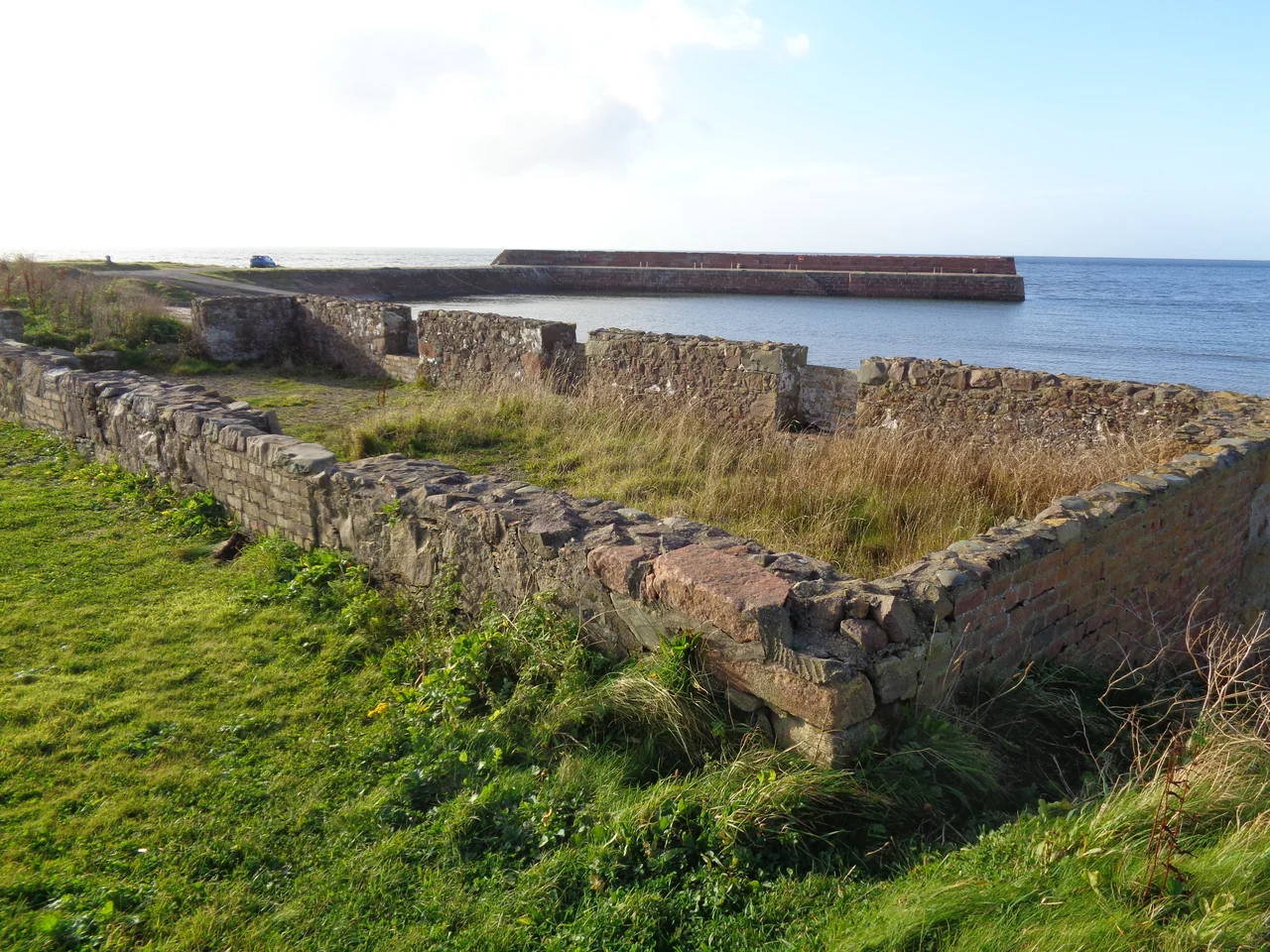
A lifeboat house still stands at Ballantrae harbour, used today as a store. Nearby is the remains of a derelict boathouse, partially collapsed, its walls thinned by a century of weather. Records are unclear on which was the RNLI's primary building, or whether both belonged to the Institution at different times — it is possible the second was constructed in 1906 to accommodate the larger Rubie-class boat. Old Ordnance Survey maps and the lifeboat magazine archive offer hints but no definitive answer. What remains certain is the village itself, the harbour cut into the south-west Scottish coast, and the small stretch of shoreline that for 48 years was the seaward end of a chain of decisions made in distant committee rooms about who would go to sea when the weather turned.
From the Air
Ballantrae sits at 55.10 degrees north, 5.01 degrees west, on the South Ayrshire coast 17 miles north of Stranraer. The harbour and remains of the lifeboat houses lie at the south-west edge of the village. Visual landmarks include Ailsa Craig, the prominent granite plug rising from the sea 12 nautical miles to the west, and the rocky inshore reefs that made the lifeboat service necessary in the first place. Prestwick (EGPK) is roughly 30 nautical miles north-east. Campbeltown (EGEC) sits across the North Channel to the north-west. Weather here is Atlantic-exposed and changeable, with frequent low cloud and squalls coming off the Irish Sea.
Nearby Stories
- Dunskey Castle 1.2 km away
- Machars 4.2 km away
- Battle of Glen Trool 5.6 km away
- Kildonan Lifeboat Station 7.8 km away
- RAF Machrihanish 8.3 km away
- Ayrshire 9.8 km away
- Carrickfergus Castle 19 km away
- Dunaverty Castle 22 km away