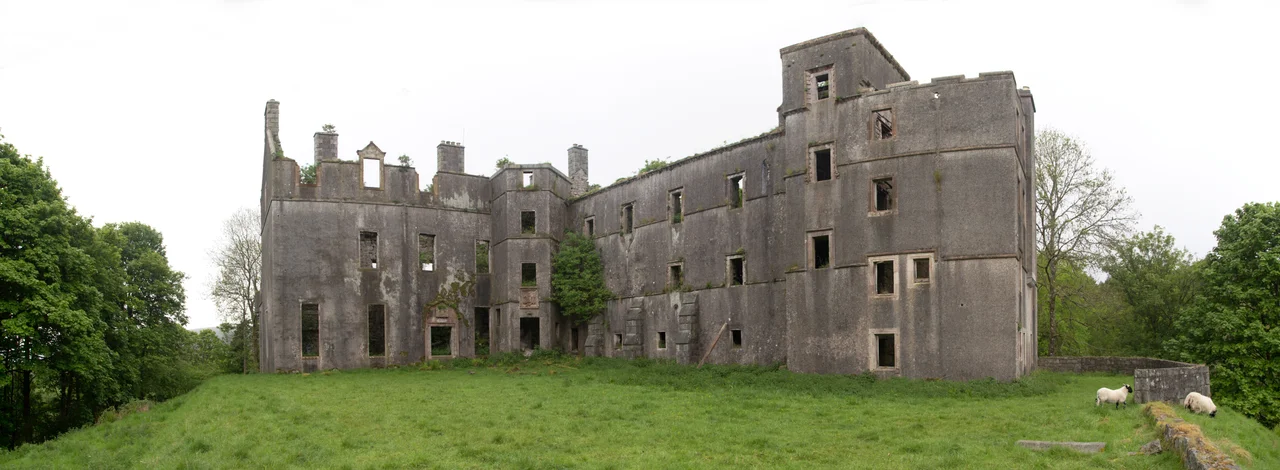

Kenmure Castle
Some ruins fall to siege. Kenmure fell to a roofer's tape measure. In 1958 the castle's interior was stripped, the roof was taken off, and a 17th-century Gordon seat that had welcomed Mary Queen of Scots, hosted Robert Burns, and survived four centuries of Galloway weather was deliberately unmade. The story most often told is that it burned. It didn't. Someone simply decided to stop holding it up.
The Mound Above New Galloway
Kenmure stands on a partly natural mound a mile south of New Galloway, in The Glenkens, where the River Ken broadens into Loch Ken. The site has been defended since the early Middle Ages - the mound itself may have been shaped by hand for that purpose. The Gordons arrived from Berwickshire in 1297 and never really left until the 20th century. They built another castle on an island in Lochinvar, six miles to the north, and made Kenmure the seat of their main line. The fortified house you see in old prints is largely a 17th-century structure with possibly earlier work folded inside, laid out around a courtyard with towers flanking the entrance gate.
Royal Guests, Pious and Otherwise
James IV came to Kenmure in March 1508, riding back from a pilgrimage to Whithorn. The royal accounts record what kings do when nothing is on fire: he played 'tables,' an old form of backgammon, and tipped the laird's servants generously on his way out. Half a century later, Mary, Queen of Scots arrived on 13 August 1563, travelling from Clary to St Mary's Isle, and stayed two nights. Sir John Gordon of Lochinvar was her host. Five years after that, the political weather shifted entirely. Mary's supporters lost the Battle of Langside in May 1568, and that June Regent Moray marched through the south-west to enforce her defeat. Kenmure was damaged or destroyed, and while he was there, Moray met an English envoy named Henry Middlemore. John Gordon wrote to Mary herself that he would not accept the regent's terms.
Viscounts, Visitors, and One Enormous Fish
Charles I created the Gordon laird Viscount of Kenmure in 1633, and the line continued through the 18th century. Robert Burns and his close friend John Syme stayed three days in July 1793, guests of the then laird. Eighty years later John Ruskin visited his cousin Joan Agnew and her husband Arthur Severn here in 1876. The strangest of the castle's stories belongs to John Murray, gamekeeper to Lord Kenmure in the 18th century. In 1774, in Loch Ken just below the castle, Murray landed a pike that weighed seventy-two pounds and measured roughly seven feet long - the largest northern pike on record. The fish's head sat on his shoulder; its tail dragged on the ground. The skeleton of that head was preserved for years in the Billiard Room at Kenmure, where Charles Tate Regan, ichthyologist at the Natural History Museum, eventually came to study and measure it. Murray is buried in Kells Churchyard; his tombstone carries a gun, a fishing rod, a dog, and a partridge in relief.
The Unmaking
By 1790 Kenmure was already described as a ruin once, then rebuilt and re-roofed in the 19th century. Brigadier-General Maurice Lilburn MacEwen, late of the 16th The Queen's Lancers, leased and then bought the castle in 1923 and ran the local Stewartry Home Guard from it during the Second World War. He died at Kenmure in 1943 and is buried in Kells churchyard. From the late 1940s to 1957 it was a hotel under Stanley Dobson - brother of the portrait painter David Cowan Dobson - and Hugh Ormond Sparks. Then, around 1958, came the deliberate stripping. Fixtures, fittings, and finally the roof. The building was scheduled in 1998 and has stood roofless since, a courtyard of bare walls on its old mound, with Loch Ken still running broad and grey below. A sundial dated 1623 from Kenmure is now in Dumfries Museum, some thirty miles to the southeast.
From the Air
Kenmure Castle sits at 55.06 N, 4.14 W on rising ground a mile south of New Galloway, just above Loch Ken. The nearest airport is Dumfries (former RAF Dumfries, now light GA) roughly 30 nm east, and Prestwick (EGPK) lies about 35 nm north-northwest. Carlisle (EGNC) is 55 nm southeast. From 2,000 to 4,000 feet AGL Loch Ken is the strongest visual anchor - a long, narrow ribbon running roughly north-south for nearly ten miles. The Galloway Hills rise sharply west of the valley, with Cairnsmore of Carsphairn a useful landmark. Expect orographic cloud and rapid weather changes blowing in off the Solway.
Nearby Stories
- Kirkcudbrightshire 0.8 km away
- Battle of Lochmaben Fair 5.4 km away
- Mochrum 6.5 km away
- Alloway 7.9 km away
- New Cumnock 9.3 km away
- Hayton Castle 12 km away
- Oliver Castle 16 km away
- Girvan 23 km away