
Alloway
At night, green light pools over the old kirkyard. The lights are deliberate - put there to give the ruined Alloway Auld Kirk a properly ghostly atmosphere for the tourists who come looking for the world of "Tam o' Shanter". But the kirk was already a ruin by the time Robert Burns wrote the poem in 1790, and William Burnes, Burns's own father, was already buried in its yard. The green light is theatre. The graves are not.
A Village That Became a Suburb
Alloway sits on the north bank of the River Doon, just south of Ayr. It had its own identity for centuries before the Royal Burgh of Ayr swallowed it in 1935. Now it is officially a suburb, though it doesn't quite feel like one. The historic core retains its conservation-area status: a primary school, a library, a post office, a church, a tearoom, a pharmacy and a museum gather along streets that still curve the way village streets do, refusing to be straightened out. South of the village, Newark Estate has been owned by the Walker family for at least three generations - a working game shoot of pheasant and partridge, with a 16th-century tower house called Newark Castle (originally the New-wark of Bargany) standing on rising ground that was once protected by a moat.
The Poet and the Mason
Robert Burns was born here on 25 January 1759, in a four-roomed clay-and-thatch cottage his father William had built two years earlier. That much is the famous part. Less famous is Tobias Bauchop, the master mason who also hailed from Alloway and went on to build Hopetoun House, Craigiehall, and Kinross House - some of the grandest country seats in Scotland. Two men, one village, both reshaping the country in their own materials. Bachope worked in dressed sandstone. Burns worked in Scots vernacular. Both are still standing.
The Geography of Tam o' Shanter
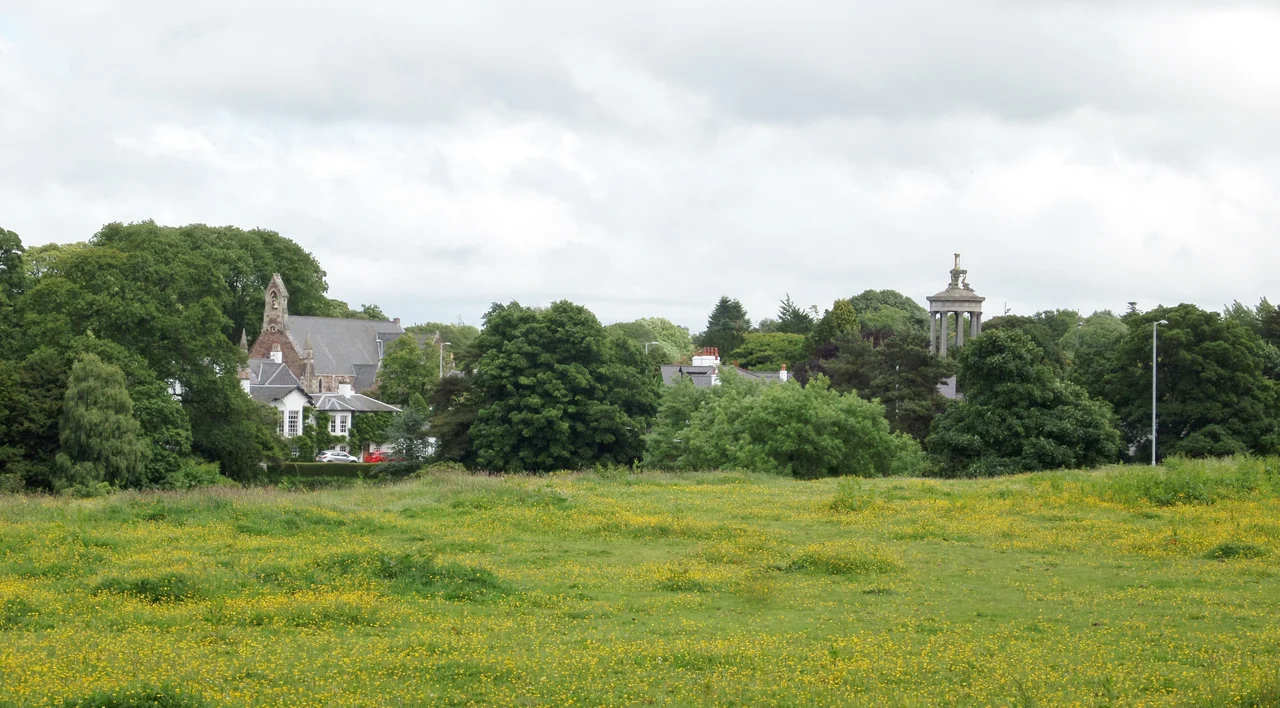
The poem Burns set in his hometown - the long, rollicking ride home from the pub through a witches' sabbath in the Auld Kirk - put real Alloway landmarks into Scots literary myth. The ruined kirk where the witches dance is the Alloway Auld Kirk. The bridge Tam crosses to escape, where the witch Nannie tears off his mare's tail, is the Brig o' Doon, the medieval single-arch span over the river just south of the village. Both still stand, and both are now part of the Robert Burns Birthplace Museum, maintained by the National Trust for Scotland alongside the cottage and the 19th-century Burns Monument designed by Thomas Hamilton.
Rozelle, Belleisle, and the Cricket Field
Alloway has two main parks, and they are not the kind of parks where you walk in circles. Rozelle hosts the Ayr Flower Show each summer and maintains a permanent sculpture collection - a Henry Moore, a series of granite carvings by Ronald Rae - in among the trees. Belleisle Park contains two golf courses, a walled garden, a glasshouse called the Camelia House, and a playground. The sporting heart of the village is Cambusdoon, on the site of the old Robertson's Field. Ayr Cricket Club has played here since 1997, having moved across the road from the original Cambusdoon ground that had been their home for sixty years. Mike Denness, the future England captain, grew up in a house on Shanter Way that adjoined the old cricket ground. The original ground was carved out of the estate of James Baird, a 19th-century iron and coal magnate whose Cambusdoon House is now a ruin.
Ministers and Memorials
The Auld Kirk has been roofless since the late 18th century; a new Alloway Parish Church was opened for worship on 10 October 1858, and the first minister was called in 1859. It was originally rectangular; alterations in 1878 and 1890 gave it its current shape, and the suite of halls beyond the churchyard was added in stages between 1965 and 1987. The Reverend Neil A. McNaught has been the minister since 1999. One of his most distinguished predecessors was the Very Rev Samuel Marcus Dill, minister of Alloway from 1881 to 1913, who in 1912 was elected Moderator of the General Assembly of the Church of Scotland - the highest honour the kirk can bestow on one of its ministers.
From the Air
Alloway lies at 55.433 N, 4.633 W in coastal South Ayrshire, immediately south of Ayr along the River Doon. From the air the village is recognizable by the Brig o' Doon's single arch over the river and the surrounding green of Belleisle and Rozelle parks. Glasgow Prestwick (EGPK) is about 6 nm north - a 5-minute hop. Glasgow International (EGPF) sits about 30 nm northeast. Best viewed from 1,500-2,500 ft AGL; the Firth of Clyde is visible two miles to the west.
Nearby Stories
- Kilbirnie 4.2 km away
- East Kilbride 5.4 km away
- Knockshinnoch Disaster 7.3 km away
- Machrie Moor Stone Circles 9.4 km away
- Kenmure Castle 16 km away
- Ballantrae Lifeboat Station 20 km away
- Loch Fyne 38 km away
- SM UB-85 46 km away