
New Cumnock
Blind Harry called it Cumno. Five hundred years after the actual events, the wandering Scottish poet placed William Wallace at New Cumnock again and again in his epic life of the patriot, weaving the village into the legend of Scottish independence. 'To the Blak Crag in Cumno past agayne,' Harry wrote, 'His houshauld set with men of mekill mayne, Thre monethis thar he dwellyt in gud rest.' That is to say: Wallace lived three months at his household in Blackcraig, in the upper reaches of the Afton Water, resting from war. In the spring of 1298, fresh from killing the English sheriff of Lanark, Sir William the Guardian of Scotland came home to the hills above New Cumnock.
Old Roads, Old Names
Roman roads once passed through the area, hinting at a presence even before the village had a name. The first recorded mention came in 1296 when Patrick Dunbar of Comenagh signed the Ragman Roll, the document by which Scottish nobles swore fealty to Edward I of England. In 1509 Cumnock was made a burgh of barony, with the market originally held at Cumnock Kirk six miles northwest of the castle. In 1659 a new kirk was built near the castle and became known as the New Kirk of Cumnock, today the Auld Kirk of New Cumnock. The original Cumnock Kirk became Old Cumnock, now just Cumnock. Place-names in this corner of Ayrshire carry their generations layered in their syllables, like geological strata of language.
Wallace at Blackcraig
In 1296 William Wallace and his men tried to reach Ayrshire from Nithsdale and found the road at Corsencon destroyed. 'At Corssencon the gait was spilt that tide,' Harry wrote. A toll and customs point had stood at Corsencon Hill since 1205, and now the way through it was gone. Wallace's detour took him to Avondale, where he defeated an English force at Loudon Hill. The next year, in May 1297, he killed the English sheriff of Lanark and brought his household back to New Cumnock. By September he had joined Sir Andrew Murray and crushed the English army at Stirling Bridge. Then the three quiet months Harry mentioned. Then back to war. Harry places Wallace at home in Blackcraig one last time before the betrayal at Glasgow in August 1305 that sent him to his execution at Smithfield.
Robert Burns and Parnassus Hill
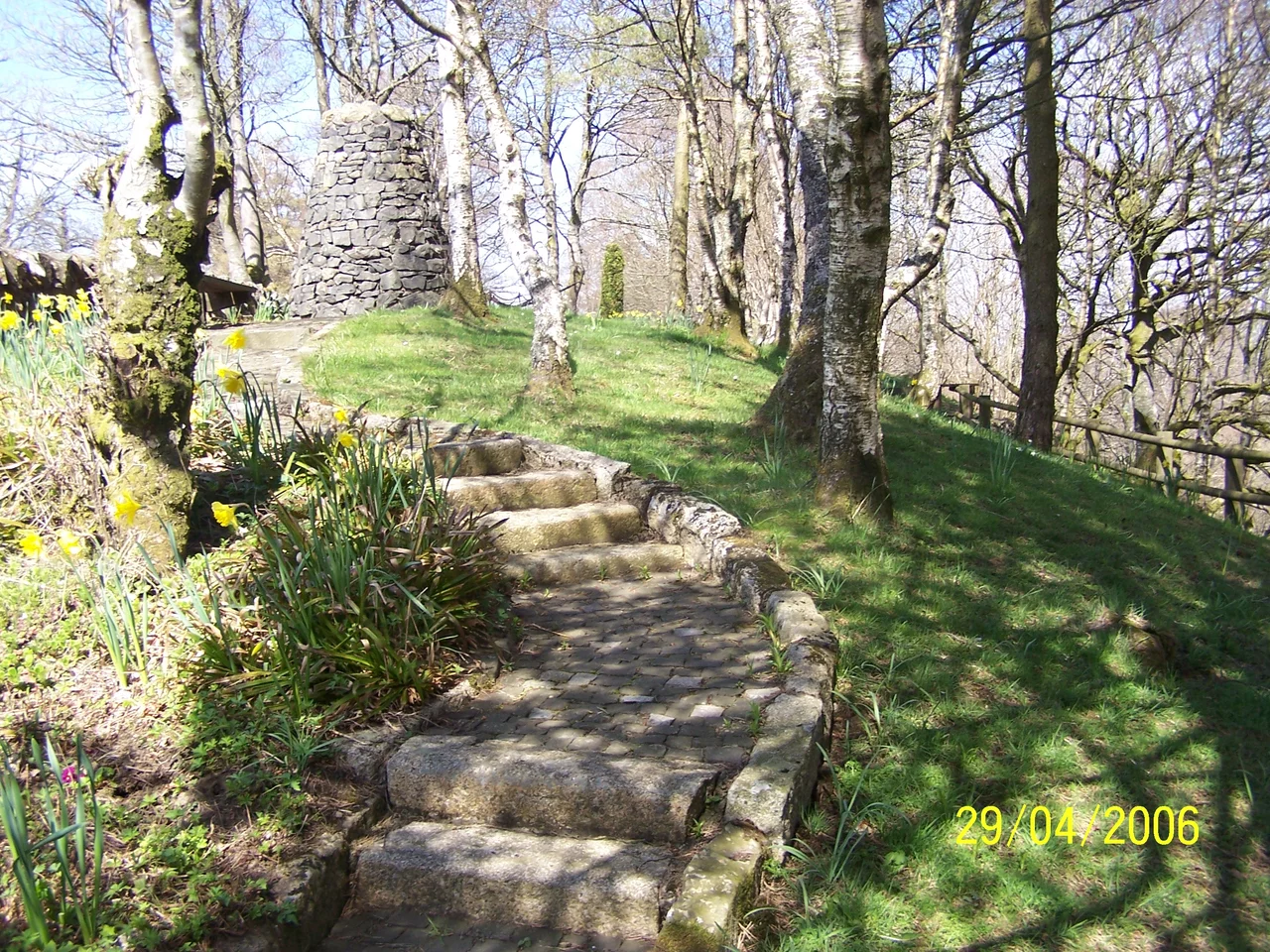
Robert Burns visited New Cumnock often in the late 1780s, making friends in the village and leaving behind plaques on several buildings, most donated by the New Cumnock Burns Club. In 1788 he wrote a poem about Corsencon Hill, the same hill where Wallace's road had been blocked five centuries earlier. Burns called it Parnassus Hill, after the mountain in Greek mythology where Apollo slew the giant serpent Python and where the Muses lived. The conceit is gentle and grand at once: a working Ayrshire hill renamed for the home of poetry, in a song written by Scotland's national poet who knew the hill from his own walking. A Burns memorial cairn now stands on the path beside the River Afton, with Burns's lines turned to stone.
Knockshinnoch
On 7 September 1950, the Knockshinnoch Castle Colliery suffered a catastrophic inrush of moss and water from the surface above. Thirteen miners died. One hundred and sixteen others were trapped underground for days before rescuers reached them through an old, disused level from a neighbouring pit. The mining communities of Ayrshire knew loss, but Knockshinnoch became infamous nationally. A 1952 film, The Brave Don't Cry, dramatised the disaster with sober dignity. After the pits closed in the 1960s, the Scottish Wildlife Trust took over the former colliery site and turned the scarred ground into a wetland reserve with paths. Where men once disappeared into deep darkness, herons now wade in the lagoons. The thirteen names remain in the village's collective memory.
From Pits to Reservoir
Mining shaped New Cumnock from the late 18th century until the 1960s, when the pits closed and the village turned to other livelihoods. Today public transport runs through on the Glasgow South Western Line, with New Cumnock railway station serving Glasgow and Carlisle. The A76 trunk road links Kilmarnock north to Dumfries south. New Cumnock Town Hall, designed by Allan Stevenson and completed in 1889, stands as a reminder of the village's Victorian confidence. Glenafton Athletic play football at Loch Park, with Ted McMinn among their alumni. Up the Afton Water sits the Afton Reservoir, holding back water in the hills Burns and Wallace both knew, ringed by craggy faces that have outlasted every army, every empire, every economic shift to shadow them.
From the Air
New Cumnock lies at 55.40 degrees north, 4.18 degrees west, in East Ayrshire in the upper valley of the River Afton. The village sits 21 miles east of Ayr and southeast of Cumnock. Cruise at 3,500 to 4,500 feet to take in the patchwork of former mining country, the Afton Reservoir tucked into the hills to the south, and Corsencon Hill rising distinctly to the east. Glasgow Prestwick Airport (EGPK) lies about 23 miles northwest. Dumfries Aerodrome (EGCO) sits roughly 25 miles southeast, and Glasgow International (EGPF) is 40 miles north. The A76 follows the Nith Valley south to Dumfries; the Glasgow South Western Line railway runs parallel.
Nearby Stories
- Ayr Cathedral 3.6 km away
- Chatelherault Country Park 4 km away
- Beith 4.9 km away
- Oliver Castle 7.8 km away
- Pentland Hills 7.9 km away
- Battle of Lochmaben Fair 8.8 km away
- Kenmure Castle 16 km away
- Ballantrae Lifeboat Station 30 km away