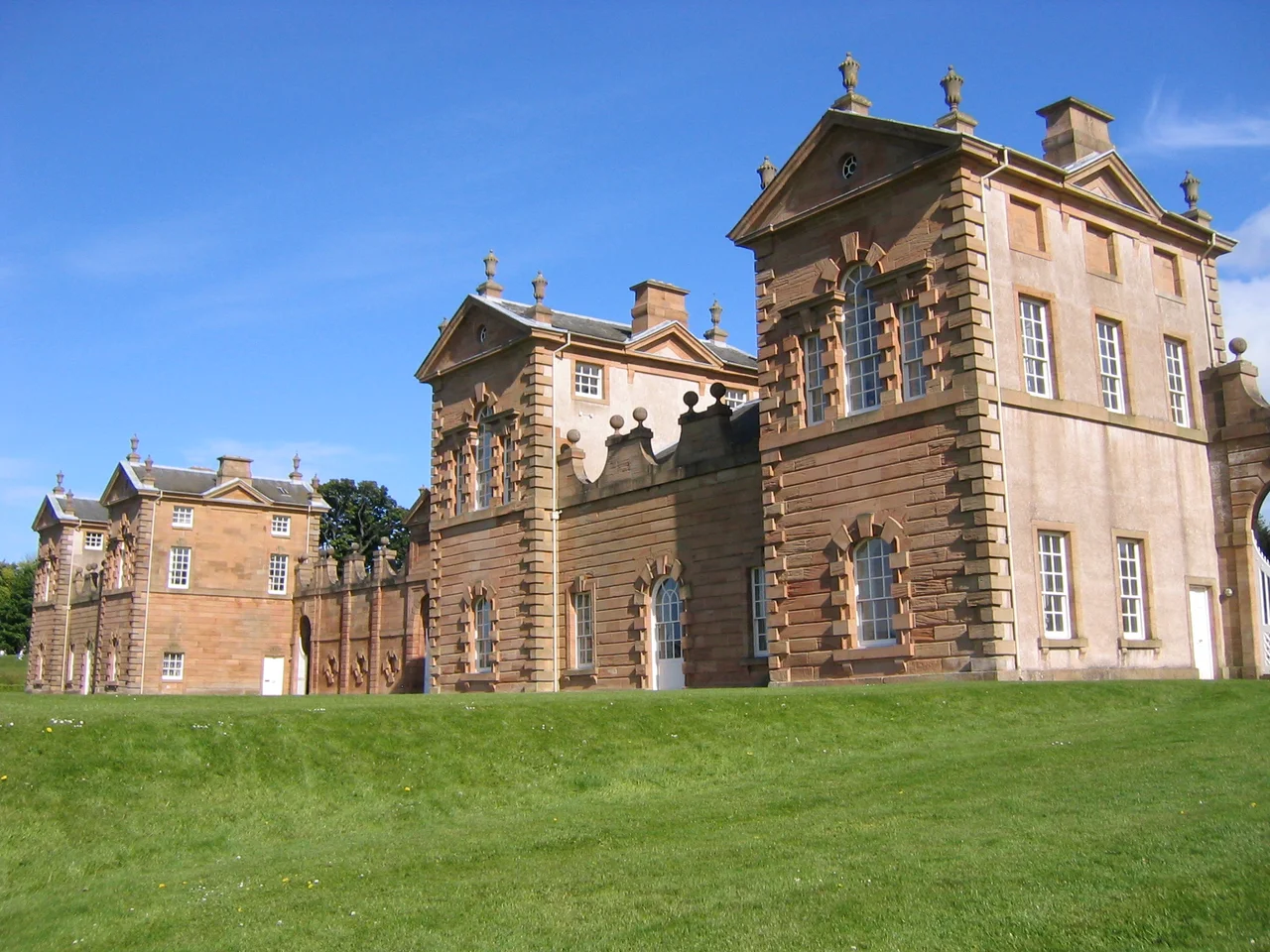

Chatelherault Country Park
The 14th Duke of Hamilton signed lease after lease to mine coal under his own estate. By 1915 the seams ran directly under Hamilton Palace itself. The result was inevitable. Subsidence cracked the largest country house in Scotland, and the palace was sold for demolition in 1921. The same subsidence reached Chatelherault Hunting Lodge a mile down the great grass avenue, tilting William Adam's elegant pavilions just enough that a coin set on the floor will roll, and many visitors report feeling faintly seasick. The lodge is haunted not by ghosts but by geology.
A French Duke in Lanarkshire
The park's name comes from the French town of Châtellerault, near Poitiers. In 1549 James Hamilton, the 2nd Earl of Arran, was formally created Duc de Châtellerault by King Henri II of France as a reward for agreeing, in 1548, to the marriage of the young Mary, Queen of Scots, to the French Dauphin Francis. The Hamilton family kept the French title, transplanted it home to Lanarkshire, and eventually used it for this hunting park - hence Chatelherault, anglicised and softened in the local accent. It was not the family's only Continental flourish: from 1684 Hamilton Palace was rebuilt as the largest country house in Scotland, with an imposing Palladian south front, and was enlarged again from 1822 by the 10th Duke as a setting for his art collection.
The Dogg Kennel
William Adam designed the lodge and completed it in 1734. It is two buildings linked by a gateway - four pavilions above a garden wall, forming a folly meant to be seen from Hamilton Palace at the far end of a half-mile grass avenue lined with lime trees. The north facade, the one facing the palace, is the formal front. The rear is laid out as a parterre garden. Inside, the rooms provided kennels for hunting dogs, stables for horses, and accommodation for guests coming back from a day in the woods. Adam himself, with characteristic dryness, called his creation 'the Dogg Kennel' - making a joke of the fact that what looked from a distance like a sumptuous Georgian country house was, in functional terms, an outbuilding for the management of dogs.
Three Thousand Years of People Here
Long before Adam built his folly, the woodlands south of Hamilton - then called Cadzow - were a hunting ground for the ancient kings of Strathclyde. A Bronze Age burial site was found here, with an urn and the undisturbed body of a woman who had lain in the soil for as much as 3,000 years. Some scholars suggest this area was the power centre of a small lost kingdom called Goddau, which Old Welsh poetry from the 6th century mentions but whose existence is otherwise barely traceable - Queen Langoureth being named as its first and last ruler before it was absorbed back into Strathclyde. After Strathclyde itself ceased to be independent in the 11th century, the hunting lodge and palace passed under Scottish royal control, and the site eventually became Cadzow Castle - whose ruins still stand on a bluff above the Avon Gorge inside the modern park.
Subsidence and Rescue
When debts forced the Hamiltons to sell their art collection in 1882 and abandon the palace, the family let the seams beneath them out for coal. By 1915 the mines ran under the palace itself. The ground in front of the hunting lodge was excavated for sand. The subsidence took the palace in 1921 and bent the lodge until coins would roll across the floor. Quarrying finally stopped in the 1970s, after the death of the 14th Duke. The High and Low Parks of Hamilton were given to the nation in lieu of death duties. Historic Scotland began restoring Adam's lodge in the late 1970s, recovering the fine Georgian plasterwork. In 1987 the park and lodge opened to the public, and in December 2005 Chatelherault railway station opened just outside the park gates - two trains an hour from Glasgow. From July 2017 South Lanarkshire Council began removing the conifer plantations that had grown up around the lodge, opening views back to the Duke's Bridge, Cadzow Castle and the wooded Avon Gorge that had been planted out of sight for decades.
From the Air
Chatelherault Country Park lies at 55.75N, 4.01W, on the southeast edge of Hamilton in South Lanarkshire, in the village of Ferniegair. The park follows the Avon Water (a Clyde tributary) through a steep wooded gorge. From the air, look for the long straight grass avenue running south-southeast from where Hamilton Palace once stood, ending at the small rectangular footprint of the William Adam lodge. The Avon Gorge cuts a green ribbon south through the otherwise built-up Lanarkshire towns. Glasgow International (EGPF) is 14 nm northwest, Glasgow Prestwick (EGPK) 22 nm southwest, Edinburgh (EGPH) 31 nm east. Best viewed from 3,000 to 6,000 feet to see the avenue, lodge and gorge together.
Nearby Stories
- HMS Gannet 3.6 km away
- Luss 5.3 km away
- Oliver Castle 6.8 km away
- Battle of Bannockburn 6.9 km away
- Beith 7.9 km away
- Pentland Hills 7.9 km away
- Lochleven Castle 16 km away
- Cumnock 17 km away