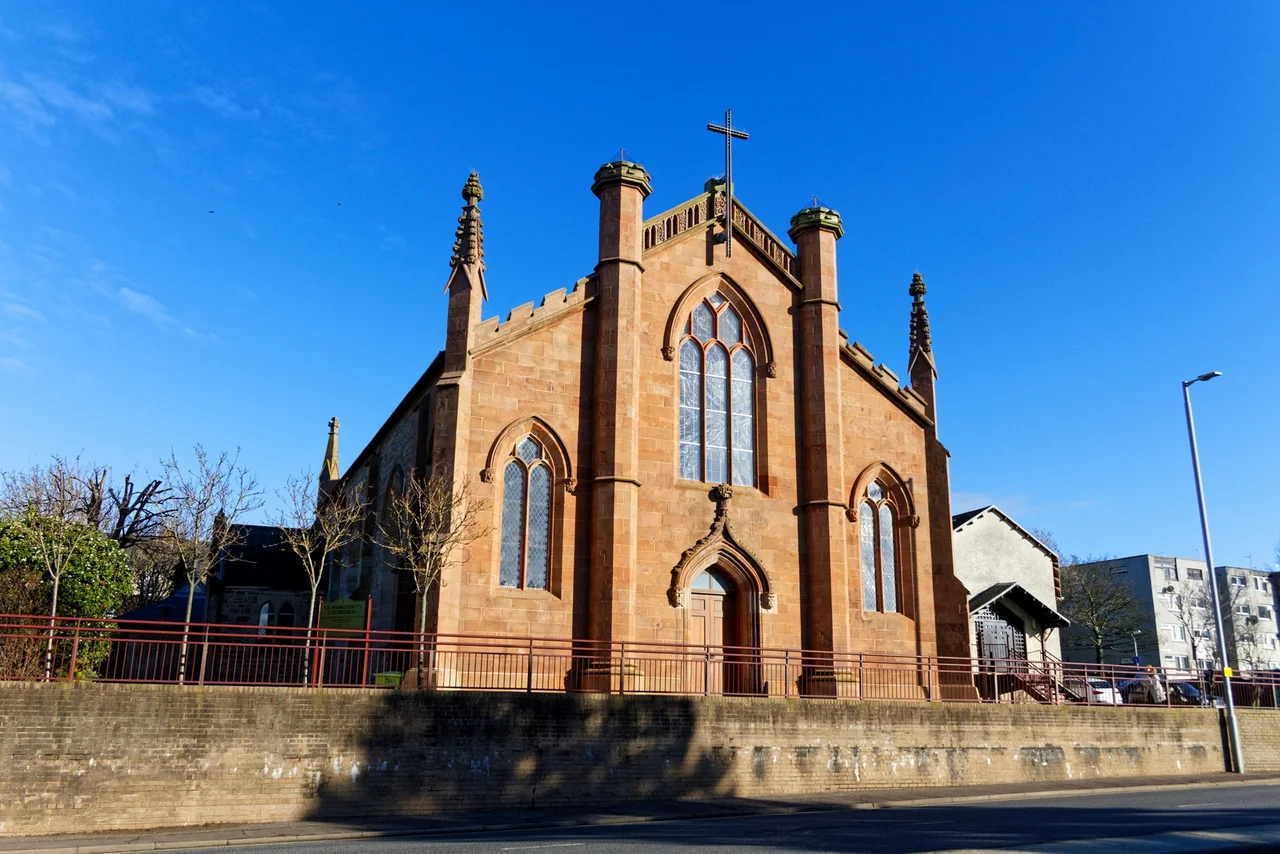

Ayr Cathedral
Most cathedrals begin with the ambition to be cathedrals. St Margaret's in Ayr did not. It was a parish church for 180 years before anyone elevated it - a working town-centre Catholic church that opened its doors in 1827 and got on with the business of Masses, baptisms, funerals, and the slow accumulation of memory that any old parish accumulates. Then in 2007 the roof of its older sister cathedral became unsalvageable, the congregation thinning, and Bishop John Cunningham petitioned Rome to move the seat of the Diocese of Galloway here instead. Pope Benedict XVI agreed. On 14 September 2007, the Feast of the Triumph of the Cross, the parish church became the Cathedral Church of Saint Margaret.
The First Stones, 1826
By 1822 the Catholic population of Ayrshire was growing fast enough that Bishop Cameron sent the Rev William Thomson north to be the first resident parish priest. Thomson petitioned hard, and in 1826 the foundation stone was laid for St Margaret's, designed by the architect James Dempster. The church opened a year later. Four original stained glass windows from 1827 still hang behind the high altar, depicting the Virgin Mary, Jesus as the Good Shepherd, Saint Joseph, and Saint Margaret of Scotland - their Gothic Revival colour scheme pictorial and Victorian, very different from anything added later.
The 1990s Rescue
By the mid-1990s the building was tired. Water had got in. The window frames were corroding. The wiring was uncertain. Father Martin McCluskey began the difficult conversation with the parish about a major renovation - and then died, untimely, in 1996, before the work he had argued for could be commissioned. Father Patrick Keegans arrived in 1997 and continued what McCluskey had started. The campaign succeeded. Grants from Heritage Scotland and the National Lottery were combined with imaginative parish fundraising, and the bills were paid off remarkably fast. The new, refurbished church reopened on 31 March 2000 in a ceremony presided over by Bishop Maurice Taylor; Canon Matthew McManus, who had served as an assistant priest from 1965 to 1976, gave the homily.
Light and Water and Lockerbie
Two large modern stained-glass windows by the artist Susan Bradbury were installed for the Millennium. The first, on the north side of the nave, is called "Divine Light" - shimmering with all the colours of the spectrum and sparkling with lenses of lead crystal, taking its text from Revelation 21:23: "the city had no need of the sun." The second, opposite, is the "Water of Life" window, a cooler design with crystal lenses that read like bubbles in a flowing river. The water reference is local: Ayr has always depended on the River Ayr and the sea. But the window has a second meaning too. It is a memorial to the 270 people who died in the Pan Am Flight 103 disaster over Lockerbie in 1988, gifted by the American relatives of the victims. Patrick Keegans had been parish priest in Lockerbie when the bomb came down. The families remembered him, and they remembered to send something back.
Hands Tell the Passion
Bradbury's Stations of the Cross trace Christ's passion using hands as the central image - hands placing the crown of thorns, hands carrying the cross, hands offering comfort, hands in torment, hands tormenting. The colours do their own work. Brown for the earth at each fall, a softer brown for the cross itself and the strength of Simon of Cyrene. Blue for the grief - Christ stretching out his hand to his mother, the meeting with the mourning women, the descent from the cross. Red for the violence: the stripping, the nails, the moment of death. Green for Veronica's gentleness, for the living branches of thorn, and for the final image as a symbol of hope beyond the grave. Each station is made of two sheets of glass in the same frame, set just far enough apart that the image dreams a little before it settles.
Side Chapels and Side Notes
To the left of the sanctuary, the Sacred Heart Chapel holds a modern ruby-red window full of hearts - a meditation on love - paired with an older window above the altar showing Christ appearing as the Sacred Heart to St Margaret Mary Alacoque. To the right, Our Lady Chapel takes grief and consolation as its theme, with the letter M for Mary, a crown for the Queen of Heaven, and the tears of a sorrowing mother. The west window above the gallery, renovated in 2016, picks up Psalm 148's theme of praise and is titled "Gloria in Excelsis Deo - Glory to God in the Highest." Three lancets, five tracery lights, a blaze of gold. Beneath it all, in two books placed under the high altar, are the signatures of the parishioners who paid for and prayed for the renewal - the Book of Dedication and the Book of Remembrance, the living and the dead held together at the centre of the cathedral.
From the Air
Ayr Cathedral sits at 55.465 N, 4.627 W on John Street near the centre of Ayr. From the air the building reads as a modest masonry church with a long nave aligned roughly east-west, surrounded by the dense Victorian streets of central Ayr. The River Ayr passes a block to the south, and the Firth of Clyde is half a mile west. Glasgow Prestwick (EGPK) lies 3 nm north - very close. Best viewing from 1,000-2,000 ft AGL; circuit traffic for Prestwick passes overhead routinely.
Nearby Stories
- Kilbirnie 4.2 km away
- East Kilbride 5.4 km away
- Knockshinnoch Disaster 7.3 km away
- Machrie Moor Stone Circles 9.4 km away
- Kenmure Castle 16 km away
- Ballantrae Lifeboat Station 20 km away
- Loch Fyne 38 km away
- SM UB-85 46 km away