
Beaufort's Dyke
On 8 February 1986, seismic monitors across Britain registered what looked like a 2.5 magnitude earthquake in the seabed between Northern Ireland and Scotland. It wasn't an earthquake. Something at the bottom of Beaufort's Dyke had detonated. The Ministry of Defence does not give a complete list of what is down there, but the broad outlines are public: well over a million tons of conventional and chemical munitions, dumped after the Second World War, including 14,500 tons of artillery rockets filled with phosgene gas dropped overboard in a single operation in July 1945. There are also, according to declassified files from the Public Record Office, about two tonnes of concrete-encased drums of radioactive laboratory waste dumped in the 1950s. The Dyke is one of the deepest places on the European continental shelf, and for most of the twentieth century the deepness was treated as a convenience.
A Tunnel Cut by Ice
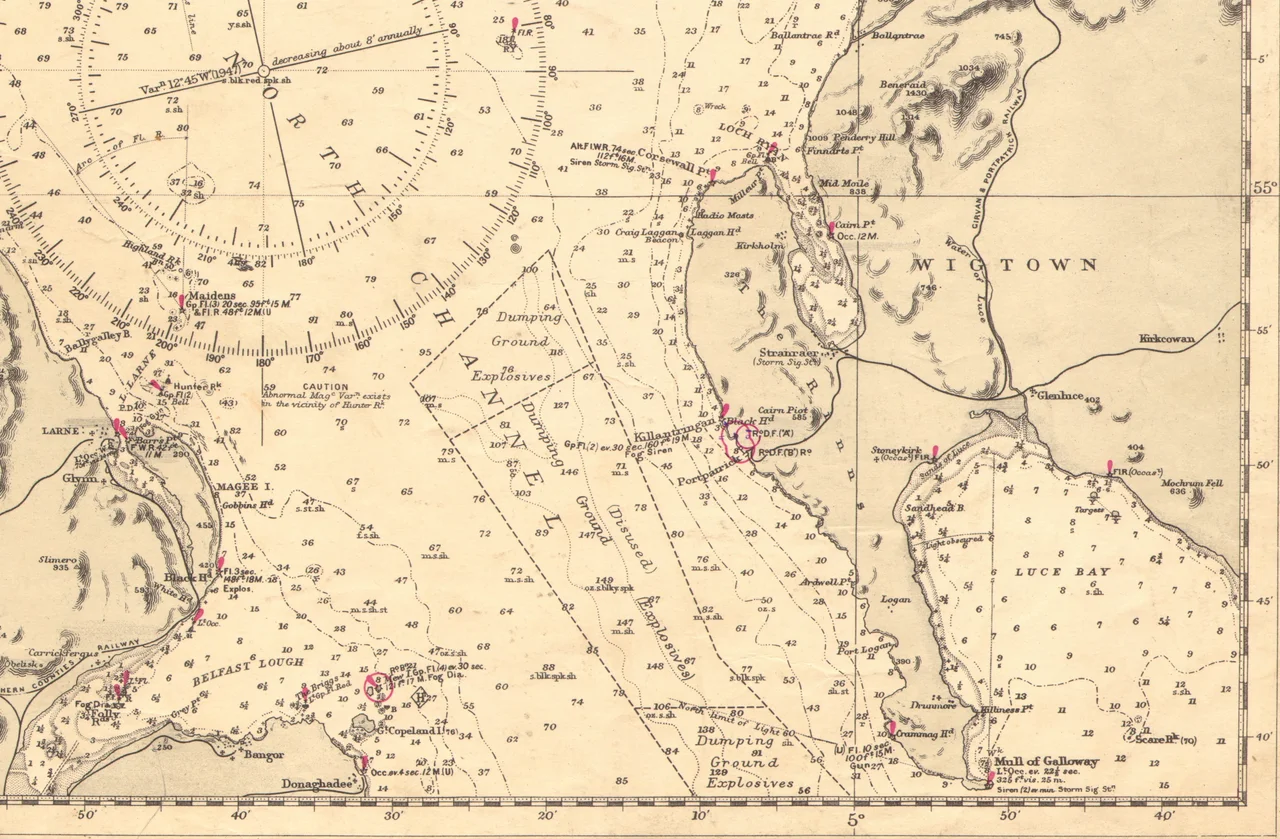
Beaufort's Dyke is a natural feature, despite its straight-edged name. It is a submerged tunnel valley, carved into the seabed by glacial meltwater during the last ice age and kept clear of sediment ever since by strong tidal currents through the North Channel. The trench runs fifty kilometres long, three and a half kilometres wide, and reaches depths of around 300 metres. From a chart it looks like a knife slash drawn through the floor of the channel between Belfast Lough and the Galloway coast. Captain Frederick William Beechey of the Royal Navy is credited with its discovery in the early nineteenth century, although the trench was already recorded in 1856 as having been found some years earlier. For seventy years after that, it was simply a deep place on a chart. Then it became a place to throw things away.
The Convenience of Depth
The military port of Cairnryan, opened on the Scottish side of the channel during the Second World War, made the Dyke uniquely useful. After 1945, Britain found itself with vast surplus stocks of weapons and chemical agents and very few good options for disposing of them. The Ministry of Defence has acknowledged that well over a million tons of munitions were dumped, including the July 1945 disposal of 14,500 tons of five-inch artillery rockets filled with phosgene, a choking agent that had been used to terrible effect in the First World War. The dumping continued into the 1970s. The decisions were made under wartime secrecy and post-war pragmatism. The consequences were left for later generations. Later generations have started to arrive.
What Washes Up
In 1995, phosphorus bombs began washing up on Scottish beaches. The timing coincided with the laying of the Scotland-Northern Ireland Pipeline, a 24-inch gas interconnector built by British Gas. The pipeline crossed the southern edge of the dump area and apparently disturbed material that had been resting on the seabed for half a century. Over the preceding five years, anti-tank grenades had appeared on shores in Northern Ireland and the Isle of Man. The munitions are still there, slowly corroding. Phosgene, in particular, was packed into shells with rubber seals that have been degrading for eighty years. Bomb-disposal teams in Scotland and Northern Ireland have a quiet, steady stream of work that the rest of the country mostly never hears about: a fisherman finds something strange in his nets, a child picks up a shiny metal cylinder on a beach, and a careful phone call is made.
The Bridge That Wasn't Built
In February 2020, the UK government announced a feasibility study for a fixed crossing between Northern Ireland and Scotland. Two routes were considered: Portpatrick to Larne, and Kintyre to Torr Head. The Portpatrick option would cross Beaufort's Dyke. The engineers concluded that even at the narrowest point, a bridge would need spans approaching four kilometres on foundations set well back from the trench's edge, because no one really wanted to start drilling anchor piles into a million tons of unexploded ordnance. The estimated cost reached 335 billion pounds. The project was rejected. The Dyke had outlasted yet another scheme to bridge it. Boris Johnson's government had spent around a million pounds on consultancy fees by the time the proposal was quietly shelved. The trench remained as it has been since the ice melted: a deep cold place where nobody really wants to look too closely.
From the Air
Beaufort's Dyke runs through the North Channel at approximately 54.78 degrees north, 5.42 degrees west, between Northern Ireland and the Galloway coast of Scotland. The dump-site marker on Admiralty charts is around fifteen nautical miles east of Donaghadee and about ten miles southwest of Portpatrick. The trench is not visible from the air, but its location can be inferred from the line of cargo and ferry traffic between Belfast and Cairnryan that passes immediately to the north. Belfast City Airport (EGAC) is about 25 miles to the west; Belfast International (EGAA) about 35 miles west-southwest. Prestwick (EGPK) in Scotland lies about 30 miles to the northeast. The channel is heavily trafficked: ferries between Cairnryan and Belfast or Larne pass within a few miles of the dump area daily.
Nearby Stories
- Ballycarry 3.2 km away
- Drummore 7.6 km away
- Hillsborough Castle 7.9 km away
- Cushendall 8.8 km away
- Castle Upton 9.3 km away
- Girvan 25 km away
- International Institute of Space Commerce 29 km away
- Ballantrae Lifeboat Station 30 km away