
Buncrana
On 30 July 1922, just after dawn, a Free State sentry stopped a car on the outskirts of Buncrana and discovered the Republican commander of the entire peninsula inside, with five armed volunteers and nowhere to go. By seven in the morning the town had changed hands without a single shot fired. That morning is one of many quiet drama scenes in Buncrana's long history: a town small enough to walk across in fifteen minutes that has, for four hundred years, kept finding itself at the edge of larger Irish stories. It sits on the eastern shore of Lough Swilly in north Donegal, twenty-three kilometres from Derry, gateway to the Inishowen peninsula and to a coastline that has watched fleets and refugees and rebels come and go.
Two Castles and a River
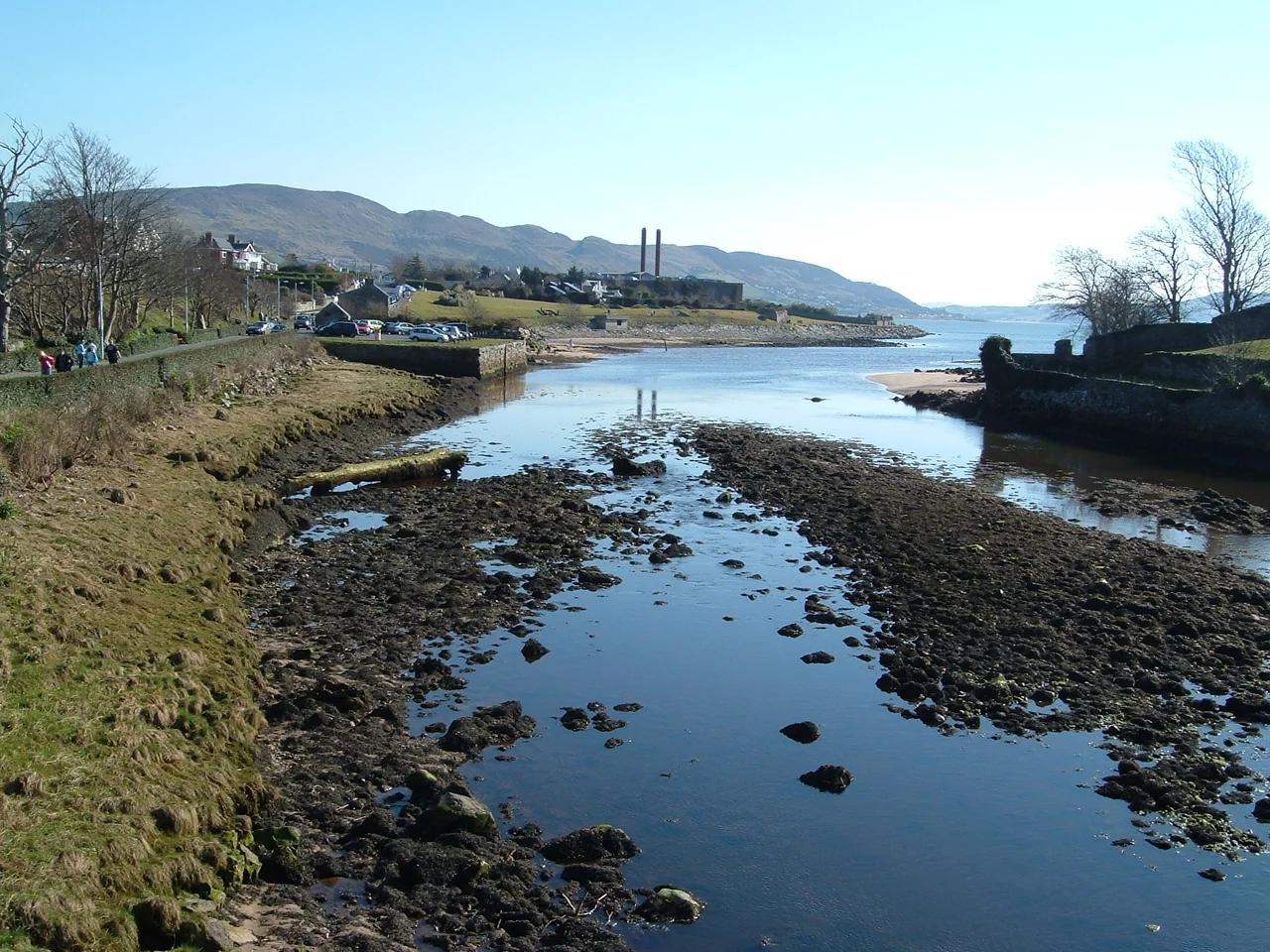
There are really two Buncranas, separated by about a century and a six-arched stone bridge. The older one grew up around O'Doherty's Keep, a small two-storey castle that Conor McGarret O'Doherty inhabited in 1601. A year later Hugh Boy O'Doherty added a third storey and prepared it as a base for Spanish military aid that never quite arrived. The newer Buncrana belongs to George Vaughan, who built Buncrana Castle in 1718 as one of the first great manor houses of Inishowen, lifting stone from the keep's old defensive bawn to do it. Vaughan moved the town to its present location, laid out the main street, and threw the Castle Bridge across the River Crana so traffic could reach his front door. The keep still stands beside its successor. Vaughan's bridge still carries pedestrians into Swan Park.
A Prisoner, a Bridge, and a Judge
In October 1798 a French fleet limped toward Donegal carrying Theobald Wolfe Tone and the hopes of the United Irishmen's rebellion. The Royal Navy intercepted them at the mouth of Lough Swilly. Tone was brought ashore in chains and held in Buncrana Castle before the long journey to Dublin and to his death. A plaque in the castle forecourt remembers him; beside it sits a memorial rock for Sir Cahir O'Doherty, the old Gaelic lord who lost everything in the same waters two centuries before. Nine years after Tone passed through, Judge Wilson built Westbrook House at the north end of town and a single-arch stone bridge to reach it. Locals still call it Wilson's Bridge. It leads now to Swan Park, where families picnic beside the same dark river that once carried French sails.
Lights, Lines, and Looms
In October 1905 Buncrana became the first town in County Donegal to receive electricity, generated at Swan Mill on the river. The mill kept the lights on until September 1954, when the national grid finally reached the town. The railway arrived first, in 1864, opening Donegal's northern shore to Derry day-trippers who came for the sea air and Lisfannon's wide pale beach, still a Blue Flag site today. The line closed to passengers in 1948 and shut entirely in 1953; its old terminus is now the Drift Inn, where you can drink a pint where Edwardian travellers once bought tickets. Later, in the 1990s and early 2000s, Buncrana's biggest employer was a Fruit of the Loom plant whose chimneys defined the skyline. The plant followed work to Morocco. The chimneys are gone. The town learned, as small towns must, to do without.
What the Pier Remembers
In March 2016 a car slipped from Buncrana Pier into Lough Swilly carrying five members of the same family. Sean McGrotty managed, in the seconds the car was still above water, to pass his four-month-old daughter through a window to a passer-by who had swum out to help. The baby lived. Everyone else in the car died. It is a story the town carries with the same quiet shock that follows the 1991 murder of Sinn Féin councillor Eddie Fullerton, killed at his home by Loyalist paramilitaries who had, it was later alleged, been handed intelligence by sympathisers inside the RUC. Buncrana does not turn these things into monuments. The pier is still a pier. Fullerton's name is spoken plainly. The town's Tidy Towns committee keeps winning awards; its 9-hole golf course, the oldest links in Ireland, still curls along the lough; and the Music & Arts Festival fills every 23rd of July.
Voices From a Small Place
For a town of fewer than seven thousand people, Buncrana has produced an unusual number of voices. The playwright Frank McGuinness, whose Observe the Sons of Ulster Marching Towards the Somme is one of the great works of modern Irish theatre, was born here in 1953. So was Ray McAnally, the actor who played the troubled Cardinal in The Mission and the dying father in My Left Foot. Three Dog Night's lead singer Danny Hutton grew up on these streets before California found him. Daniel Devlin, born in 1814, crossed the Atlantic and became City Chamberlain of New York. The names tell you something about Buncrana that a tourist brochure cannot: it is a place from which people leave, and to which a surprising number return, often as plaques.
From the Air
Buncrana sits at 55.14 degrees north, 7.46 degrees west, on the eastern shore of Lough Swilly. From cruise, the long blue finger of the fjord is the unmistakable landmark, running roughly south from Fanad Head and Dunaff Head with the Inishowen peninsula on its right bank. The nearest controlled airport is City of Derry (EGAE), about 27 km southeast across the border; Donegal Airport (EIDL) lies roughly 50 km west on the Atlantic coast. Belfast International (EGAA) is the nearest major hub at around 110 km east. Clear visibility is rarely guaranteed in this maritime climate, but on a fine day the bright crescent of Lisfannon beach south of town and the dark chimneyless silhouette of the old Fruit of the Loom site by the river mark Buncrana from miles up.
Nearby Stories
- Falcarragh 3.4 km away
- Lifford 5.2 km away
- Harry King Goode 7 km away
- German submarine U-218 20 km away
- Donegal Castle 21 km away
- Plantation of Ulster 22 km away
- German submarine U-1005 30 km away
- Port Ellen Distillery 60 km away