.JPG)
Audleystown Court Tomb
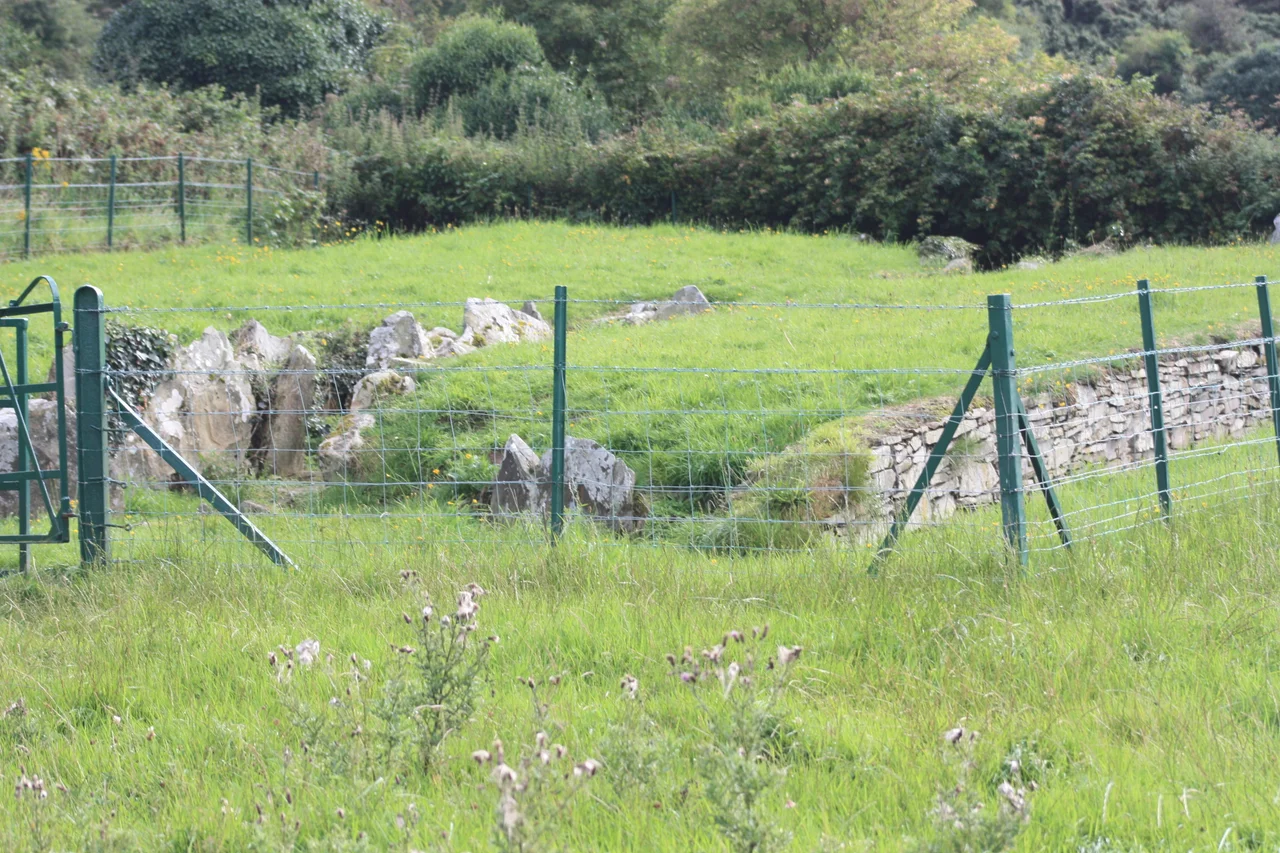
Thirty-four people lie at Audleystown, or rather, the bones of thirty-four people, found together in the burial chambers and described by the archaeologist who excavated them in 1952 as primarily women and children, mostly defleshed, mostly unburnt, lifted apart and put down again in pieces. This is not how the Neolithic farmers of the Strangford shore disposed of their dead by accident. The Audleystown court tomb is one of the earliest works of architecture in Ireland. It is older than the pyramids by a thousand years. The people whose bones it holds were our European ancestors at the moment they stopped following the herds and learned to plant grain, and what they built for their dead is still here.
What a Court Tomb Is
Between roughly 3900 and 3500 BCE, the farming communities of the northern Irish Sea built more than 390 court cairns in Ireland and another hundred in southwest Scotland. They are the earliest megalithic monuments these islands knew, older than the passage tombs of the Boyne valley, older than Stonehenge. A court tomb is built around an uncovered ceremonial courtyard, a kind of open-air room walled in standing stones, attached to one or more roofed and partitioned burial chambers running back into a long cairn of piled stone. The court itself was where the living gathered. The chambers behind it were where the dead were laid. Most court tombs have a single court at one end, but a small handful, including Audleystown, have a court at each end, and this dual-court arrangement appears to be unique to Ireland. The pattern is mirrored at Cohaw, in County Cavan. Why these particular communities built tombs with two facing courts instead of one is something the bones do not tell us.
The 1952 Excavation
Audleystown was first excavated by the archaeologist A.E.P. 'Pat' Collins in 1952, as part of the Archaeological Survey of Northern Ireland. Collins published his findings in 1954, the Ministry of Finance took the site into guardianship as an ancient monument, and the burial galleries were filled back in with sand to protect the inner stones. What he found in those galleries set Audleystown apart. The remains of at least 34 individuals lay in the chambers, in a state of mixed disorder, cremated bones alongside bones that had been partially burnt and others that had never seen fire. About two-thirds of the bones were unburnt and defleshed, the marks suggesting the bodies had been allowed to decompose elsewhere first and the bones moved later. The dead were mostly women and children. With them were the broken pieces of at least three pottery bowls, some made in a smooth corky fabric, and a few sherds of the decorated style called Carrowkeel ware, alongside worked flint and the scattered bones of animals.
Rebuilding the Cairn
In 1958 Collins came back to Audleystown with a small team to consolidate what he had found. The work was both archaeology and architecture. The courts were taken down to their original ground level. A search of the nearby fields turned up several large Silurian slabs, the local greenish rock that the original builders had used, which had been carried off centuries earlier to be reused in walls and outbuildings. The slabs were brought back and put into the positions the excavation had marked for them. Where the original standing stones could not be found, similar-sized replacements were set in their places. Where no suitable stones existed, the walls were patched with a mixture of drystone and concrete, the patches deliberately visible so that the rebuilding could be read. The cairn itself was rebuilt up to what Collins judged was its original height, using stones and earth from the immediate site. Audleystown today is not quite what stood here in 3700 BCE, but the careful work of 1958 is the closest the modern eye is likely to get.
The Long Memory of the Shore
From the cairn the land falls away gently to the southern shore of Strangford Lough, perhaps half a mile distant, the same shore the Neolithic farmers used for shellfish and for travel. The view westward across Ballyculter parish is open enough that the placement of the tomb feels deliberate, like a building meant to be seen from the lough. The people who built Audleystown were not Celts, or Vikings, or any of the later peoples whose names attach to this landscape. They had no metal. Their language is gone. The farming they began here, sometime around 3800 BCE, is the same farming, broadly, that the modern fields above the lough still practise, the same wheat and barley, the same cattle, the same long slow rhythm of planting and harvest. The bones at Audleystown are ours, in the only sense that matters. They are what these islands held before they were anything we would now recognise.
From the Air
Audleystown Court Tomb sits at 54.3778°N, 5.5970°W in Ballyculter parish, half a mile from the southern shore of Strangford Lough and about a mile west of Audley's Castle. From the air the cairn appears as a long low pale mound aligned roughly east-west in open fields, with the lough visible to the north. Recommended viewing altitude 1,000–2,500 feet for the cairn outline against the field pattern. Nearest airports: Newtownards (EGAD) 14 nm north, Belfast City (EGAC) 22 nm north-northwest, Belfast International (EGAA) 33 nm northwest. The local Silurian bedrock is best lit by low morning or evening sun, which raises the cairn's profile against the surrounding pasture.
Nearby Stories
- Silent Valley Reservoir 1.7 km away
- Drummore 3 km away
- Copeland Islands 5.2 km away
- Castle Upton 8.4 km away
- Hillsborough Castle 9.5 km away
- Bradda Head 11 km away
- Pasages (steam trawler) 20 km away
- Chicken Rock Lighthouse 41 km away