
Pasages (steam trawler)
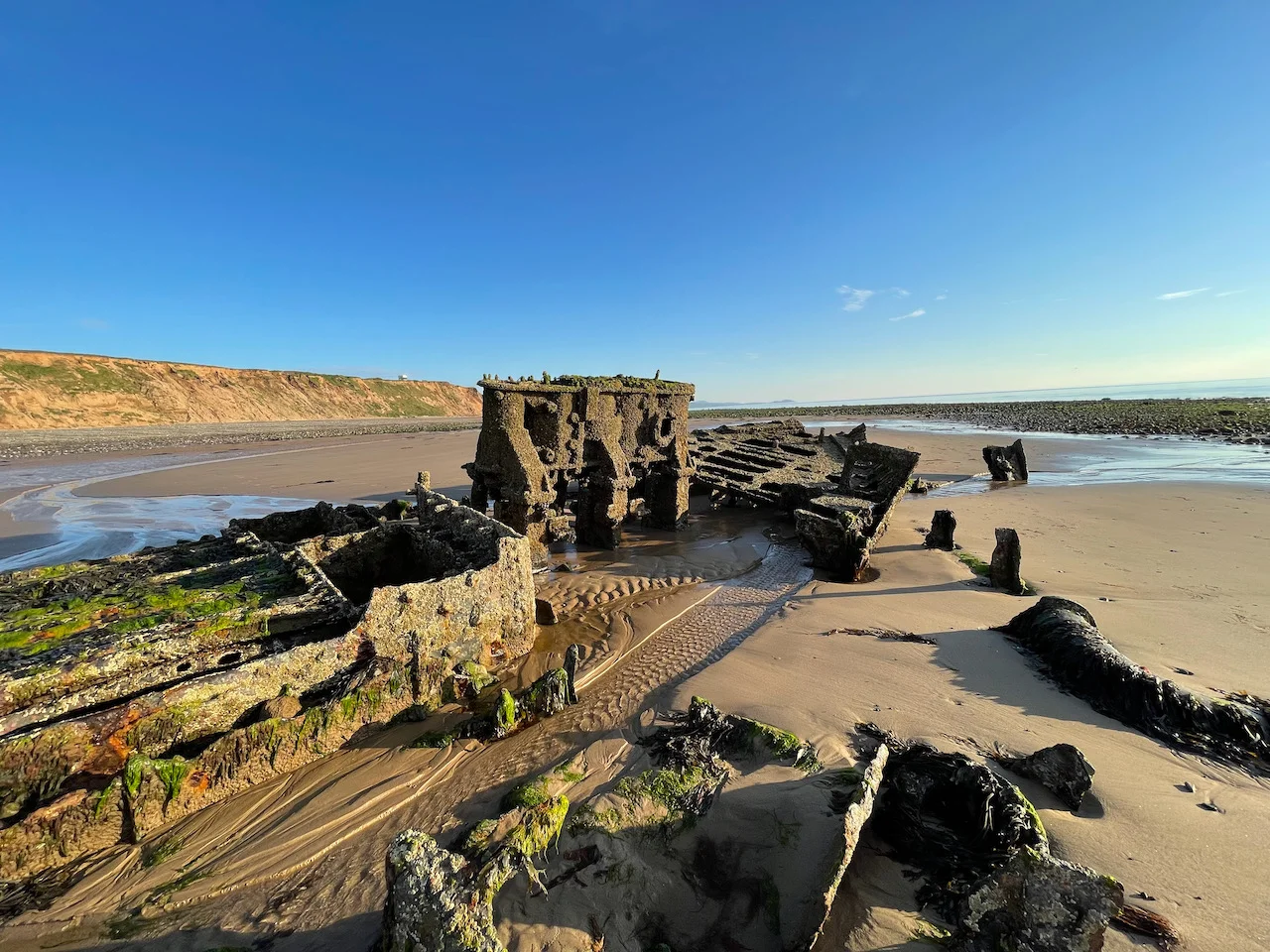
The wreck is still there at Jurby Head, half buried in shingle, half pushed up against the cliffs of the northwest Isle of Man. Two pieces of riveted steel hull lie tilted on the beach where the sea left them ninety-odd years ago. The bow is gone. The stern still rises in fragments. Walk down at low tide and you can read the lines of a vessel built for one war and ending its days in another trade altogether - the steam trawler Pasages, registered FD 119, formerly TR 14 of the Royal Canadian Navy.
Built in Toronto for a Distant War
She slid down the ways at the Dominion Shipbuilding Company in Toronto in 1917, the same year the German submarine campaign in the North Atlantic reached its peak. In February of that year, the British Admiralty had asked Canadian yards to build 36 naval trawlers - copies of a Royal Navy design with small Canadian modifications, the gun mounted further forward and a different lighting system. The TR series, as they were called, displaced 275 long tons. They measured 40.8 metres overall, with a beam of 23 feet and a draught of 13. Their triple-expansion steam engines produced 480 indicated horsepower through a single shaft and pushed them along at a maximum of 10 knots. Forward, each carried a single QF 12-pounder 12 cwt naval gun. They were not glamorous ships, but they were exactly what Canadian coastal waters needed - small, sturdy, and willing to drag a minesweeping cable through any sea.
Patrolling the Atlantic Coast
TR 14 went to work along the East Coast of Canada. Officially she was a minesweeper, but the Royal Canadian Navy in 1917 needed every hull it could float for everything at once. She did patrol work along the shipping lanes. She escorted coastal convoys between Halifax and the smaller Atlantic ports. The submarine threat that had pushed Britain to its knees was less acute in Canadian waters but still real - U-boats made the crossing periodically and stalked merchant traffic off Newfoundland and Nova Scotia. Trawlers like TR 14 were the small, anonymous workhorses of that thin defensive line, never glamorous enough for medals, never large enough for headlines. When the Armistice came in November 1918, she was paid off and laid up - no longer needed, but not yet ready to be scrapped.
From Inverness to Grimsby
In 1921 the Admiralty shipped a batch of surplus TR-class trawlers across the Atlantic to be sold off in Britain. TR 14 made the crossing and ended up moored at the Muirtown Basin on the Caledonian Canal at Inverness, waiting in fresh water for a buyer. The wait was a long one. Not until August 1926 did the Boston Deep Sea Fishing and Ice Company of Grimsby buy her. They had her converted for fishing, registered her in Fleetwood with the trawler designator FD 119, and renamed her Pasages. A load line was assigned to allow her to carry herring as cargo. Basil Parks of Fleetwood took over as manager. Within months a Canadian minesweeper had become an Irish Sea herring trawler, working out of Fleetwood for the same company that would in time own one of the largest distant-water fleets in Britain.
Jurby Head, 1931
On 3 December 1931, Pasages went ashore on the rocks at Jurby Head, on the northwestern corner of the Isle of Man. She had been fishing the grounds off the Manx coast, as the Fleetwood trawlers regularly did. Exactly what brought her in is not recorded - bad weather is the usual suspect, but so is mechanical trouble, and so is a navigation error in poor visibility. She struck hard and could not be refloated. The crew got off. The vessel did not. Salvage attempts must have been made - she had value in her engine and her plates - but what remains today suggests the sea got most of the work. The wreck has been a fixture of Jurby beach for nearly a century. Photographs from 2024 show that the stern section is still recognisable, riveted plates curving up out of the shingle, weed-darkened, salt-bleached.
What the Tide Uncovers
There is something about the slow disintegration of a vessel like Pasages that catches at the imagination - more than a complete wreck, more than a clean sinking. The fragments at Jurby Head are unfinished business. You can stand on the beach and trace where the hull plates met the keel, where the stern post took the rudder, where the gun mounting once was on the foredeck back when she was TR 14 patrolling Nova Scotian fog. A ship that survived the war that built her was finished by a December morning on a Manx beach. The men who built her in Toronto, the sailors who served in her, the Fleetwood fishermen who took her over - none of them are remembered. The hull is what is left of the work they did.
From the Air
The wreck site lies at approximately 54.58°N, 4.92°W on the northwest coast of the Isle of Man, at Jurby Head, just north of the disused Jurby aerodrome. Two stern sections of the hull are visible at low tide on the beach below the cliffs. Visible from low altitude in clear weather - cruise around 1,500-2,500 ft along the coast for the best view of the wreck and the Jurby coastline. Nearest active airport is Ronaldsway (EGNS) at the south end of the island; the historic Jurby airfield (former RAF Jurby) is immediately inland from the wreck site. The Mull of Galloway sits across the water to the northwest, and the Cumbrian coast is visible east on a clear day.
Nearby Stories
- Peel Castle 11 km away
- Ballywalter 14 km away
- SS Georgetown Victory 16 km away
- Threave Castle 19 km away
- Raeberry Castle 25 km away
- Battle of Glen Trool 32 km away
- Larne 35 km away
- Black Combe 58 km away