
Ballywalter
Read the Freeman's Journal of August 11, 1798, and you find a sentence that captures Ballywalter's whole strange history in one breath. The paper reported that in the little village of Ballywalter, nine men had been killed and thirteen returned wounded after the recent rebellion. 'If a trifling village suffered so much,' the journal asked, 'what must have been the aggregate loss in those parts of the country which were in a state of rebellion?' Ballywalter then had a population perhaps a tenth of what it has today, around 2,000 modern residents. To lose nine men was to lose a generation. The graves are still in Whitechurch graveyard, on the village's northern edge, beside the headstone of a man who emigrated from Scotland in 1606 and died at 90 in 1608.
Walter's Townland
The village's Irish name is Baile Bhaltair, Walter's townland - a gaelicisation of the Anglo-Norman name Walter or Walterston. Walter was a common given name among the Norman lords who arrived in Ireland in the late twelfth century, and Pope Nicholas IV's tax census of 1291-1292 refers to Rector ville Walteri de Logan, 'the rector of Walter-de-Logan's town.' The village's older name was Whitkirk, known as early as the twelfth century, and the surrounding townland of Whitechurch preserves the same idea in English. Today's village sits on the east coast of the Ards Peninsula, facing the Irish Sea, between Donaghadee to the north and Ballyhalbert to the south. It covers 437 acres of townland and serves as the centre of a civil parish that contains seven other townlands, including the much-divided Whitechurch on its northern edge.
Pike Sunday
On the morning of June 10, 1798 - thereafter known as Pike Sunday - a force of United Irishmen marched on Newtownards. They came from Bangor, Donaghadee, Greyabbey and Ballywalter. They were met with musket fire from the market house in the town centre, and among those killed was James Cain, an 18-year-old from Ballyferris outside Ballywalter. Cain was buried in Whitechurch graveyard, where his stone sits among others from the rebellion. A number of Presbyterian ministers in the Ards were tried for participating in the rebellion, found guilty, and executed - including Reverend Robert Goudy of Dunover, just outside Ballywalter. After the rising collapsed, bands of soldiers and yeomen scoured the country looking for survivors. Local memory holds that some Ballywalter men escaped capture by spending days at sea, hidden behind Long Rock. The Freeman's Journal published its sentence about the trifling village three weeks later.
A Stately Home Open by Appointment
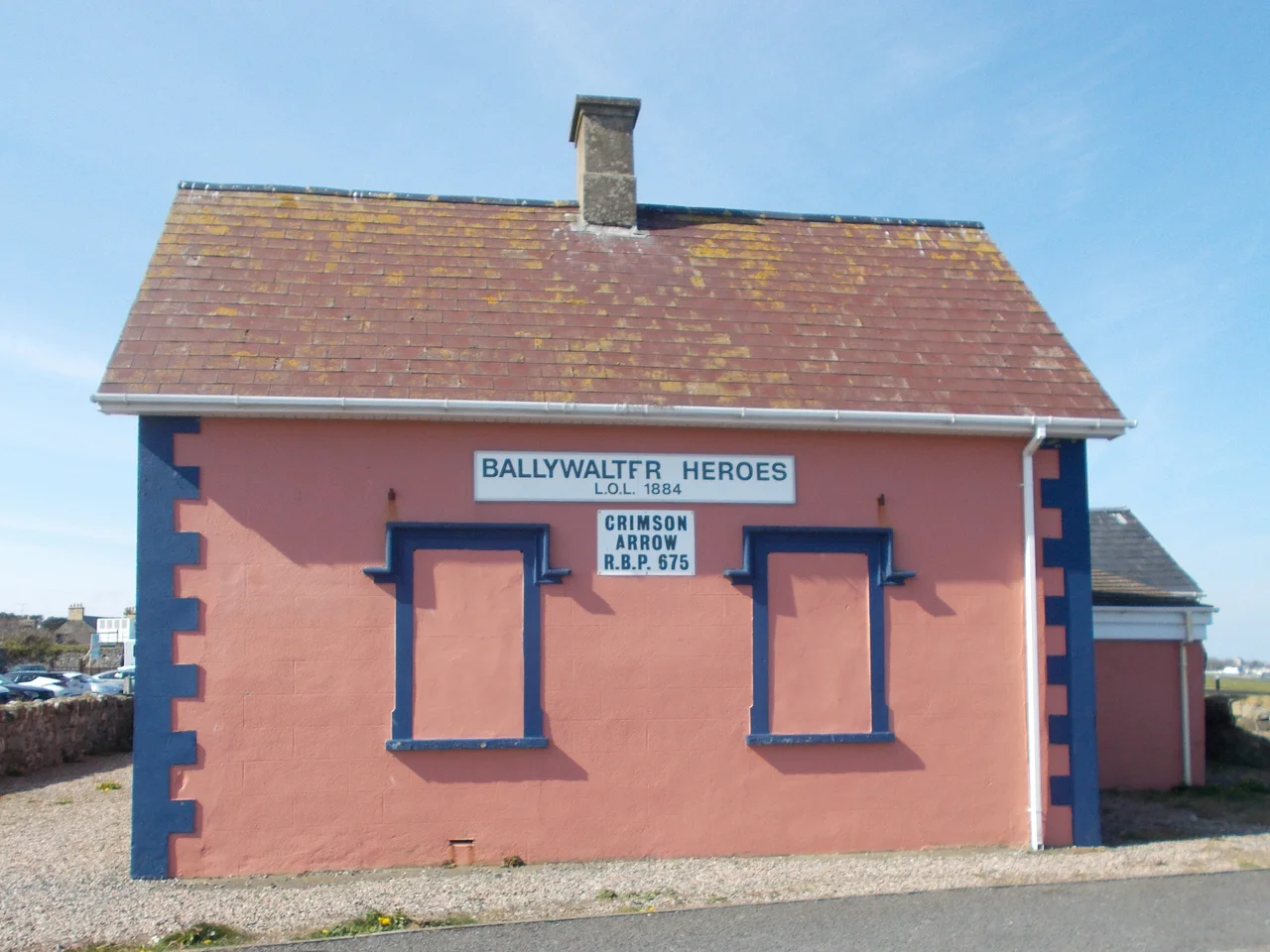
On Ballywalter's southern edge stands Ballywalter Park, the ancestral seat of the 6th Baron Dunleath, a Grade A listed stately home that opens to the public only by appointment. The house and grounds host the annual Northern Ireland Game Fair, which has drawn nearly 40,000 people over a single weekend - a remarkable footprint for a country estate near a village of just two thousand. Two churches anchor the village's religious life today: the Holy Trinity (Church of Ireland) on Whitechurch Road, and the Ballywalter Presbyterian Church on Main Street, founded in 1626 and one of the oldest Presbyterian congregations in Ireland. The Loyal Orange Lodge in Ballywalter, Lodge No. 1884, has met continuously in the Orange Hall on Main Street since the mid-nineteenth century.
Voyagers and Chefs
Two Ballywalter natives stand out as having travelled remarkably far from this small village on a peninsula coast. Thomas Jamison, born here in 1752 or 1753, sailed to New South Wales as a Royal Navy surgeon's mate aboard the First Fleet in 1788 and eventually became a colonial official, merchant trader and substantial landowner in early Sydney. He died in 1811. Two centuries later, Paul Rankin grew up in Ballywalter and became one of the United Kingdom's first celebrity chefs - co-presenter of Ready Steady Cook on the BBC, holder of a Michelin star at Roscoff in Belfast (the first restaurant in Northern Ireland to receive one), and a national figure in British food media. Inside the Whitechurch graveyard church, a single headstone commemorates Arthur Lusks, who circumnavigated the world with Admiral George Anson's expedition in 1740-1744, an enormously dangerous voyage from which only one of six ships returned and fewer than one in ten of the men survived. Lusks was one of the survivors who made it home.
From the Air
Ballywalter sits at 54.54N, 5.48W on the east coast of the Ards Peninsula in County Down. From altitude, look for the village strung along the Irish Sea shoreline between Donaghadee to the north and Ballyhalbert to the south. The small harbour with its 1866 lifeboat house is on the seaward side. Ballywalter Park is visible to the south as a wooded estate. Nearest airport is Belfast City (EGAC), about 19 nautical miles northwest. Recommended viewing altitude 2,000-3,500 feet. The east coast of the peninsula contrasts visibly with the sheltered Strangford Lough on the western side.
Nearby Stories
- Pasages (steam trawler) 0.5 km away
- Edward Harland 1.1 km away
- SS Georgetown Victory 4.7 km away
- St Patrick's Isle 18 km away
- Ballymena 19 km away
- Silent Valley Reservoir 20 km away
- Larne 23 km away
- Battle of Glen Trool 39 km away