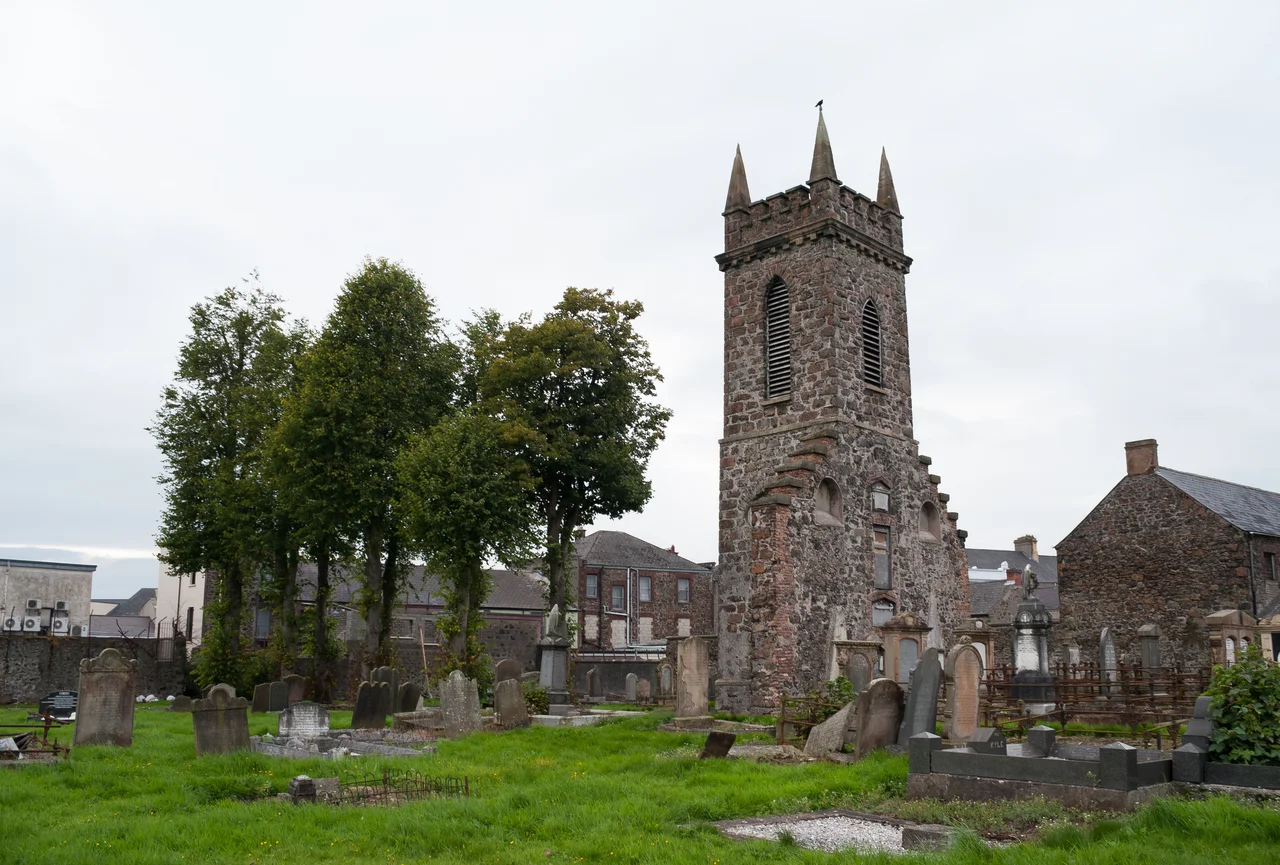

Ballymena
Liam Neeson grew up here. So did James McHenry, who signed the United States Constitution. So did Timothy Eaton, who built Canada's largest department store. So did Mary Peters, who won pentathlon gold for Great Britain at the Munich Olympics. The town's name, An Baile Meánach, means "the middle townland." Ballymena is the seventh largest town in Northern Ireland, with 31,205 people at the 2021 census, and the geographical centre of County Antrim. It is also a town that has been described - by some of its own observers - as the heart of Northern Ireland's Bible Belt. In June 2025 it was the town where the worst anti-immigrant rioting in Northern Ireland in decades began. Like a lot of places, Ballymena is more than one thing.
Edward Bruce at Connor
Recorded history here begins in the Early Christian period - ringforts in the townland of Ballykeel, a souterrain found in Kirkinriola two miles north, and a seventh-century inscribed stone unearthed by a gravedigger in 1868 that now stands in the porch of St Patrick's Church of Ireland. Vikings burned the church at Connor in 831. In the late twelfth century, the Anglo-Normans built a motte-and-bailey fort at what is now Harryville, one of the best surviving examples in Northern Ireland. Then, in 1315, Edward Bruce - brother of Robert the Bruce, the Scottish king - invaded the Earldom of Ulster to open a second front against the English. On 10 September 1315, at the Battle of Connor near Ballymena, Bruce's army defeated the Anglo-Norman forces of Richard de Burgh, the Earl of Ulster. The Bruce campaign collapsed three years later at Faughart, but the battle near Ballymena belonged to one of the strangest sustained attempts to flip the politics of the Irish Sea.
Charles I, William Adair, and a Saturday Market
On 10 May 1607, during the Plantation of Ulster, King James I granted the Ballymena Estate to the native Irish chief Ruairí Óg MacQuillan. The estate passed through several hands until William Adair, a Scottish laird from Kinhilt in southwestern Scotland, came into possession. He briefly renamed the place "Kinhilstown" after his Scottish lands. The original castle of Ballymena was built in the early seventeenth century, on an ancient ford on the River Braid. In 1626, Charles I confirmed the grant of the estate to William Adair and granted him the right to hold a Saturday market in Ballymena. Adair hired local Irish workers as tenant farmers; they served as tenants for the next two centuries. Galgorm Castle, built nearby by Sir Faithful Fortescue in 1618, still stands. The original Ballymena Castle did not - it burned down in 1740. In 1690, during the Williamite-Jacobite War, the Williamite general the Duke of Württemberg used Galgorm as his headquarters. Sir Robert Adair raised a Regiment of Foot for King William III and fought at the Battle of the Boyne. Ballymena's first market hall went up in 1684. The Gracehill Moravian settlement was founded nearby in 1765. In 1798, ten thousand United Irishmen occupied the town for three days during the rebellion and stormed the market hall, killing three of its defenders.
The Bible Belt and the Troubles
Ballymena has long had a Protestant majority. The 2021 census showed 59.5 percent of residents from a Protestant or other Christian background, 27.4 percent from a Catholic background. Some observers have called it Northern Ireland's Bible Belt. In the early 1990s, the Democratic Unionist Party-dominated council banned a performance by ELO Part II, citing "the four Ds - Drink, Drugs, Devil and Debauchery." The council also banned the screening of Brokeback Mountain in 2005, and an impersonator of the comedian Roy 'Chubby' Brown. Ian Paisley, the firebrand preacher and politician who founded the Free Presbyterian Church and served as First Minister of Northern Ireland, was made a freeman of Ballymena in December 2004. Liam Neeson received the freedom of the borough in January 2013. During the Troubles, the town lost eleven people to killings by the IRA and various loyalist groups. The conflict mostly happened elsewhere, but it touched Ballymena.
When the Factories Left
Ballymena was traditionally a market town, then in the twentieth century it became a manufacturing centre. Michelin opened in Broughshane. JTI Gallaher ran a tobacco plant at Galgorm. Wrightbus, the local bus manufacturer, employed thousands. The 1980s brought the first wave of job losses. In November 2012, the Patton Group, a major builder, went into administration with 320 jobs gone. JTI Gallaher closed in October 2014 with the loss of 877 jobs. Michelin announced in November 2015 that it would close after fifty years in Ballymena, costing up to 850 jobs. Wrightbus has struggled. The hope is that a manufacturing hub on the old Michelin site will bring new businesses; the reality has been a town adjusting, sometimes painfully, to what the deindustrial age has done to small-city economies all over the United Kingdom. Ballymena bid for city status as part of the Platinum Jubilee Civic Honours and was unsuccessful.
June 2025
On 7 June 2025, a teenage girl was allegedly sexually assaulted on Clonavon Terrace in Ballymena. Two Romanian-speaking Roma boys, aged fourteen, were charged with attempted rape. (The charges were dropped in November 2025 after new evidence meant the case no longer met the threshold for prosecution.) On the evening of 9 June, a peaceful vigil was overtaken by rioters. Properties were attacked, petrol bombs thrown, a Filipino neighbour's car flipped and burned. Of the 1,200 Roma residents of Ballymena before the riots, an estimated two thirds had left by the end of two weeks of disorder that spread to Larne, Portadown, Coleraine, and other towns. The town that is the geographical centre of County Antrim, whose name means the middle townland, that produced a star of Hollywood and a signatory of a constitution and an Olympic gold medallist, has work to do to be honest about what happened on its streets in June 2025. That work has not finished.
From the Air
Ballymena sits at 54.86°N, 6.27°W in central County Antrim, on the Braid River. From altitude, look for the town in the inland centre of the county, with Slemish Mountain visible to the east. Nearest airport is Belfast International (EGAA), about 18 nautical miles south. The town is on the main Belfast-Derry railway line.
Nearby Stories
- Groomsport 0.5 km away
- Fair Head 2.9 km away
- Crumlin, County Antrim 7.3 km away
- Northern Ireland 7.7 km away
- County Londonderry 11 km away
- Greencastle Lifeboat Station 17 km away
- Beaufort's Dyke 21 km away
- Campbeltown 25 km away