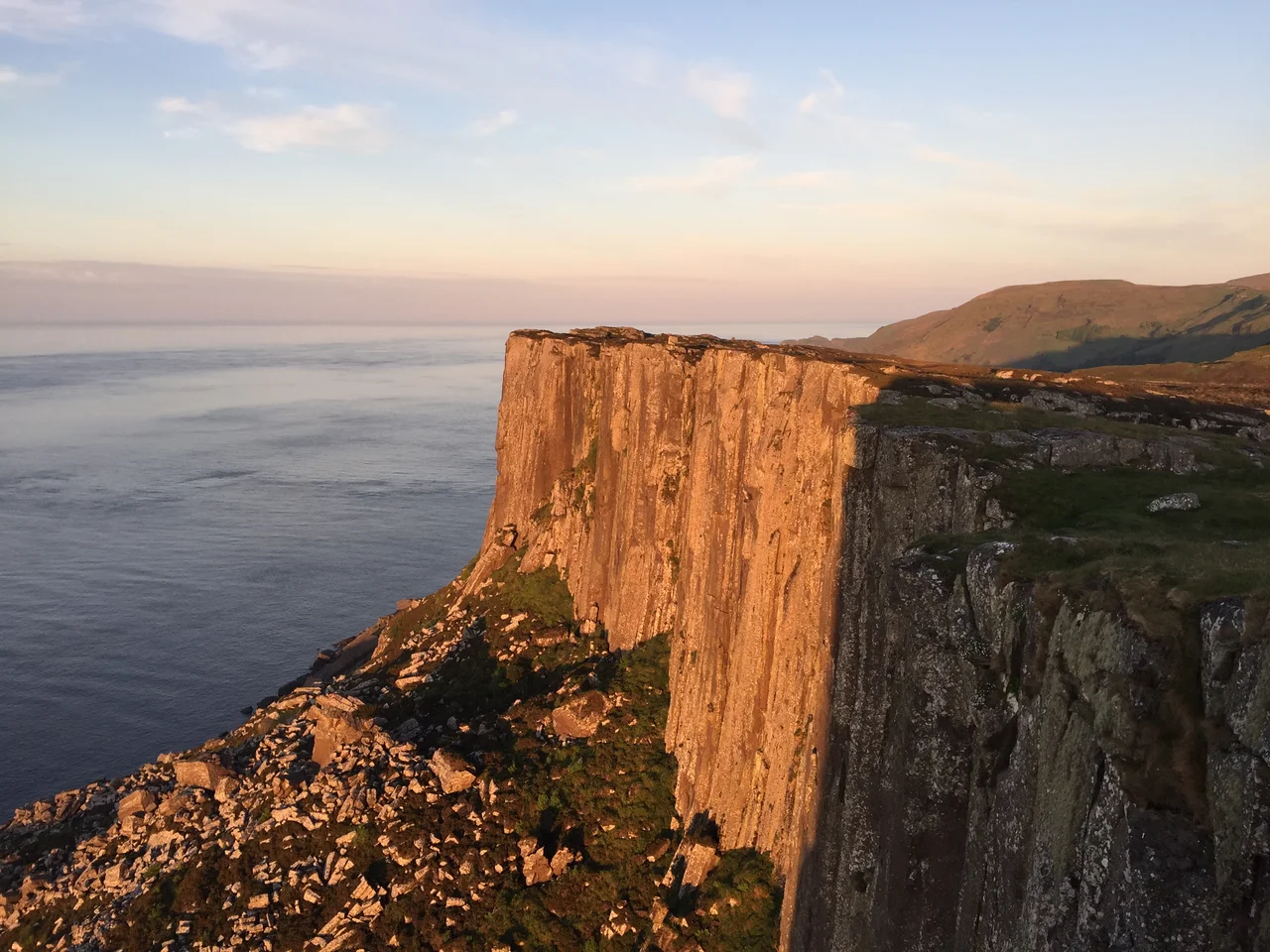

Fair Head
The Irish name is Benmore, the Great Cliff, and the great cliff is exactly what it is. Three miles of vertical dolerite, rising in cyclopean organ-pipe columns up to 300 feet above the boulder slope at its foot. From the climbers' lake at the top of the headland, the rim drops away in a hard black line. From sea level on the right day, the whole face stands silhouetted against the sky like a wall the giants of Irish myth might actually have built. Climbers who have climbed everywhere will tell you, with no irony, that there is nothing else quite like it. Belgian climbing magazine Climbing once ranked one Fair Head route in its top-five hardest E6 climbs in the world. British boulderer Dan Turner has called the bouldering here 'Britain's answer to Magic Wood in Switzerland'.
A Sill From the Birth of the Atlantic
Fair Head's columns are not basalt like the Giant's Causeway a few miles west. They are dolerite, a coarser-grained relative of basalt, and they form what geologists call a sill: a tabular sheet of molten rock that was injected horizontally between layers of older sedimentary rock and then cooled in place. The injection happened about sixty million years ago, in the Palaeogene era, when the North Atlantic was tearing open and the volcanic province that gave us the Giant's Causeway, Mull, and the Inner Hebrides was at its most violent. As the dolerite cooled, it cracked into hexagonal and pentagonal columns, the same physics that produced the Causeway, but here the columns are vertical, fifty to a hundred metres tall, and they form not steps but a wall.
Trad-Climbing Religion
To climbers, Fair Head is one of the great trad-climbing destinations of the world. 'Trad' means traditional: no pre-set bolts, no fixed protection, only what the climber places into cracks as they ascend, and removes after themselves. Fair Head's routes average over fifty metres, with many running up to a hundred. The cracks are perfectly proportioned for hand-jamming - inserting a clenched fist or open hand into the crack and using it as a wedge - and the friction is so aggressive that climbers tape their hands to prevent what is locally called Fair Head rash. The whole cliff is divided into named sectors. An Bealach Runda. Grey Man's Path. The Prow. Marconi's Cove. The Big Skin. Some sections are reached only by an intimidating ninety-metre abseil from in-situ stakes at the top. Once you are on the wall, there is no going back unless you climb.
The Climbing Meet
Every year, on the first weekend of June, Mountaineering Ireland organises the Fair Head Climbing Meet. Climbers from across the British Isles and well beyond camp at the headland, climb together, and share the queue for the better-known routes. The American climber Alex Honnold, of Free Solo fame, came to Fair Head in June 2016 and flashed a route called The Dark Side at the E8 6c grade - a first-attempt ascent of one of the hardest routes on the wall. Local hero Ricky Bell, in 2015, free-soloed Long Runs the Fox at E9 6c in Murlough Bay, climbing without ropes the kind of route most climbers would not attempt with full protection. The combination of route quality, scale, and steep crack climbing has earned the headland a global reputation that the surrounding villages of north Antrim are only beginning to register.
Goats and a Crannog
If you visit Fair Head and never see a climber, the headland still rewards the trip. The McBride family farm has worked this land for over three centuries and gives access to walkers. The plateau on top is open moorland scattered with small lakes. In one of those lakes, the largest of them, sits a man-made island - an Iron Age crannog, built up from stones thousands of years ago and used as a defensible dwelling. Wild goats with shaggy white coats graze the cliff edges and occasionally pose for photographs against the basalt of Rathlin Island in the background. Murlough Bay, just east of the main cliffs, is a steep wooded gorge running down to the sea, with a small road that ends at a stone-built nineteenth-century cottage and one of the loneliest beaches in Northern Ireland.
On Screen Again
Like much of the Antrim coast, Fair Head has had its turn in Game of Thrones. Two episodes of Season 7, The Queen's Justice and Eastwatch, used the headland as a location, the dolerite face standing in for various fictional cliffs of Westeros. The film crews come, the cameras roll, and the headland goes about its business. Climbers continue working out new routes. Goats continue cropping the heather. Most days you can stand on the clifftop and hear only the wind, the sea below, and - if you are lucky - the distant calling of a peregrine falcon, the fastest bird in the world, riding the updraft from the columns down to the boulder field. From the top edge, looking out, Rathlin Island sits clear in the middle distance, the Mull of Kintyre stretches across the channel to the northeast, and on a still afternoon you understand why the old Irish called this place the Great Cliff.
From the Air
Fair Head's summit sits at 55.221 N, 6.154 W, at an elevation of roughly 196 metres / 643 feet. The cliffs drop more or less vertically from the plateau edge for about 90 metres / 300 feet. Best viewed from 2,000 to 3,500 feet, where the wall of columns reads clearly against the sea below and the headland's triangular shape stands out from the rest of the coast. From above, look for Murlough Bay to the east, Ballycastle Bay to the west, Rathlin Island sitting six miles north, and the Mull of Kintyre 13 nm northeast. Nearest airports: City of Derry (EGAE) about 32 nm west, Belfast International (EGAA) about 42 nm south. Caution: sheer cliffs and the kind of updrafts that fascinate peregrines and unsettle small aircraft - maintain a wide buffer.
Nearby Stories
- Dunyvaig Castle 9.8 km away
- North West 200 10 km away
- Glenarm Castle 14 km away
- County Londonderry 16 km away
- Campbeltown 16 km away
- Isle of Arran 25 km away
- Beaufort's Dyke 29 km away
- German submarine U-155 (1941) 61 km away