
Mornington
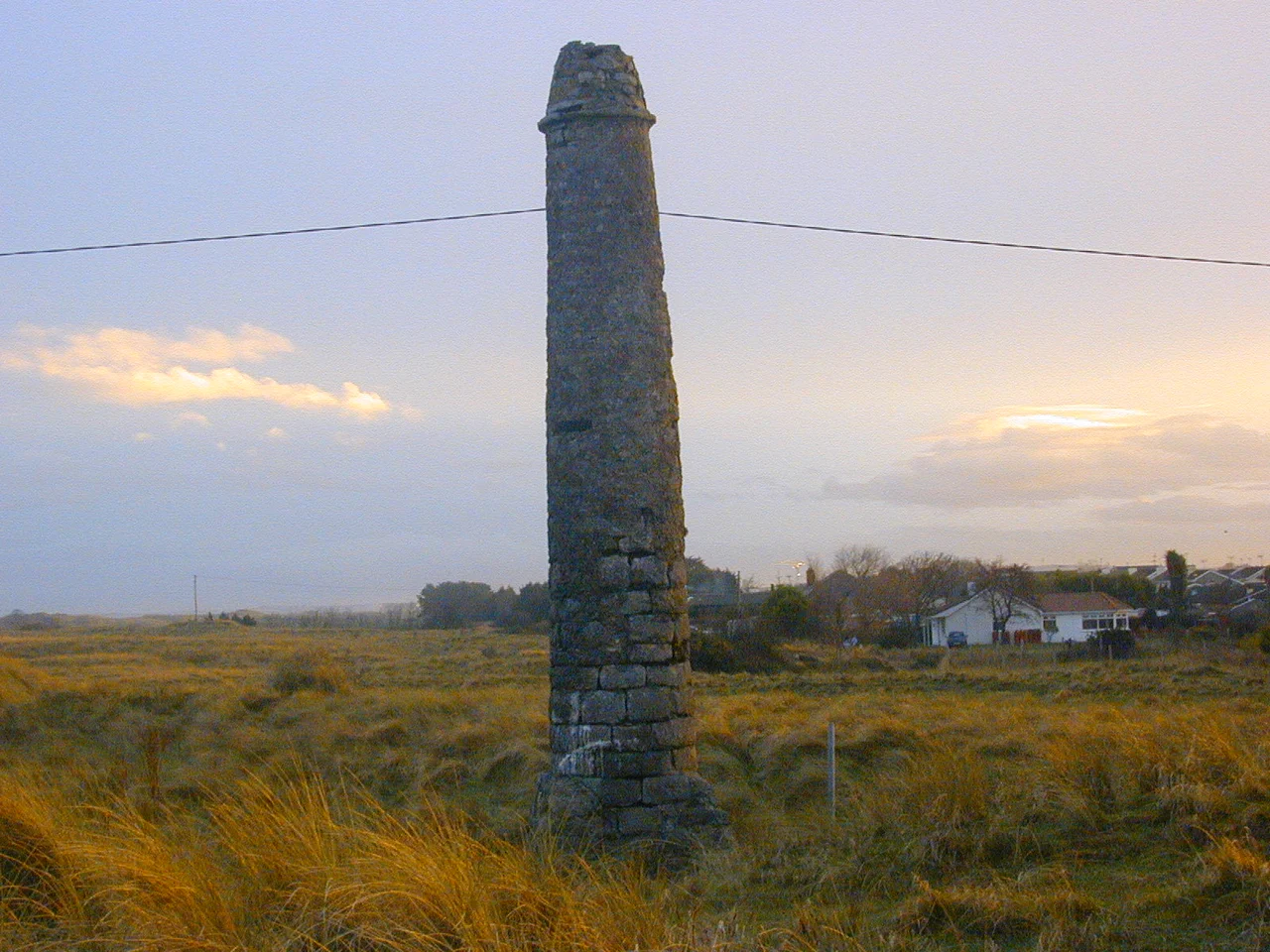
On the south bank of the Boyne, where the river finally meets the Irish Sea, two strange stone shapes have watched the water for four centuries. One is the Maiden Tower, a square sixty-foot watchtower with a spiral staircase tapering to its parapet, built during the reign of Elizabeth I. The other is the Lady's Finger, a stone pillar a short distance away. They were navigation marks: a ship approaching the river mouth knew it was safely lined up with the channel when the Finger disappeared behind the Tower. They worked beautifully. They also accumulated stories. The tower is named, by tradition, for the Virgin Queen herself.
The Mouth of the Boyne
Mornington sits at the river-mouth that the early Irish called Inber Colpa - the estuary of Colpa. In the foundation myth of the Milesians, the legendary first Gaelic ancestors of the Irish, Colpa son of Mil Espaine drowned trying to land here. His brother Eremon made it ashore, and went on to become one of the first High Kings. According to a second tradition told in the Dindshenchas, the great mythical creature Mata was killed by the Dagda atop Newgrange, and parts of its body thrown into the Boyne; the calf or shinbone - colptha - washed downstream and gave Inber Colptha its name. St Patrick is said to have landed here too, walking up the Boyne to begin his Irish mission at Slane. By the 9th century the estuary was being called Inber na mBarc - Estuary of the Ships - because of the Viking fleet of sixty boats that used it as a base for raids into Brega.
The Maiden Tower and the Lady's Finger
The Maiden Tower was certainly standing by 1582, when Dublin Corporation proposed building "a tower of such height and strength as shall be of a perpetual continuance like the tower at Drogheda" at Ringsend. The name's link to Elizabeth I - the Virgin Queen - was already considered conjectural when Sir William Wilde wrote The Beauties of the Boyne in 1849. It probably also served as a lookout during the Elizabethan wars with Spain, watching the eastern approaches for the kind of fleet that never came. The local folk story tells that a faithful wife waited at the top for her husband's ship to return. When his vessel hoisted what she believed was the death flag - actually a signal misread - she threw herself from the tower. The husband, who was alive, raised the Lady's Finger in her memory. The story echoes the Greek myth of Aegeus and Theseus down to its smallest details, which suggests it travelled here through the medieval imagination rather than from any specific local event.
The Fishermen's River
Mornington was a fishing village for at least eight centuries. The Boyne fishery - salmon nets and mussel beds - was the lord's fishery from Stuart times, granted by James I to George Carew in 1603 and then folded into Drogheda's town charter in 1609. Salmon were taken by draft nets worked by two-man teams: one man on shore holding a rope, one rowing out with the net stretched between them, then both hauling the catch ashore. The boats had a special stern platform built to hold the nets. Mussel dredging used a punt-like canoe and a long-handled rake, in a technique borrowed from the River Conwy in Wales. The mussel fishery ran every winter from October to April. Both fisheries were suspended in 2006 - draft net salmon fishing because spawning numbers had collapsed, mussel beds because the river channel needed dredging. Of fifty licensed salmon fishermen in 2006, only fourteen remained on, working with Inland Fisheries Ireland to tag and release fish for scientific monitoring.
Robert the Mariner
The village name comes from a 12th-century Norman called Robert le Mariner. By 1182 Hugh de Lacy, Lord of Meath, had granted the tithes of Robert's land to the Augustinian abbey at Colpe, and Mornington was on the medieval record as Villa Roberti Marinarii, Villa Marinarii, and eventually plain Mariners or Mornington. Robert died without heirs before 1234. Walter de Lacy granted the lands held by his widow Christiana to the Cistercian Abbey of St Mary of Furness in England. The little borough never grew large. By 1235 a single burgage in the vill included a church, a stone tower, a mill, and some houses. The Henry Draycott family acquired the estate at the Dissolution of the Monasteries in 1536. Then in the 18th century the Wesley - later Wellesley - family inherited the estate. Richard Wesley was created 1st Baron Mornington in 1746. His son Garret became the 1st Earl of Mornington. Garret's third son, Arthur Wellesley, became the 1st Duke of Wellington.
The Earl's Long Shadow
The title Earl of Mornington became one of the most prominent in the British peerage. Mornington is now a courtesy title held by Arthur Darcy Wellesley, born 2010, eldest son of the Marquess of Douro and heir to the Wellington dukedom. The 2nd Earl of Mornington - the Duke of Wellington's elder brother Richard, Governor-General of India - gave his name to dozens of places around the world: Mornington Peninsula in Victoria, Mornington Island in Queensland, Mornington Crescent in Camden in London, and the surreal Mornington Crescent radio game on I'm Sorry I Haven't a Clue. The famous jockey Herbert Mornington Cannon was named for a horse called Mornington that his father rode to victory at Bath on the day Herbert was born in 1873. The little Meath village of fishermen and rabbit-warrens, which never had more than a few hundred residents until the housing boom of the 2000s, gave its name to landscapes a world away. The combined urban area of Laytown-Bettystown-Mornington-Donacarney had 15,642 residents in the 2022 census - the largest it has ever been.
From the Air
Mornington sits at 53.72 N, 6.27 W on the south bank of the River Boyne, immediately at the river-mouth, in County Meath. From the air the broad Boyne estuary opens to the Irish Sea, with Mornington's Maiden Tower visible on the south shore and the deepwater port of Drogheda 5 km upstream to the west. Dublin Airport (EIDW) is about 35 km south; Belfast (EGAA) lies roughly 100 km north. The M1 motorway runs 4 km west, crossing the Boyne on the Mary McAleese Boyne Valley Bridge. The wide sandy beach of Mornington Strand stretches south toward Bettystown and Laytown. Best appreciated at lower altitude in clear weather.
Nearby Stories
- St Doulagh's Church 3 km away
- Carlingford 9 km away
- Abbey of Kells 13 km away
- German submarine U-1051 17 km away
- Castleblayney 18 km away
- Irish Military Intelligence Service 29 km away
- Ardglass 32 km away
- Minesto 57 km away