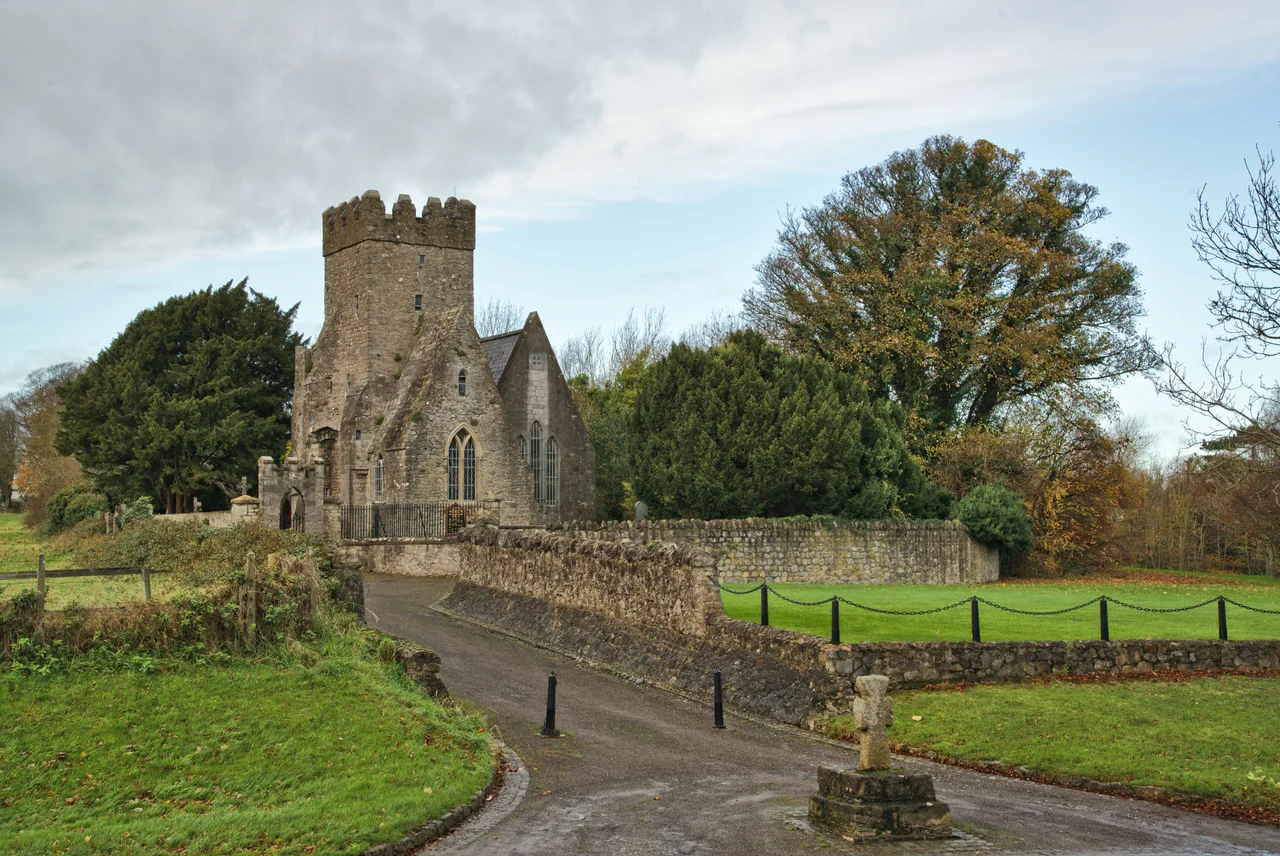

St Doulagh's Church
There is a low window on the south wall of St Doulagh's Church where, tradition says, the hermit placed his plate every morning in the hope that someone would leave him food. The man himself lived in a cell attached to the church and rarely emerged. We do not know what he looked like, what he ate, or exactly when he lived - all we know is that he was here in the early seventh century, and that he was an anchorite, and that the church that took his name and the holy well beside it are still in active Christian use fourteen hundred years later. St Doulagh's is the oldest stone-roofed church still in use in Ireland.
The Hermit on the Hill
Very little is known of Doulagh. The Martyrology of Donegal places him in the lineage of Conmac son of Fergus; the Martyrology of Oengus, written in the ninth century, calls his church Duilech Cain Clochair - 'fair Duilech of Clochar.' The 1859 scholar William Reeves, working back through the genealogies, dated him to roughly the year 600. He lived as a hermit, in a cell attached to the church, with only minimal contact with the outside world. Anchoritism - the discipline of voluntary enclosure - was a feature of Celtic Christianity. It is one of several echoes between early Irish Christianity and the Eastern desert tradition that has long puzzled and delighted historians. Doulagh's feast day is November 17, the day pilgrims still gather at the open-air pool beside the well outside his church.
Stone Roof, Stone Bones
The main historic building is 48 feet by 18 feet - a stone box with a wedge-shaped double roof of rough stone, the space between the two roof skins still usable. Halfway along the roof a small stone tower rises. The construction technique is Irish - heavy walls, stone vaulted ceiling, then a stone outer roof over the vault to shed water. Almost every other medieval Irish church with a stone roof has either collapsed or been roofless for centuries. St Doulagh's has kept its roof in some form since the twelfth century. The earliest part, called the Oratory, has a Romanesque window dated by the historian Peter Harbison to about 1230. A small square hole in the southeast corner, beside where the altar would have stood, was a viewing slot for lepers who were not permitted inside. A blocked-up arcade in the western wall hints at a vanished aisle once added to seat overflow crowds.
Ireland's Only Detached Baptistry
A few yards from the church, in a sunken stone enclosure, stands a low octagonal building over the spring known as St Doulagh's Well. It is believed to be a baptistry - the only freestanding example of one anywhere in Ireland. Beside it sits an open-air pool with stone seating, very likely used for adult immersion. In 1609 a resident of the now-vanished village of Feltrim repaired the baptistry and commissioned fresco paintings on its interior walls - St Patrick, St Doulagh himself, St Bridget, St Columcille, and others. After the Battle of the Boyne in 1690, soldiers under Sir Richard Bulkeley of Dunlavin defaced the frescoes. Fragments still survive. A short walk further sits a small rectangular stone building over a second pool - St Catherine's Pond, connected to St Doulagh's Well by an underground channel. A single spring feeds both.
Ruin, Rebuild, Repeat
The church was already old when the Norman conquest reached the Pale. In 1406 the Archbishop of Armagh granted indulgences to anyone who visited St Doulagh's, confessed to the resident chaplain Eustace Roche, and paid a donation - the money probably funded the tower house that still stands at one end of the building. In 1506 John Burnell of Balgriffin endowed a chantry for masses to be said for him in the church, and was probably the man whose late-medieval burial was uncovered under the north wall during 1987 excavations. After the Reformation the parish became Church of Ireland; the Catholic majority worshipped elsewhere. By 1630 the building was in ruins. The Civil Survey of 1654-56 found only three small thatched houses and the wall of a decayed chapel on the site - the stone roof must have collapsed. Rebuilding came after 1656. Many of the surviving windows, including low-set ones thought to have served as defensive gun ports during the Cromwellian wars, date from this rebuilding. A Victorian extension was added in 1864 and consecrated in 1865, and a state-funded restoration in 1991 finally stabilised the whole complex.
Still in Use
St Doulagh's is today part of the Church of Ireland 'United Parishes of Malahide, Portmarnock and St Doulagh's.' Services are still held. The graveyard outside has no published excavations to date its earliest graves, though the curved ditch to the north of the site - probably dating to the sixth or seventh century - suggests Christian burial has been happening on this hill for fifteen hundred years. The cross of non-local granite at the entrance is medieval. The small bell still rings before services. Modern Balgriffin has grown around the church, and the M50 motorway hums two kilometres away, but the squat dark roofline of the church under its stone vault looks almost exactly as it must have looked when Norman knights from Dublin Castle first rode out to see what the locals were calling Clochar - the stone place. A hermit's church without the hermit, his well still flowing, his door still open.
From the Air
St Doulagh's Church stands at 53.42°N, 6.18°W in Balgriffin, north Dublin, about 10 km north of Dublin city centre and just south of the M50 motorway. From altitude it is a small dark roofline in surviving fields surrounded by newer suburban development, with Dublin Airport (EIDW) immediately to the northwest (4 km) - this is one of the closest historic sites to the airport. Howth Head rises as a recognisable rocky peninsula to the east.
Nearby Stories
- Wicklow Mountains 12 km away
- Mornington 14 km away
- German submarine U-1051 16 km away
- Abbey of Kells 18 km away
- Irish Military Intelligence Service 20 km away
- HMS Manners (K568) 37 km away
- Templemore 42 km away
- Irish Sea Bridge 43 km away