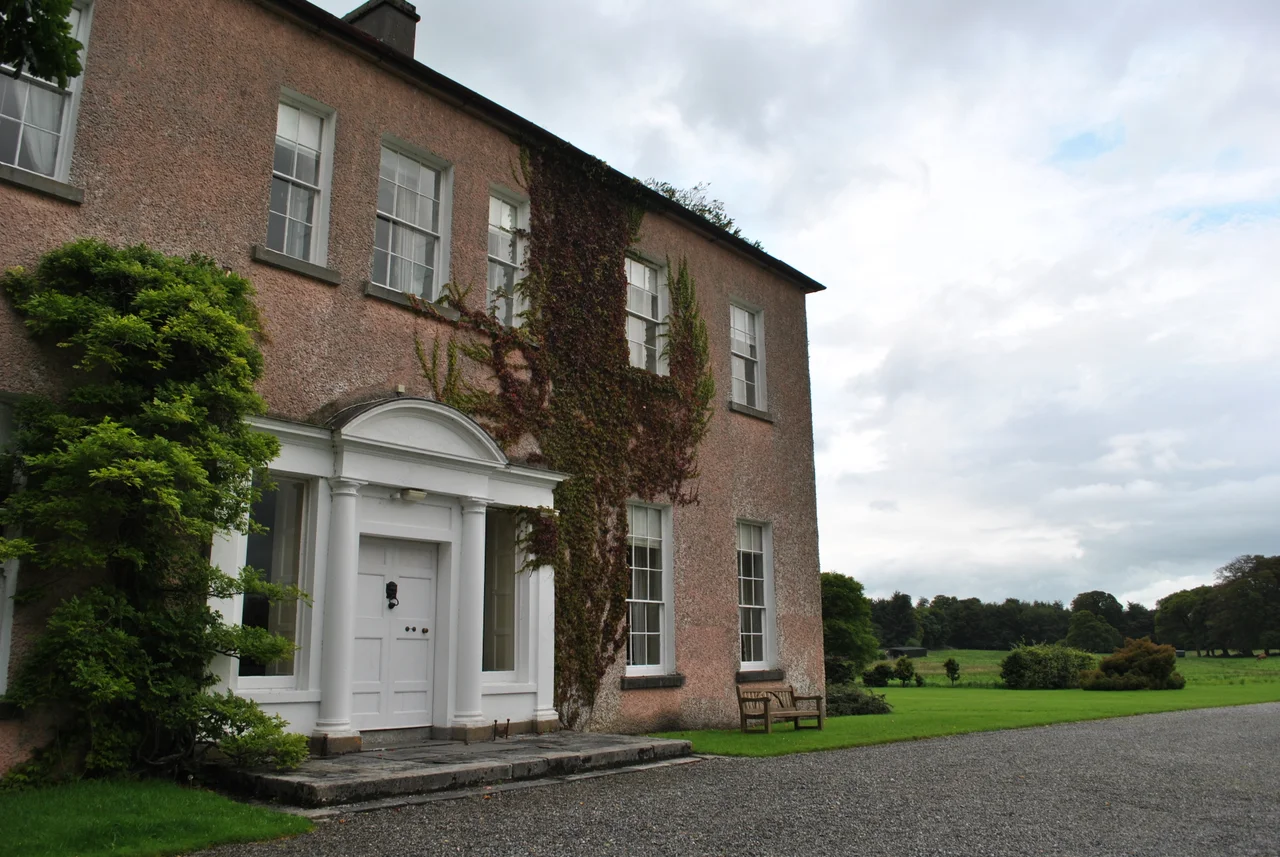

Cabra Castle
Around 1810, the Foster family decided to build themselves a grand new country house outside Kingscourt in County Cavan. They commissioned a building in mixed neo-Norman and Gothick style, with battlemented towers outside and pointed-arch interiors inside. They called it Cormey Castle, after the local townland. It nearly ruined them. By 1813, before they had really finished moving in, the Fosters were so broke that they sold the whole thing to their wealthier neighbours across the road, the Pratts. The Pratts moved in, eventually renamed the place Cabra Castle, and held it for the next 151 years. The Fosters' folly is now a four-star hotel.
Two Houses Called Cabra
The name confuses people. Cabra is a townland just north of Kingscourt, and there have been two different country houses associated with it. The earlier was Cabra House, sometimes called Cabra Castle, which the Pratt family had built on the Cabra Estate after acquiring the land in 1699. Its ruins still stand on a slight rise near a wishing well, in what is now Dun a Ri Forest Park, owned by Coillte. The other castle - the one that still stands and is now a hotel - was built across the road by the Foster family in the first decade of the nineteenth century and originally called Cormey Castle. After the Pratts bought it in 1813, they let the old Cabra House fall into ruin and around 1820 renamed Cormey Castle as Cabra Castle. The original Cabra became a folly in a forest. The new Cabra became a working country house. Two castles, one name, one switch.
Neo-Norman with a Gothick Inside
Architecturally, what stands today is an early example of the Gothic Revival in Ireland, built before the more austere mid-Victorian neo-Gothic of churches and railway stations. The exterior is heavy neo-Norman - battlemented towers, round-arched doorways, the visual vocabulary of medieval castles dressed onto a Regency country house. The interior is Gothick - that earlier, more whimsical eighteenth-century version of medieval revival, with pointed-arch fireplaces and elaborate plaster vaulting that no one in the actual Middle Ages would have recognised. The result was theatrical, expensive, and absolutely characteristic of the Ascendancy taste of the time - the Protestant landlord class of Ireland, fond of building dramatic homes that announced their permanence even when their fortunes were thin. The Fosters' fortunes were thin. They could not afford what they had built, and the Pratts could.
The Pratt Dynasty
The Pratts had owned the Cabra Estate since 1699 and were one of the major Anglo-Irish gentry families of Cavan. Colonel Joseph Pratt absorbed the new Cormey Castle and much of the Foster lands into his own holdings in 1813. Five generations of Pratts lived here. Major Mervyn Pratt held the estate from 1927 until his death in December 1950 - though by then the family lived mostly at Enniscoe in County Mayo, which the Pratts had owned since the 1860s. His nephew, Tan Sri Dr Mervyn Sheppard, inherited the Cavan property in 1950. Sheppard was a remarkable figure - a senior British colonial civil servant who had spent decades in Malaya, become a scholar of Malay culture, converted to Islam, and been knighted in the Malaysian honours system. He never moved back to Cavan. Running a country estate from Kuala Lumpur was impossible, and in 1964 he sold Cabra Castle to a Cavan Catholic family, the Brennans. The era of the Anglo-Irish landlord in this corner of Ulster ended quietly with a paperwork transfer.
The Brennans and the Sheikh
The Brennan family did what many Irish families did with their newly-acquired big houses: they turned it into a hotel. Cabra Castle opened to guests in the late 1960s, and for nearly twenty years the Brennans ran it. In 1986 they sold to a Mr Mansour - a senior politician and businessman from Abu Dhabi, the wealthiest emirate of the United Arab Emirates. Mansour intended to restore the castle to use as a private residence and closed the hotel. He never got round to either restoring it or living in it. For five years, Cabra Castle stood empty under absentee ownership, the Gothick rooms locked, the gardens going to weeds. In 1991, Mansour sold it to the Corscadden family, hoteliers, who restored the building and reopened it as a four-star hotel in the early 1990s. The Corscaddens still own it. About 100 acres of demesne remain as parkland around the castle.
Dun a Ri
The original Pratt house - the older Cabra House - is now a ruin in Dun a Ri Forest Park, just across the R179 from the hotel. Dun a Ri means king's fort, after a nearby Iron Age earthwork. The forest park is one of the prettier walks in Ulster, with a wishing well, a fairy glen, a chain-suspended bridge over a stream, and the rough stone foundations of the old Cabra House visible on a slight rise. Coillte, the state forestry company, took the land in the twentieth century when the Pratts gradually divested. The wishing well still has coins in it. Hotel guests at modern Cabra Castle can walk over to see the ruin of the place the castle was named after - a 19th-century landlord ruin overlaid on an 18th-century manor that was abandoned when the new one across the road took its place. The country survives the families that built across it.
From the Air
Cabra Castle is at 53.91 degrees north, 6.77 degrees west, just north of Kingscourt in County Cavan, near the borders of Cavan, Monaghan, and Meath. Nearest airport is Dublin (EIDW) about 55 miles south. From 2,000-3,000 feet in clear weather, the castle and its 100-acre demesne show up as a wooded estate on the north side of Kingscourt, with Dun a Ri Forest Park visible on the opposite side of the R179 road. The wider Cavan landscape is characterised by drumlins - small egg-shaped hills left by glaciers - giving the country a softly rolling, almost quilted appearance from above. Best aerial visibility in spring; expect frequent cloud and showers.
Nearby Stories
- Crom Castle 5.3 km away
- Tristernagh Abbey 6.6 km away
- Trim Castle 7.9 km away
- Annaglogh Lead Mines 8 km away
- Balbriggan 9.6 km away
- Miami Showband killings 13 km away
- Mornington 18 km away
- Killeshandra 18 km away