
Bailieborough Castle
In 1610, King James VI and I gave a Scottish undertaker named William Bailie a stretch of east Breffnie on the condition that he build a fortified house, enclose a demesne, and settle the land with English or Scottish families. Bailie did all of it by 1629. Three centuries later, in 1918, the house he had built burned to the ground while it was being used as a school by the Marist Brothers. What stands now is a 3-kilometre walking loop around Castle Lake, a small graveyard for the Marist Brothers in the woods, and the outline of an estate that has had ten owners in 400 years.
Plantation
William Bailie was an undertaker in the technical sense - one of the Scottish and English landowners who undertook to the Crown to plant Protestant settlers on confiscated Irish land. His grant in 1610 was part of the Plantation of Ulster, the most systematic colonisation project in Irish history, which followed the Flight of the Earls and the breaking of Gaelic Ulster. The conditions were strict: build a stone house within a fixed time, enclose a demesne, and bring over a quota of British tenants. Bailie complied, raising his fortified house and settling families on the land by 1629. The Irish, dispossessed but not gone, did not accept the arrangement quietly. During the Rebellion of 1641, a troop of Irish soldiers under Colonel Hugh O'Reilly attacked the house and occupied it for a month. Bailie survived. Most planters did not - the rebellion killed thousands of Ulster settlers in its first weeks. The house was Bailie's and the Bailies kept it.
The Hamiltons and Stewarts
William Bailie died around 1648 and the estate passed to his son, also William, who was Church of Ireland Bishop of Clonfert and Kilmacduagh. When the Bishop died in 1664, the estate went to his only daughter Jane, who had married James Hamilton. Hamiltons held it for two generations - until Henry Hamilton, MP for County Cavan, was killed at the Siege of Limerick in 1690 during the Jacobite war, fighting on the Williamite side. His son James Hamilton sold the property in 1724 to Major Charles Stewart and left the area. The Stewarts kept it for three more generations of High Sheriffs and MPs for Cavan, ending with another Charles Stewart, killed in an accident in 1795. His nephew Thomas Charles Stewart Corry sold it to Colonel William Young in 1814 - and that purchase changed the whole place.
Lord Lisgar
Colonel William Young came from Loughgall in Armagh and brought ambition. He laid out the town of Bailieborough in its present location, with neat parallel streets and a market square, replacing the older settlement. In 1821 he was made the first Young Baronet of Bailieborough Castle. His son Sir John Young inherited in 1848 and proceeded to one of the most remarkable careers of any Irish landlord of the period. He was Chief Secretary for Ireland - the senior British government official in the country - and later High Commissioner of the Ionian Islands, then Governor of New South Wales, and finally from 1869 to 1872 Governor General of Canada. He was created the first Baron Lisgar in 1870. In retirement at Bailieborough he renovated the house before his death in 1876, and the place became known briefly as Lisgar House. The Lisgar name still survives in Canadian place-names: Lisgar Collegiate Institute in Ottawa, and the federal electoral district of Selkirk-Interlake-Eastman, formerly called Lisgar.
The Marists
Lady Lisgar died in 1895, and with no direct heir the estate went into the Chancery courts. Much of the land was sold to its tenants under the Land Acts that were slowly dismantling the great Anglo-Irish estates. The house itself was sold to Sir Stanley Cochrane, who passed it to his nephew, a local solicitor named W L B Cochrane. In 1910, the bulk of the remaining land was sold to the Forestry Division of the Department of Lands. In 1915, the house and the last 100 acres went to a religious order - the Marist Brothers of Athlone, a Catholic teaching congregation, who took over the property to run a boys' school. The Marist Brothers buried several of their dead in a walled enclosure in the woods - the graves are still there, on the present walking trail. Three years after the brothers moved in, in 1918, the house burned down. They rebuilt part of it and continued teaching there until 1936, when they sold what remained to the Department of Lands and left. The house was demolished soon afterwards. There is no obvious trace of it on the ground today.
The Castle Lake Loop
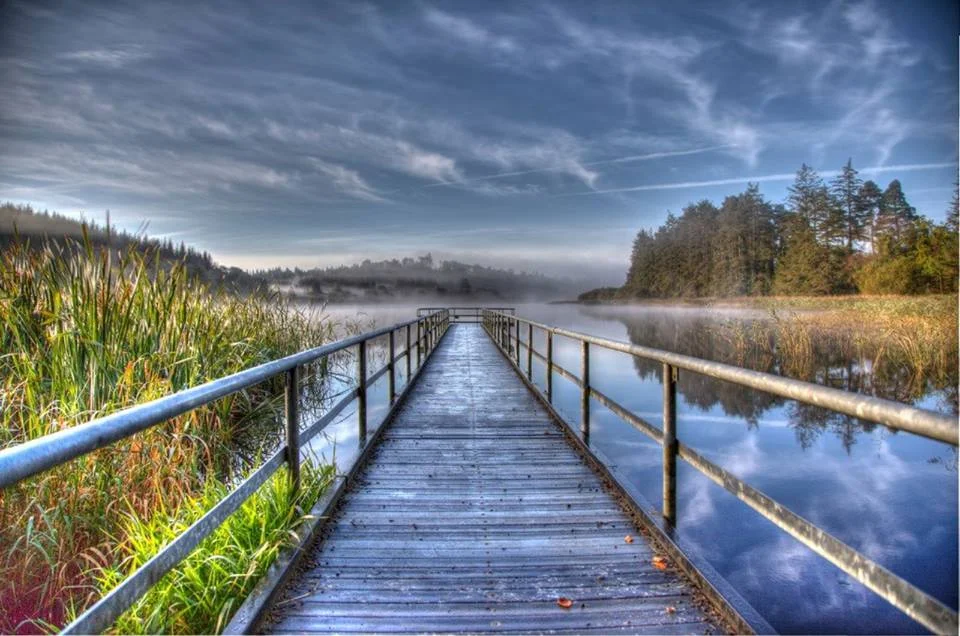
What survives is the demesne itself, now Bailieborough Demesne, a state-owned forest park on the north-western edge of the town. The 3-kilometre Castle Lake loop starts and ends at the car park on the lakeshore. It is suitable for walking or cycling, an easy circuit through mature woodland that grew up around the former gardens. The track passes the walled graveyard of the Marist Brothers - five or six headstones in a small enclosure, the inscriptions weathered but still legible. Beyond the graves, the path skirts the lake, with reeds along the edges and herons on the bank. There is no signage explaining that a 400-year sequence of Scottish planters, English bishops, Williamite MPs, baronets, peers, and Catholic teaching brothers all lived here, in turn. The lake is still here. The house is not. The forestry plantation, planted in 1910, has thickened into something that feels much older than its age.
From the Air
The Bailieborough Castle site is at 53.93 degrees north, 6.99 degrees west, in County Cavan about 55 miles northwest of Dublin and 25 miles north of Navan. Nearest airport is Dublin (EIDW) about 60 miles south; Belfast International (EGAA) is about 70 miles north. From 2,000-3,000 feet in clear weather, Castle Lake is visible on the northwest edge of the town, surrounded by Coillte forestry plantation - the lake reflects sky on bright days and shows clearly against the surrounding pasture. Best aerial visibility on spring or early summer mornings; Cavan weather is often damp and overcast.
Nearby Stories
- Crom Castle 5.3 km away
- Tristernagh Abbey 6.6 km away
- Trim Castle 7.9 km away
- Annaglogh Lead Mines 8 km away
- Balbriggan 9.6 km away
- Miami Showband killings 13 km away
- Mornington 18 km away
- Killeshandra 18 km away