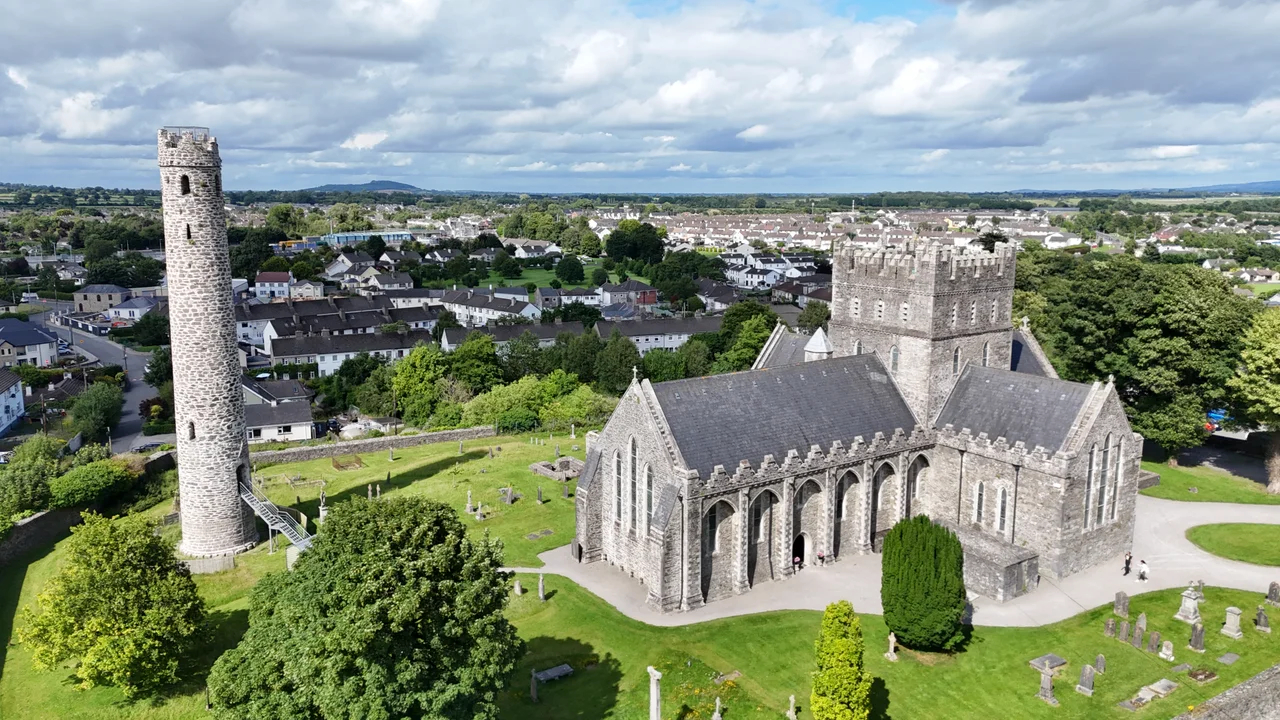

Kildare Cathedral
For centuries Kildare ran a small experiment in Irish church government: the abbess ruled, the bishop reported to her. From the time Saint Brigid arrived here around 480 AD until well into the medieval period, the cathedral at Kildare maintained a double community of women and men - and the abbess held authority over the bishop. The arrangement was unique in Ireland and barely paralleled elsewhere in Christendom. Brigid arrived just thirty-five years after Saint Patrick had settled in Armagh, and the church she founded was built on what is likely the site of a pre-Christian shrine to the goddess Brigid - the same name. The perpetual flame that burned in the cathedral grounds may have been continuous from pagan times until Henry VIII dissolved the monasteries.
Burned, Rebuilt, Burned Again
Between 835 and 998, the cathedral was devastated approximately sixteen times. Vikings raided it. Local clans raided it. Disease and famine made monasteries tempting targets. By the time the Norman Ralph of Bristol became Bishop of Kildare in 1223, the original church was effectively in ruins. Ralph began the rebuild that survives today - largely complete by 1230, in the early Gothic style with a massive square central tower. The site is cruciform in plan without aisles, and all the windows are lancet windows: singles or doubles in the walls, triples in the four gables. The parapets are of the stepped Irish type, restored over the centuries but probably datable to around 1395 - the year a Papal indulgence was issued to those who visited Kildare and gave alms for the conservation of the church.
Demise, Then Resurrection
After the 16th-century Reformation, the cathedral fell into disrepair. The Irish Confederate Wars of the 17th century left it ruined. By 1649 it was derelict. A partial rebuild followed in 1686, but by 1875 the building was barely standing. The Victorian architect George Edmund Street - who designed the Royal Courts of Justice in London - began a near-complete restoration in 1875. Work continued after his death in 1881 and was completed in 1896. Street added a new north transept, a new chancel, a new west wall, and rebuilt three sides of the square central tower. A new oak roof, supported on stone corbels, was built into the wall buttresses. The result is a Victorian-medieval hybrid: 13th-century bones with 19th-century skin.
The Sheelagh-na-gig and the Round Tower
Inside the cathedral are features that startle: an altar-tomb effigy of Bishop Walter Wellesley, who died in 1539, an example of 16th-century Irish sculpture; oak choir stalls carved with acorns and oak leaves; a stone baptismal font from the medieval period; and, unusually for a cathedral, a Sheelagh-na-gig - a small carved figure of a naked woman, a folk motif found on Irish churches that medievalists are still debating the meaning of. Beside the cathedral stands one of County Kildare's five round towers, 32 metres high and climbable at certain times. Round towers were monastic bell-towers and refuges, built in Ireland between the 9th and 12th centuries. From the top of the Kildare tower, on a clear day, you can see the Curragh plain stretching east toward the Wicklow Mountains. The west window inside the cathedral is dedicated to Saint Patrick, Saint Brigid, and Saint Columba - the three patron saints of Ireland - and the Czech artist Gerda Schurmann's 1974 stained-glass window of Saint Luke is one of the more striking modern additions to a building that has been adding and subtracting itself for sixteen hundred years.
From the Air
Kildare Cathedral sits at 53.16N, 6.91W in the centre of Kildare town. Cruise 2,000-3,000 ft to take in the Curragh plain immediately to the east and the M7 motorway. The round tower is the most prominent visual landmark - 32 metres high, visible from several kilometres away across the flat plain. Nearest international airport is Dublin (EIDW), about 55 km northeast. Casement Aerodrome (EIME) is closer.
Nearby Stories
- River Liffey 3.3 km away
- Swords 7.6 km away
- Avoca, County Wicklow 10 km away
- Clonard Abbey 10 km away
- County Westmeath 10 km away
- County Offaly 12 km away
- Templemore 19 km away
- Kilcooly Abbey 30 km away