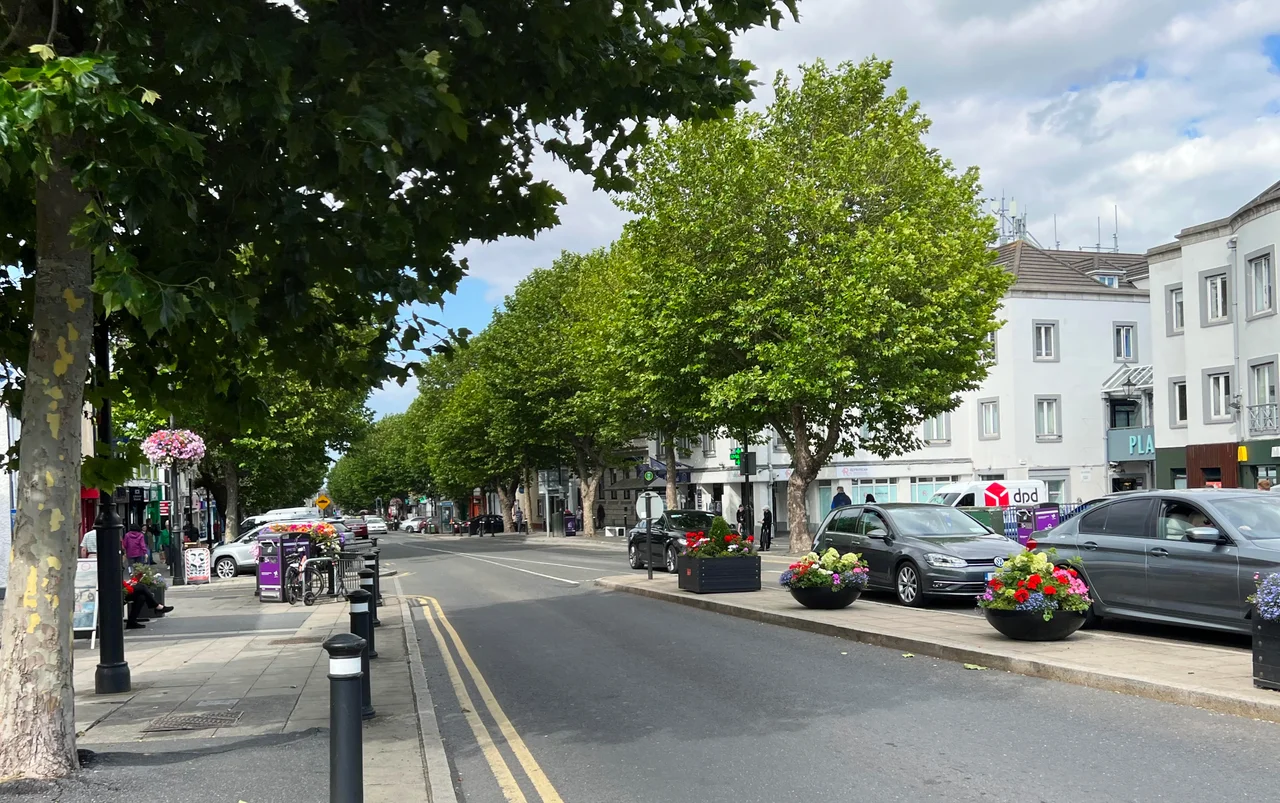

Swords
Brian Boru's body passed through Swords in 1014. The High King of Ireland had been killed in his tent at the Battle of Clontarf on Good Friday, 23 April, after his Irish forces had broken the power of the Vikings of Dublin. His body was carried north toward Armagh for burial, and along the way it stopped at the small monastic settlement on Spittal Hill in Swords. A requiem mass was said in the church beside the round tower that still stands at the centre of town. Spittal Hill takes its name from a medieval hospital that once stood there. The round tower, 26 metres tall, is the only structure in Swords that Brian Boru's mourners would still recognise.
The Pure Well
Swords was founded, by tradition, in 560 AD by St Colmcille - Columba - the Irish prince-turned-missionary who would later sail north to found the monastery of Iona on the Scottish island of the same name. Colmcille is said to have blessed a well of clear water on what is now Well Road, and from this Irish word for clear - sord - the settlement took its name. The original ecclesiastical enclosure has shaped the street pattern of the town to this day; the curving alignment of Main Street follows what was once the outer circumference of a circular monastic enclosure. The 26-metre round tower beside St Columba's Church is the surviving remnant of that early Christian monastery. Round towers like this one served partly as bell towers, partly as refuges from Viking raiders, and partly as visible markers of important monastic foundations. About 65 of them still stand in Ireland.
The Archbishop's Castle
The medieval manor of Swords was Crown property, but it was traditionally granted to the Archbishop of Dublin for his lifetime. Swords Castle - 200 metres northeast of the old ecclesiastical site, at the northern end of Main Street - was built in the early 13th century as the archbishop's country residence. Not a defensive castle so much as a fortified manorial complex, it consisted of a curtain wall around an irregular pentagon enclosing a great hall, kitchens, a chapel, and the constable's tower. The archbishops used it as a summer retreat from Dublin until the political turmoil of the 14th century, when raids by Edward Bruce's army and the long economic decline that followed made it less useful. The castle fell into ruin and was used as a farmyard for centuries. Restoration began in the 1980s and continues today; the central tower and the curtain wall now anchor the planned Swords Cultural Quarter, where construction of a new library, art gallery, and 165-seat theatre began in February 2025.
The County Town That Was Not
Swords sent two MPs to the Irish House of Commons until the Acts of Union of 1801 disenfranchised it. The population in 1841 was 1,788. For the next century and a half it remained a quiet market village on the Dublin road. The change came in the 1970s with the construction of the Rivervalley estate - then the largest private housing development in Ireland - which began the transformation of Swords into a Dublin commuter town. In 1994, when the old County Dublin was abolished and Fingal was created as one of the three successor counties, Swords became Fingal's county town. The County Hall opened in 2001. The population reached 40,776 by the 2022 census, making Swords the eighth-largest urban area in Ireland. Fingal County Council has formally identified the town as an emerging city and projects that the wider Swords area may reach 100,000 residents by 2035.
Beside the Airport
Dublin Airport sits a few kilometres south of Swords, and the relationship between the two has shaped both. The airport prevents the town from sprawling southward; the Broadmeadow Estuary blocks expansion to the east. Many residents work at the airport or in the business parks along the R132 dual carriageway - Balheary, Swords Business Campus, the Airside complex. Aer Lingus, Ryanair, ASL Airlines, and CityJet are all headquartered in or near Swords. The National Museum of Ireland's Collections Resource Centre, occupying a former Motorola factory at the northern edge of town and the size of two football fields, holds the museum's storage, archive, library, and research facilities. The RNLI Ireland opened its all-Ireland headquarters at Airside Business Park in June 2006. The proposed MetroLink light rail line, in planning for decades, would finally connect Swords to Dublin city centre via the airport - possibly in operation by 2035.
Wells Beneath the Car Park
When enabling work on the new Cultural Centre began at Swords Castle in April 2023, archaeologists found two medieval wells beneath the existing car park. The wells were carefully excavated, recorded, and removed for potential display in the finished building. The find was a useful reminder of what lies underneath modern Swords: a thousand-year-old monastic site, a 13th-century archiepiscopal castle, layers of medieval workshops and burials. St Colmcille's Well is still on Well Road behind a locked door. The graveyard beside the Catholic church on Chapel Lane holds the gravestone of Andrew Kettle, the 19th-century nationalist politician known as Parnell's right-hand man. The Old Borough School building on Main Street, designed by the great Georgian architect Francis Johnston, is now a Wetherspoon pub called The Old Borough. In 2003 an IBAL litter survey called Swords the worst litter blackspot in Ireland. By 2011 it was the second cleanest town in the country. By 2019 the surveyors called it "a model for others to follow."
From the Air
Swords sits at 53.46 N, 6.22 W in the south of County Fingal, just north of Dublin Airport (EIDW). From cruising altitude the town is hard to separate from the airport complex - Dublin Airport is the dominant landmark, with Swords forming the urban cluster immediately to the north. The Broadmeadow Estuary opens to the east and is a useful coastal feature; Lambay Island lies about 12 km east. The M1 motorway runs along the eastern edge of the town toward Belfast (EGAA, 110 km north). Dublin city centre is only 10 km south. Best appreciated at moderate altitude in clear weather, when the round tower and Swords Castle can be picked out among the modern buildings.
Nearby Stories
- Carrickmines Castle 1.8 km away
- Trim Castle 8 km away
- Irish Military Intelligence Service 12 km away
- Cabra Castle 15 km away
- Athclare Castle 16 km away
- German submarine U-1051 21 km away
- Irish Sea Bridge 51 km away
- Ardglass 52 km away