
Ballymun
Between August 1966 and the end of that year, the first tenants moved into Ballymun. Seven concrete tower blocks, each fifteen storeys high - in fact sixteen plus plant rooms - rose from green fields five kilometres north of Dublin city centre. They were named for the seven signatories of the 1916 Proclamation: Pearse, Connolly, Plunkett, MacDonagh, MacDermott, Clarke, Ceannt. Nineteen eight-storey blocks and ten four-storey blocks surrounded them, all built by the National Building Agency on a timetable so accelerated that the entire estate of 3,021 dwellings was complete in three years. The first tenants had to pass an interview to get in. By 1985 the towers were synonymous with everything Irish public housing had got wrong; by 2007 they were being demolished. The story Ballymun tells is not about brutalism or modernism. It is about what happens when a country in a hurry builds homes without the shops, schools, and bus routes that turn houses into a place to live.
Why the Towers Went Up
By 1964 the Dublin Corporation had a crisis on its hands. Whole blocks of Georgian tenements in the north inner city were structurally failing - the 1963 collapse of houses on Fenian Street, killing four people, had finally forced the issue. The national government's response, championed by Fianna Fáil minister for local government Neil Blaney, was speed. Build high, build fast, build cheap, on green fields where nothing slowed the bulldozers. The 1966 fiftieth anniversary of the Easter Rising provided the naming theme. The seven tower blocks rose at a pace nothing in Irish construction had matched before. Ali Grehan, who served as Dublin's City Architect after working on the regeneration, later described the original vision as 'a really great idea' that was 'doomed to fall into decline.' The buildings themselves were not the problem. The problem was everything around them: the lifts that broke and were not repaired, the heating that failed, the shopping centre that arrived years late, the lack of social mix, the abrupt uprooting of tight tenement communities to a roundabout on the edge of the city.
Life in the Towers
The first generation of Ballymun residents arrived with hope. The flats had central heating, hot water, indoor toilets - amenities most of them had never lived with before. There were waiting lists. People interviewed for the right to move in. Then the supports that should have come with the buildings did not arrive. For the first decade there were only 'van shops' - mobile grocers with limited selection and high prices. The lifts failed and the city did not fix them quickly enough. The 1985 tenant-purchase scheme, which allowed people to buy out their council houses on generous terms but only if they lived in a house rather than a flat, drained the most committed residents away. Drug use and unemployment rose. The local community responded with extraordinary self-organisation - anti-drug campaigns, small enterprise schemes, community art projects - but the negative media stories had a momentum the community could not match. By the 1990s, 'Ballymun' had become national shorthand for everything that had gone wrong with Irish urban planning.
Misneach and Hotel Ballymun
The regeneration that began in 1997 made an unusual decision: a 'percent for art' programme called Breaking Ground commissioned ambitious public art projects alongside the demolition and rebuilding. In 2007, a floor of the vacated Thomas Clarke Tower was temporarily transformed into an art-project hotel - heavily booked, with a waiting list, a final guest sequence in a building due to come down. The amaptocare project saw more than six hundred sponsors fund the planting of around 635 trees, each with a plaque carrying an inscription. The most striking sculpture was Misneach - the Irish word for courage - a 1.5-times life-size bronze of a young local woman named Toni Marie Shields, selected by public audition and 3D-imaged in London, mounted on a horse. The statue was meant for the central plaza but ended up temporarily in front of the area's only secondary school, where it remained as of 2021. Few Irish housing estates have ever been demolished with this much care to commemorate what they had been.
After the Demolition
By 2017, when the formal regeneration ended, the 2,820 demolished apartments had been replaced by just under 2,000 social-housing units and 1,350 privately owned units. The social-housing share had dropped from 80 percent to about 60 percent. Twelve percent of residents were in private rental, 28 percent owner-occupied. The seven towers were gone. The promised replacement shopping centre never materialised: Treasury Holdings bought 53 percent of the Ballymun Town Centre site in 2000 for redevelopment by 2005, secured planning permission in 2009 for an 800-million-euro complex called Springcross, then went bankrupt in the financial crisis and surrendered the site to NAMA. The shopping centre was finally demolished in 2020. A Lidl opened that year. The Supervalu closed in 2023. The 18,000 residents of Ballymun still travel to Finglas or Santry for most of their shopping. The buildings are new. Some of the original failures of planning are not yet fixed.
The Almost-Crash and the Famous Resident
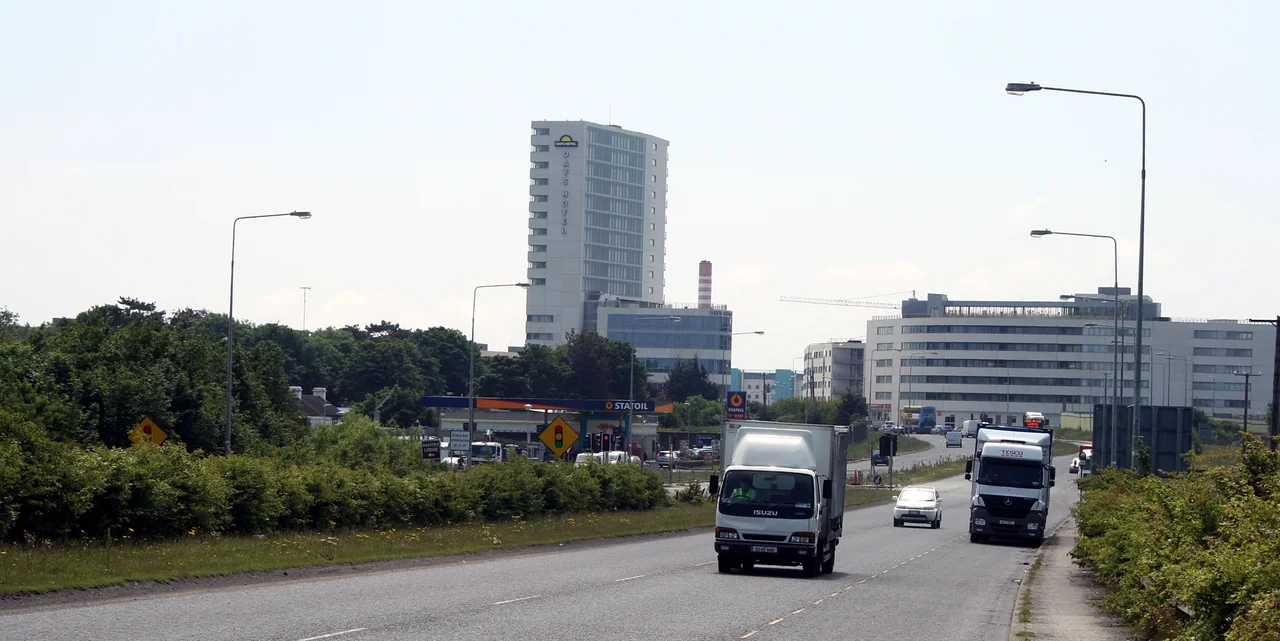
On the night of 16 August 2007, a McDonnell Douglas charter jet carrying 118 passengers and crew on a flight from Lisbon to Dublin came within seconds of crashing into the Metro Hotel, the fifteen-storey building put up as part of the Ballymun regeneration. The pilot, descending through low cloud, mistook the hotel's red rooftop lights and white interior glow for the approach lights of a Dublin Airport runway. The aircraft pulled up in time. The hotel was a young building then; the regeneration was still ongoing. In March 2018 the same hotel caught fire on its thirteenth floor, in a private apartment above the guest rooms. Twelve Dublin Fire Brigade units attended. Nobody was hurt. The most famous Ballymun resident is the musician Glen Hansard - the Frames frontman who won the 2008 Academy Award for Best Original Song for 'Falling Slowly' from the film Once. Catherine McAuley, founder of the Sisters of Mercy religious order, was born in 1778 in Stormanstown House, the Georgian mansion that once stood on the site now occupied by Ballymun Library. The neighbourhood she grew up in is now seven towers gone, two thousand new homes built, and one library where her birthplace used to be.
From the Air
Ballymun sits at approximately 53.398 degrees N, 6.268 degrees W on Dublin's far Northside, between Glasnevin to the south and Santry to the north. Dublin Airport (EIDW/DUB) lies just 4 km north - Ballymun is directly under the southern approach to runway 28R, and the area's height restrictions are partly governed by airspace constraints. Aircraft on final approach pass overhead at low altitude. Best viewing altitude 2,500-4,000 ft. The seven Ballymun towers, once the area's most distinctive feature from the air, have been demolished; the current district reads as a mix of medium-rise apartment blocks and lower-density housing, with the IKEA store off the M50 a prominent landmark to the west. Maritime climate, frequent low cloud, prevailing westerlies.
Nearby Stories
- Wicklow Mountains 12 km away
- Mornington 14 km away
- German submarine U-1051 16 km away
- Abbey of Kells 18 km away
- Irish Military Intelligence Service 20 km away
- HMS Manners (K568) 37 km away
- Templemore 42 km away
- Irish Sea Bridge 43 km away