
Maynooth University
Ireland's youngest university grew from one of its oldest religious houses. For most of the twentieth century the buildings at Maynooth were a Catholic seminary - the largest in the world for a while - filling each year with young men preparing to be ordained as priests. In 1966 the seminary did something its founders in 1795 could not have imagined: it admitted lay students. A trickle became a torrent. The Universities Act of 1997 split the institution in two. The new Maynooth University, with its arts, science and Celtic studies faculties, took the old Georgian south campus and built a modern northern one across the Kilcock Road. Today over sixteen thousand students and a thousand staff from twenty different countries call it home.
The Fear of Revolutionary France
The college was founded in 1795 for a very particular reason. Before then, Irish Catholic priests had been trained on the European mainland, mostly in France. The French Revolution had begun in 1789 and the Dechristianization that followed alarmed the British and Irish authorities almost as much as it alarmed the Vatican. They did not want Irish priests returning from Paris with revolutionary ideas in their satchels. So Thomas Pelham, the Chief Secretary for Ireland, introduced a bill to establish a Catholic college in Ireland itself. The Maynooth College Act passed on 5 June 1795. The new Royal College of St Patrick would educate Catholic lay and ecclesiastical students alike, in a country whose penal laws against Catholic education had only just begun to thaw. Several of the first professors were themselves French refugees - Anglade, Darré, Delahogue, Delort - exiles from the very revolution the college was designed to keep at bay. Three years after its founding, eighteen of the college's sixty-nine students were expelled for taking the oath of the United Irishmen.
Two Centuries as a Seminary
The lay college closed in 1817, and for nearly a hundred and fifty years Maynooth functioned solely as a Catholic seminary. At its peak it was the largest seminary in the world, ordaining as many as ninety priests a year for service in Irish parishes and the missions overseas. The Pontifical Charter, granted by Pope Leo XIII in 1896, gave the college the right to confer its own degrees in canon law, philosophy and theology. In 1910 the college also became a recognised constituent of the new National University of Ireland, awarding NUI degrees in arts and science alongside its pontifical theology. The seminary tradition shaped everything: the architecture of St Joseph's Square, the Georgian dignity of Stoyte House from 1780, the College Chapel begun in 1875 and opened for worship in 1891 to celebrate the centenary. The library still holds 22,000 pre-1850 books, a large proportion of them printed on the European continent.
1966 and After
In 1966 the college reopened its doors to lay students. The change was tentative at first, but Irish society was shifting fast - the Second Vatican Council had just ended, free secondary education was about to be announced, the number of vocations to the priesthood would soon begin its long decline. Within a generation the lay students vastly outnumbered the seminarians. The Universities Act of 1997 made the split formal. The new Maynooth University took over the faculties of arts, Celtic studies, philosophy and science. St Patrick's Pontifical University kept the theology, canon law and ecclesiastical training. They still share the historic south campus. In 1979 Pope John Paul II had visited and addressed an enormous crowd; the John Paul II Library was named in 1983 to mark the visit. In 2008 the university canteen burned down during the open day - the same year the Sunday Times named Maynooth University of the Year.
South Campus, North Campus, Two Worlds
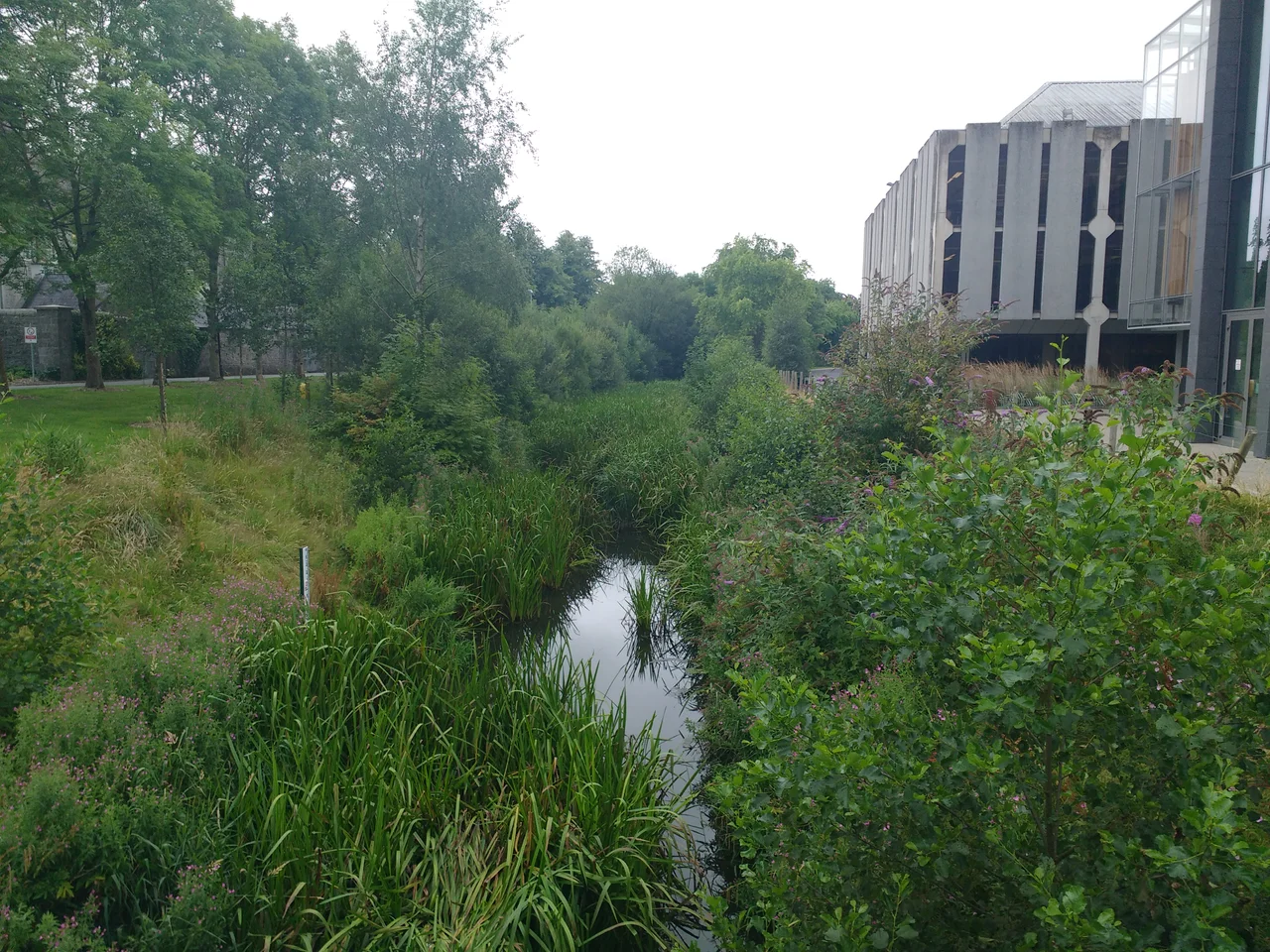
Walk across the Kilcock Road and you walk between centuries. The south campus is built around St Joseph's Square, a formal garden surrounded by Georgian and Victorian buildings. The eastern side of the square holds Callan Hall and Physics Hall, named for Nicholas Callan, the priest-physicist who taught here in the nineteenth century. Callan invented the induction coil and the Maynooth Battery; he is buried in the college grounds, and the museum holds the apparatus he used to discover the laws of electromagnetic induction, alongside instruments associated with Marconi. The north campus, by contrast, is a modern university in glass and concrete: the John Paul II Library and its extension, lecture halls, the science buildings, accommodation blocks named Rye, Village, River and Courtyard. In the Times Higher Education Young University Rankings of 2023, Maynooth ranked as the highest of Ireland's four universities under fifty years old. The first woman president of the institution, Finnish academic Eeva Leinonen, took office on 1 October 2021.
From the Air
Located at 53.38°N, 6.60°W in the town of Maynooth, County Kildare, about 25 km west of Dublin. Best viewed at 2,000-3,500 ft AGL; the historic south campus reads as a formal square of buildings, with the larger modern north campus across the Kilcock Road. Nearest airports: Weston (EIWT) 10 km south-east, Dublin (EIDW) 30 km east-north-east.
Nearby Stories
- Athcarne Castle 4.2 km away
- Wicklow Mountains National Park 10 km away
- Castlepollard 12 km away
- Portlaoise 19 km away
- Edward Pakenham 20 km away
- German submarine U-1051 39 km away
- HMS Manners (K568) 52 km away
- HMS Tyler 61 km away