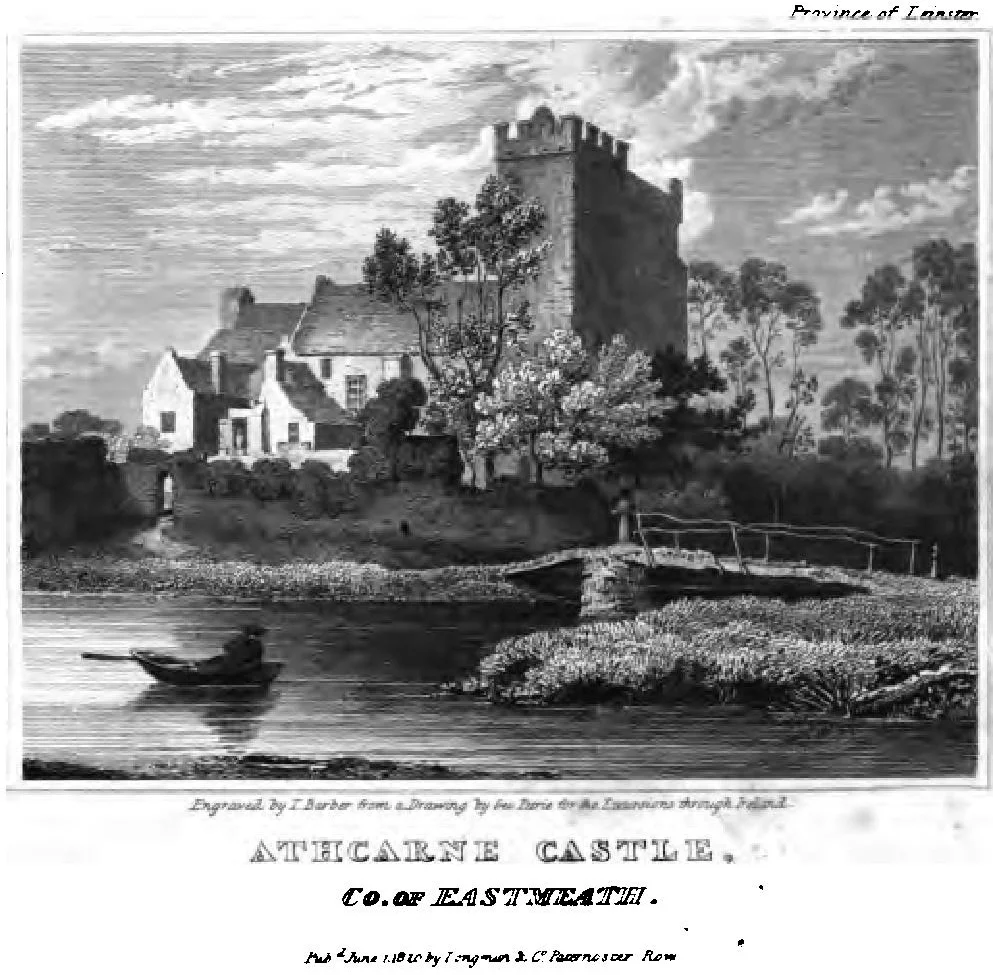

Athcarne Castle
On the night of 30 June 1690, King James II of England probably slept at Athcarne Castle. The next morning he rode six miles north to the River Boyne, where his army would lose to the forces of his son-in-law William of Orange in the battle that decided the religious and political future of Ireland for the next 230 years. Athcarne stands ruined now in a field outside Duleek, but the bones of an Elizabethan tower house still rise above the Hurley River, and according to local belief the place is still haunted by the ghost of the king who lost everything the next day.
The Cairn at the Ford
The name Athcarne comes from the Irish Áth Cairn - the fording point at the cairn - or alternatively from Ard Cairn, the high cairn. There is a Bronze Age burial mound just southeast of the castle, across the river, and the Meath historian Beryl Moore argued that the castle itself may sit on top of a buried cairn. These cairns were built about 4,000 years ago. The Vikings raided Newgrange in 861, and Moore believed they may have raided the Athcarne cairns at the same time. The early Irish texts knew this stretch of country as Cerna or Cernae, naming it as a principal burial site for the men of east Midhe and Brega. Long before the Normans arrived, before the Vikings, this was sacred ground for the kings of Tara.
Hugh and the Judge
In 1172, the Anglo-Norman knight Hugo de Bathe - from Bath in Somerset - was granted Athcarne by Hugh de Lacy, Lord of Meath. He probably built the first defensive structure on the site, which evolved over centuries into a tower house. In 1590, the property got its most dramatic upgrade: Sir William Bathe, a High Court judge, and his wife Janet Dowdall built a substantial Elizabethan mansion around the older tower. William died in 1597, and Athcarne passed to his brother James and then to James's descendants. For the next half-century the Bathe family lived comfortably here, near the productive Boyne valley, holding court and managing tenants like every other Old English Catholic gentry family of the Pale.
Cromwell on the Nanny
Everything changed on 31 August 1649. That morning Oliver Cromwell marched north from Dublin with 12,000 men to take Drogheda from the Royalists. The Boyne valley was the gateway to the north, and a series of small rivers and castles controlled the approaches. The River Nanny ran parallel to the Boyne, south of it, and three castles - Athcarne, Bellewstown, and Dardistown - controlled its crossings. The Earl of Ormonde, commanding the Royalist forces, ordered his troops in Drogheda to seize all three. They were too late. Cromwell's army captured all three castles on 1 and 2 September. Drogheda fell on 11 September in one of the most notorious massacres of Irish history. Athcarne was granted to Cromwell's Colonel Grace. James Bathe and his family fled to Ashbourne. The family never legally regained ownership.
The King Who Lost
Under the Second Act of Settlement in 1662, the confiscated Bathe estates were transferred to the Duke of York - James Stuart, brother of King Charles II and future King James II. James kept the prime Dublin estates outright but let the Bathe family rent Athcarne back from him in 1668 on a 99-year peppercorn lease - 1,200 acres for £430 total. Twenty-two years later, in June 1690, James II returned to Athcarne. He had been deposed in England by his Protestant son-in-law William of Orange, and had come to Ireland to recover his throne with French and Jacobite support. He rode to his own castle, slept there - so the story goes - and the next day fought and lost the Battle of the Boyne six miles north. James fled to France within days. He was the last Catholic monarch of Britain or Ireland. The castle whose ghost is said to be his outlived him by three hundred years.
Gutted at Auction
The Bathe family eventually left around 1700, after the lease ran out. The Garnetts owned the castle for the next century; the Gernon family bought it around 1830 and remodelled it heavily, demolishing the 1590 Elizabethan mansion but keeping the older tower house and adding a south-facing extension with large windows. They built a boating lake by damming the Hurley each winter - the dam is still visible. The Gernons fell on hard times. In 1939, the castle was sold at auction, then gutted, with the carved chimneypieces, panelling, and ironwork sold off as architectural salvage. A plan to demolish the ruin and grind it into roadbed came to nothing, and what remains - a tower, fragments of wall, the silhouette of two lost houses - eventually passed into the care of the Irish State. The boating lake is gone but the dam is there. The cairn is somewhere underneath. The king has not been seen for a while.
From the Air
Athcarne Castle ruins are at 53.62 degrees north, 6.44 degrees west, outside Duleek in County Meath, about 25 miles north of Dublin and 5 miles south of Drogheda. Nearest airport is Dublin (EIDW) about 25 miles south. From 2,000-3,000 feet in clear weather, the Boyne valley and the smaller River Nanny show as silver threads through the green Meath farmland; the Boyne battlefield site lies 6 miles north of Athcarne. The castle ruin sits in trees beside the Hurley River, southwest of Duleek. Spring and early summer offer the clearest visibility; expect frequent low cloud and rain otherwise.
Nearby Stories
- Cootehill 8.4 km away
- Maynooth University 8.7 km away
- Oldcastle, County Meath 12 km away
- 1989 Jonesborough Ambush 15 km away
- Slieve Donard 24 km away
- Kilbeggan Distillery 32 km away
- German submarine U-1051 40 km away
- Minesto 80 km away