
Cootehill
In 1872, in a Cavan market town founded by a Cromwellian colonel, a branch of the International Workingmen's Association opened its doors. Karl Marx's First International, the parent body, had branches in Dublin, Cork and Belfast, and now in Cootehill, a town of perhaps a few thousand people. Why a small Irish linen town joined a global socialist movement is one of those quirks that local history sometimes throws up and then mostly forgets. But Cootehill specialises in unexpected combinations. Its Palladian villa rivals anything by Edward Lovett Pearce. Its workhouse held 800 inmates. Its 21st-century factories make infant formula for Abbott Laboratories. Few towns of its size carry as much complicated history per square kilometre.
Coote's Charter
The town's founder was Thomas Coote, born around 1620, a Cromwellian colonel who later became a judge of the Court of King's Bench. The lands were granted to his father, Sir Charles Coote, after the Act of Settlement in 1662. Thomas married Frances Hill of Hillsborough, County Down, and the Hill family connection brought him into the linen trade. In 1725 Coote obtained a royal charter to hold markets and fairs at the new town, which took his name. By 1844, the topographer William Brabazon was writing of Cootehill: 'The town is comparatively well-built and respectfully inhabited; and is not equalled in appearance by any place between it and Dublin except Navan.' That is high praise for any provincial town in famine-era Ireland.
Pearce's Hidden Masterpiece
Between 1725 and 1730, Thomas Coote's nephew Edward Lovett Pearce designed Bellamont House just outside town. Pearce was Surveyor General of Ireland until his death in 1733, and his major works include the former Houses of Parliament in College Green, Dublin, now the Bank of Ireland. Bellamont is one of the finest Palladian villas in Ireland, a brick-built temple-front composition set into the landscape with extraordinary confidence. The Cootes who built it became Earls of Bellamont, and their estate once stretched from the town centre north toward Rockcorry, planted with Norway spruce and dotted with lakes, drumlins, gatehouses and wild deer. Most of Bellamont Forest is now designated as a Natural Heritage Area, though the original conifer planting was clearcut in the early 1990s.
Bishop's Son, Carnival King
Cootehill has produced an unusually international cast of children. Mary Anne Madden Sadlier, born here in 1820, emigrated to Canada and became one of the most popular Irish-Catholic novelists of nineteenth-century North America. John Charles McQuaid, born in 1895, rose to become Archbishop of Dublin and Primate of Ireland, one of the most powerful Irish prelates of the twentieth century. Major-General Eric Dorman O'Gowan served as a senior British Army officer in the Second World War and then, in retirement, advised the IRA executive during the 1950s Border Campaign, an arc as unlikely as any in Irish military history. His brother, Sir Reginald Dorman-Smith, became Governor of Burma. Cootehill, in other words, has fielded both an archbishop and a man who advised both the Crown and the IRA, separated by perhaps a couple of streets.
Workhouse and Wind Farms
The Cootehill workhouse was built in 1841-42 to designs by George Wilkinson. It was meant to hold 800 inmates. A fever hospital was added in 1846 as the Great Famine bit down. It closed in 1917 after serving as an asylum for a few years and was demolished in the 1960s. The town's industrial pivot points are scattered through the same period: Ulster Bank opened one of its first eight branches here in 1837, a building that still operates today. The Dundalk and Enniskillen Railway reached Cootehill in 1860 and closed completely in 1955, a typical Irish branch line that lived just under a century. Now the energy comes from the air: Bindoo wind farm opened in 2006 supplying 48 megawatts, and three more wind farms have followed. Abbott Laboratories makes infant formula here. Local chef Neven Maguire isn't from Cootehill but is from nearby Blacklion, and his restaurant draws diners who pass through Cootehill on the way.
What Endures
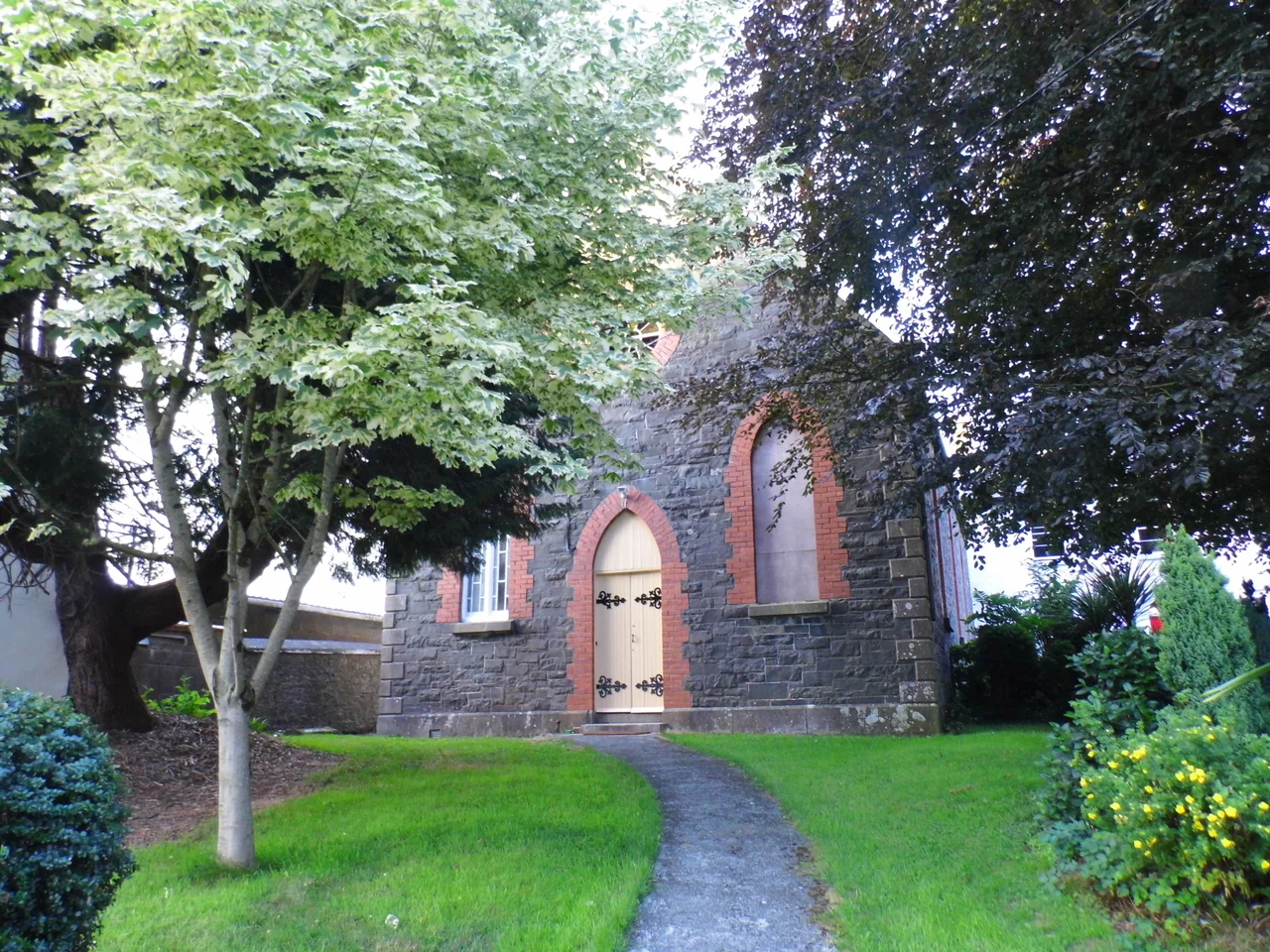
Walking Market Street today, you pass Georgian buildings the Cootes' charter set in motion, the William G. Murray-designed sandstone-faced bank building of 1858, the 1819 Church of Ireland church and the renovated St Michael's Roman Catholic Chapel within ninety metres of each other. The Court House from 1832, designed by William Deane Butler, sits just along the street. There's a megalithic tomb in the townland of Cohaw, about five kilometres along the Shercock road, evidence that this part of Cavan was settled in deep prehistory. Bellamont House survives in private hands, still one of Pearce's least-known masterworks. The Ulster Fleadh Cheoil has been hosted here multiple times. A market town founded by a Cromwellian, designed for prosperity by a Palladian architect, threaded into international socialism in the 1870s, supplying formula to global markets in the 2020s, Cootehill has spent four hundred years quietly refusing to be just one thing.
From the Air
Cootehill sits at 54.04°N, 7.05°W in northeast County Cavan, surrounded by the lake-and-drumlin landscape that characterises this part of Ulster. The Dromore River runs north toward the former Bellamont estate and Dartrey Forest. Nearest commercial airports are Belfast International (EGAA) about 95 km northeast and Dublin (EIDW) about 125 km southeast. Cootehill is connected by R-class regional roads; bus service runs via Cavan and Monaghan. From altitude, Bellamont Forest is the most distinctive feature, a dark mass northwest of the town centre. The drumlin country around Cootehill takes on extraordinary texture in low sun. Best viewing altitude 1,500-3,000 ft for picking out the Georgian street grid against the surrounding wind farms.
Nearby Stories
- Oldcastle, County Meath 3.7 km away
- Roman Catholic Archdiocese of Armagh 3.8 km away
- Shannon-Erne Waterway 4.9 km away
- Boho, County Fermanagh 5.4 km away
- St Mel's Cathedral 8 km away
- Attack on UDR Clogher Barracks 9.3 km away
- Slane Festival 12 km away
- Ring of Gullion 18 km away