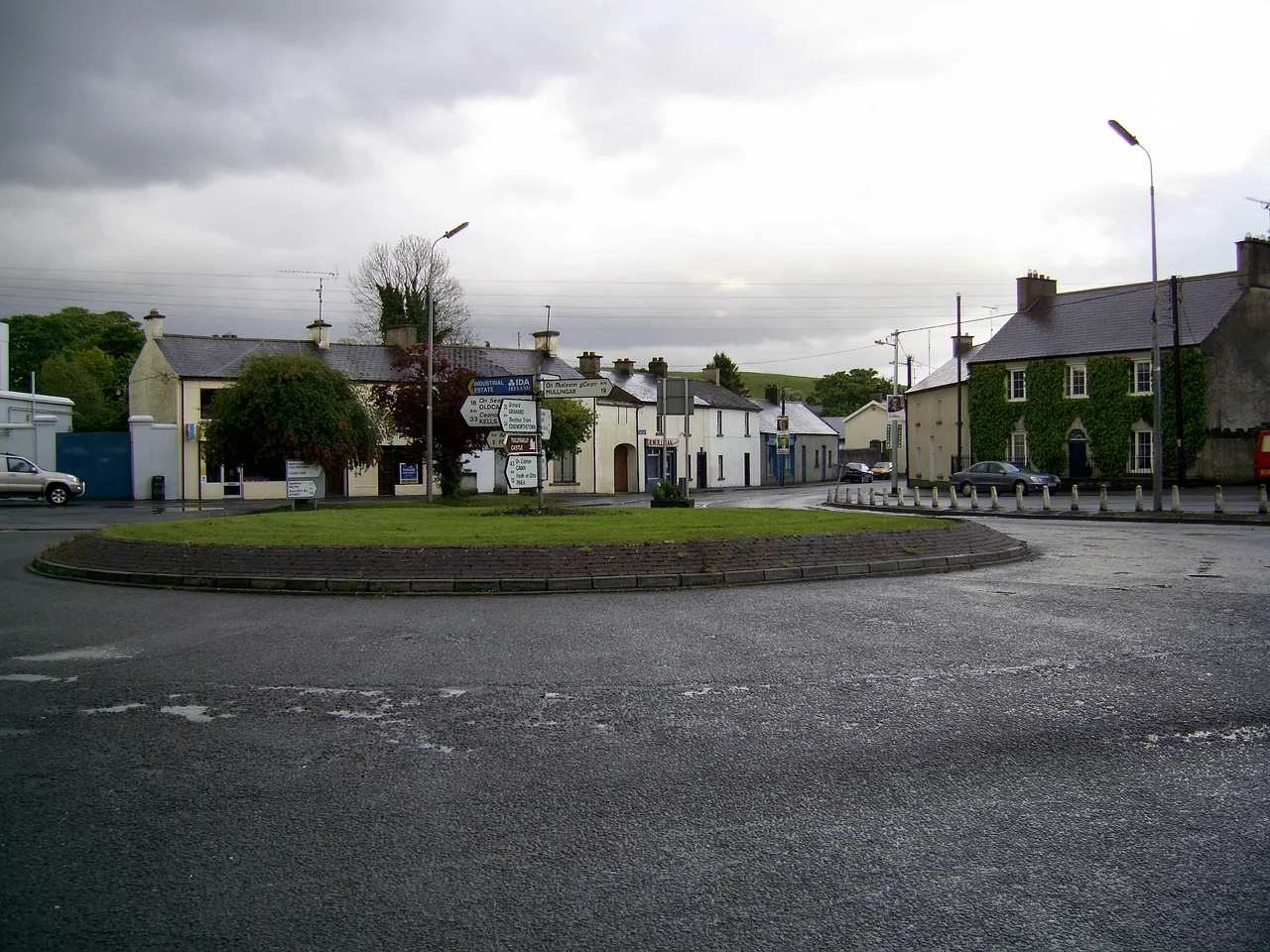

Castlepollard
In the middle of Castlepollard, on a triangular green ringed by Georgian buildings, stands a sculpture of four swans. They are the Children of Lir, the four siblings of Irish myth who were transformed by their jealous stepmother and condemned to spend nine hundred years on the cold lakes of the country before being released back into human form to die. The setting of the story, by tradition, is Lough Derravaragh, a few kilometres south. A plaque beside the sculpture tells the tale in several languages, for the visitors who occasionally find their way to this small town in the north of County Westmeath.
Two Names, One Place
The town has two names. In English it is Castlepollard, after the Pollard family, the 'Old English' landlords who took possession of the area in the early seventeenth century. In Irish it is sometimes Cionn Toirc — anglicised as Kinturk — meaning "head of the boar." Both names sit on the same triangle of land, which began as a settlement around the old Kinturk Demesne, the Pollard family seat. The early nineteenth century is when the town we see now was laid out: Kinturk Demesne and the surrounding buildings were rebuilt in Georgian style, common lands were enclosed, a new Church of Ireland was built, and a Market House was erected on the west side of the green. That market house served as both commercial centre and venue for the quarterly Court of Petty Sessions — the place where local disputes were settled and minor offenders sentenced.
The Burning of the Market House
In 1921, during the Irish War of Independence, the IRA mounted a coordinated wave of attacks on government buildings across the country, aimed at paralysing the British administration in Ireland. Castlepollard's Market House was set alight along with the Royal Irish Constabulary barracks on the Mullingar Road. The RIC had to relocate to the courthouse. On their way to a sitting, two local magistrates were kidnapped by IRA men and held in a cow byre on the Hill of Moal for forty-eight hours before being released unharmed. The town, somewhat unusually for this period, escaped reprisals. The Market House was rebuilt in 1926 and went on to serve, at different times, as a fire station and a library.
Tullynally and the Pakenhams
Two kilometres west on the Granard Road stands Tullynally Castle, the seat of the Pakenham family — also known as Pakenham Hall, after the surname they held before being elevated to the earldom of Longford. The original house was a fortified building from around 1655, remodelled first as a Georgian mansion in the 1730s and then expanded again as a vast Gothic Revival castle in the early nineteenth century. The architects involved were among the most prominent of their day: Francis Johnston, James Shiel, Sir Richard Morrison. It is still a private residence, but the gardens — nearly twelve hectares of terraced lawns, ornamental lakes, and a walled garden with a 200-year-old avenue of Irish yews — are open to the public in spring and summer. The Pakenhams gave Britain several generals, several writers, and a famous historian (Antonia Fraser) — and their family vault at nearby Killucan holds the body of General Sir Edward Pakenham, killed at New Orleans in 1815.
The Sacred Heart Sisters
On the eastern edge of the town, set back from the road in what was once the Kinturk Demesne, stands a complex of buildings that Castlepollard has only recently begun to discuss openly. The Sacred Heart Sisters bought the Kinturk House and grounds from the Pollard family in 1935 and opened a Mother and Baby Home there. For thirty-six years, until 1971, almost five thousand unmarried Irish women were sent to the home to give birth, and most of their children were adopted out. Hundreds of those children died in the home. The story of these institutions across Ireland surfaced into national consciousness only in the past decade, after the historian Catherine Corless's research at Tuam in 2014 prompted a government Commission of Investigation. The 1938 hospital and Georgian manor stand empty today, owned by the HSE, alongside bungalows that house people with disabilities.
A Town That Has Grown
The Castlepollard of today is a small but growing community, its population having increased by more than 50% in the twenty years between the 2002 and 2022 censuses — from 895 inhabitants to 1,349. The hurling club has won the Westmeath Senior Hurling Championship fourteen times, more than any other in the county; their arch-rivals are Lough Lene Gaels GAA, based in neighbouring Collinstown. The local economy turns on Mergon International, a plastics manufacturer that occupies the largest single workplace in the area. Across the high ground around the town are scattered ringforts and ancient earthworks — Randoon and Turgesius Island on Lough Lene, named for a Viking leader who, by local tradition, took respite here with a Cavan lover between his sea-raiding expeditions from Norse Dublin. The triangular green at the centre still holds the sculpture of the swans, the children of Lir watching over the small Georgian town that grew up around them.
From the Air
Castlepollard lies at 53.65°N, 7.21°W in northern County Westmeath. From cruise altitudes of 3,000–5,000 ft the town is recognisable by its central triangular green ringed by Georgian buildings; Tullynally Castle and its 12-hectare gardens are visible two kilometres west. Lough Lene lies northeast, Lough Derravaragh to the southwest. The nearest controlled airspace is Dublin (EIDW), about 95 km southeast; Casement Aerodrome (EIME) lies due southeast. Knock (EIKN) is further west. Visibility in the Westmeath lowlands is often marginal — low cloud, drizzle — but a clear day reveals an unusually concentrated landscape of small loughs, demesnes, and the wooded ridges where Iron Age and early Christian settlements left their traces.
Nearby Stories
- Mount Temple, County Westmeath 2.9 km away
- St Mel's Cathedral 5 km away
- Athlumney Castle 5.7 km away
- Maynooth University 8 km away
- Cavan 10 km away
- Shannon-Erne Waterway 11 km away
- Kilbeggan Distillery 21 km away
- 1989 Jonesborough Ambush 23 km away