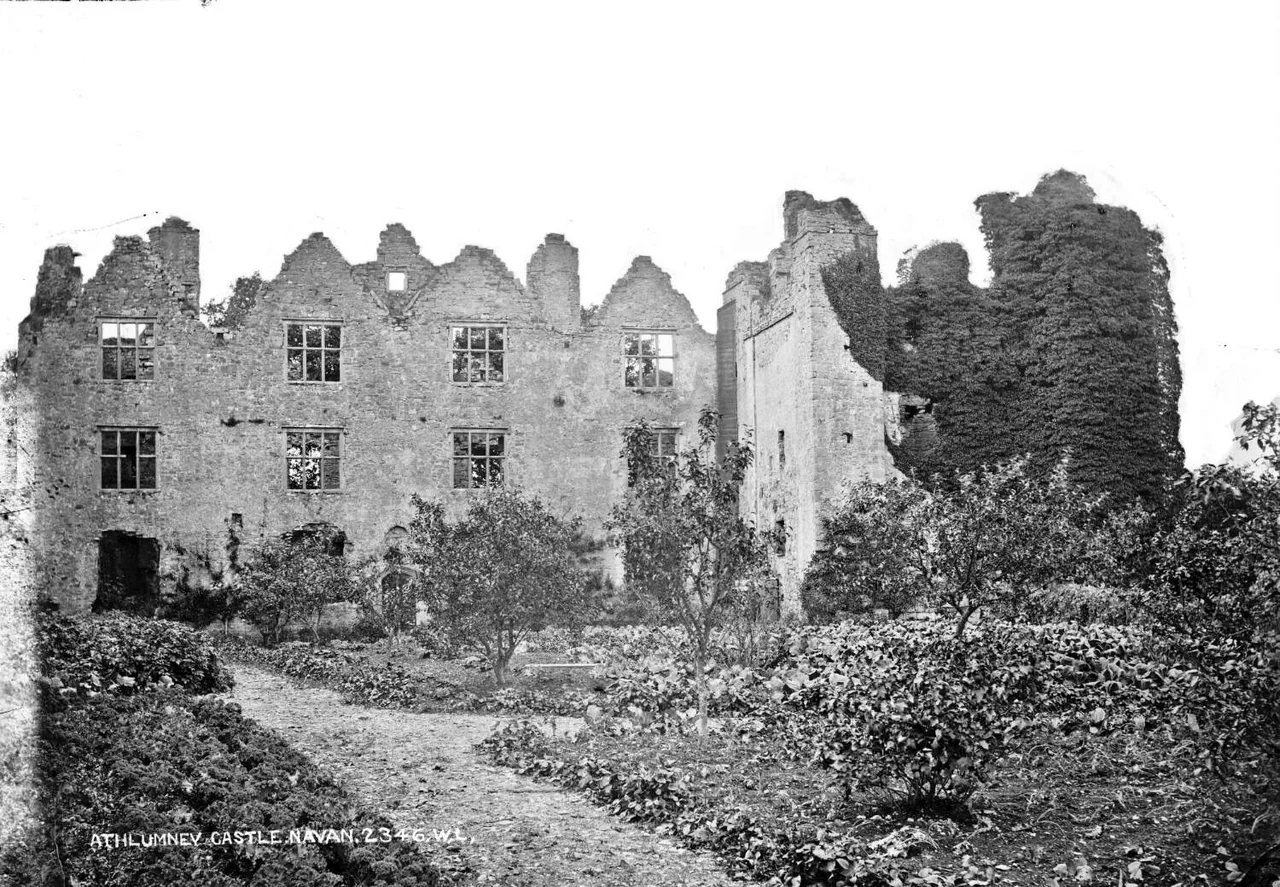

Athlumney Castle
Twice in forty-one years, Athlumney Castle was deliberately burned by the man who owned it, rather than let an enemy take it intact. In 1649, the Maguire who held it set it ablaze ahead of Cromwell's advance on Drogheda. In 1690, after the Battle of the Boyne went the wrong way for the Catholic side, Sir Launcelot Dowdall is said to have done the same before fleeing to France. You can visit the ruin today on Convent Road in Navan, but you have to leave a deposit at the nearby B&B and collect a key.
Loman's Ford
Athlumney guards the point where the Leinster Blackwater drains into the Boyne, southeast of Navan. The Irish name means Loman's ford, after Lommán of Trim, the patron saint of the medieval town a few miles upstream. People had been crossing here for a very long time before the Normans arrived: archaeological digs uncovered an Early Christian souterrain - one of those underground stone-lined passages built as refuge and cold storage in the centuries before the Vikings. The Normans built a motte here after 1172, when Hugh de Lacy granted the lordship of Skryne to Adam de Feypo, who in turn passed Athlumney to his relative Amauri de Feipo. The earthwork mound from that first Norman defence is still visible in the grounds.
A Tower and a House
The older part of the castle that stands today is a 15th-century tower house - three storeys of stone with a spiral staircase climbing inside its corner, and holes on the first floor where the wooden beams once supported floorboards. Tower houses like this were built across Ireland in the 1400s as the standard residence for any gentry family that mattered, defensive enough to repel a raid but small enough to heat. Attached to it, at the end of the 16th century or the beginning of the 17th, is a much grander structure - a Tudor-style fortified house with four sets of widely-spaced mullioned windows, projecting corner turrets, and a fine cut-limestone doorway. An oriel window juts out from the eastern wall. The ground floor held the kitchen, whose fires heated the first floor where the lord and his family lived - a new arrangement reflecting a new age, when the lord no longer dined among his retainers but withdrew with his family into glazed, wooden-floored private rooms above.
The Secret Behind the Wall
Hidden inside the first floor of the fortified house is a secret mural chamber, accessible only by a set of stairs that descend from above. The Irish call this kind of feature a priest hole - a small concealed room where a Catholic priest could be hidden during the centuries when celebrating Mass was a treasonable offence under English law. From the 1530s to the 1820s, the Catholic gentry of Ireland concealed priests routinely. The Dowdalls of Athlumney, who held the castle in the seventeenth century, were Catholic. The hidden chamber - tight, dark, behind the stone wall of the family's own home - is a physical reminder of how religion was practised under threat. Entering the castle, the original doorway was also defended by a murder-hole - a hole in the ceiling of the entry passage, through which a defender could drop stones or boiling water on intruders below. The fortified house was elegant, but it was still ready for a fight.
Burning Their Own House
Two times the lord of Athlumney made the same drastic choice. In 1649, Cromwell's army was marching north from Dublin toward Drogheda, and the Maguire who held Athlumney burned the castle to deny it to the New Model Army. Twelve thousand soldiers needed shelter, supplies, and intact gun-platforms; a smoking ruin gave them nothing. In 1690, James II of England lost the Battle of the Boyne nineteen kilometres north of here. Athlumney's then-lord, Sir Launcelot Dowdall - High Sheriff of Meath in 1686, a committed Jacobite - is said to have stood on the riverbank watching the smoke rise from his own castle before he turned for France. The Williamite victors, when they arrived, found nothing worth taking. Dowdall died in exile; the Dowdall lands at Athlumney passed eventually to the Somerville family of Kentstown, who took the title Baron Athlumney as compensation. The castle has stood roofless ever since.
Key from the B and B
Athlumney is a National Monument now, protected by the state and locked. There is no ticket office, no gift shop, no curated path. To visit, you walk to the bed and breakfast on Convent Road, leave a deposit, and they hand you a key. You unlock the gate, step through, and have the place to yourself - the tower, the fortified house, the priest hole, the motte. You can climb the spiral staircase. You can stand where the lord stood watching his own castle burn. When you are done, you lock up, walk back, and get your deposit back. There are few medieval monuments in Europe still rented out by the deposit-and-key. It feels like trespass, but it is the official arrangement.
From the Air
Athlumney Castle is at 53.65 degrees north, 6.68 degrees west, in Navan, County Meath - about 30 miles northwest of Dublin and 19 kilometres south of the Boyne battlefield site near Oldbridge. Nearest airport is Dublin (EIDW) about 30 miles south. From 2,000-3,000 feet in clear weather, look for the confluence of the Leinster Blackwater with the Boyne just southeast of Navan; the castle ruins lie on a rise overlooking this junction. The river loops east toward Drogheda from here, passing under Athcarne and the Boyne battlefield. Best visibility on bright spring mornings.
Nearby Stories
- Cootehill 8.4 km away
- Maynooth University 8.7 km away
- Oldcastle, County Meath 12 km away
- 1989 Jonesborough Ambush 15 km away
- Slieve Donard 24 km away
- Kilbeggan Distillery 32 km away
- German submarine U-1051 40 km away
- Minesto 80 km away