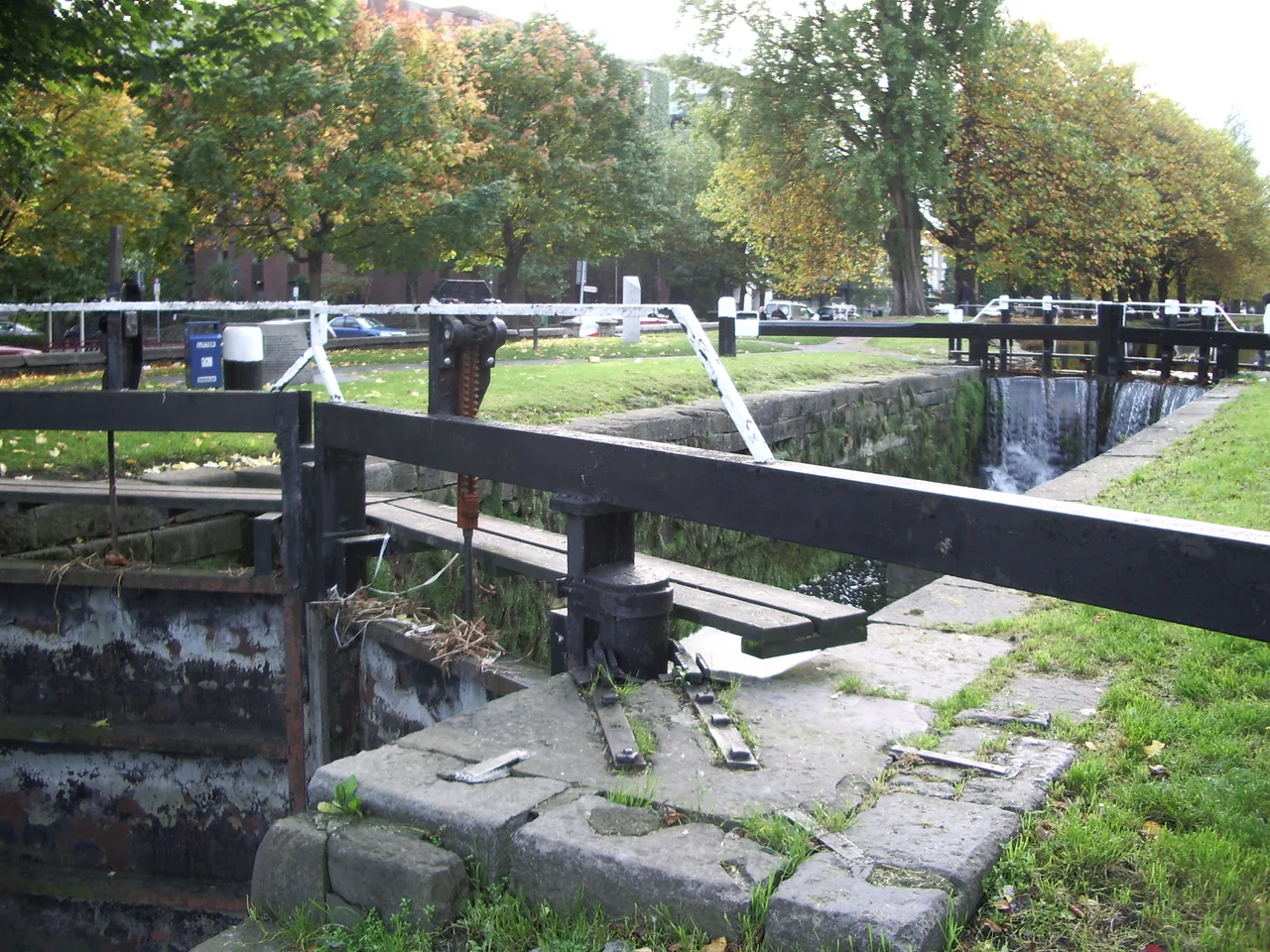

Grand Canal (Ireland)
In the 1960s, Dublin Corporation looked at the Grand Canal cutting its way through the south side of the city and saw a problem to be solved with concrete. The proposal was straightforward: drain the canal, lay new sewage pipes along its bed, and pave the result into a six-lane dual carriageway. It would have been the largest infrastructure transformation in the city since the Georgian period. A petition of 100,000 signatures said no. The plan was abandoned. The Grand Canal—131 kilometres of still water, 43 locks, two centuries of engineering—survived because Dubliners decided in sufficient numbers that they preferred it as water. The canal had been built to move stout, turf, and people from Dublin to the Shannon. By 1960 the last working cargo barge had passed through, and the question was no longer how to use it but whether to keep it at all.
The Idea That Took Sixty Years
The notion of connecting Dublin to the Shannon was floated as early as 1715. Nothing happened. The Board of Inland Navigation was established by Act of Parliament in 1751. Thomas Omer received £20,000 in 1757 to start construction. By 1759 he had completed 3 km in the Bog of Allen and 13 km of canal running from the Liffey near Sallins towards Dublin. By 1763 he had finished three locks and six bridges. Then the project stalled. The Corporation of Dublin had hoped the canal could double as a water supply for the city basin, but when the new sections were filled, the banks gave way. By 1768, £77,000 had been spent and little more was forthcoming. The Bog of Allen had defeated Omer's strategy of draining and lowering. The canal needed someone to start over.
Smeaton, Jessop, and the Mistake at Full Height
In 1772, the Grand Canal Company was established by a consortium of noblemen and merchants, raising capital through public subscription—a new venture in canal finance. The company invited the great English civil engineer John Smeaton, with his assistant William Jessop, to Ireland for two weeks of consultation. Smeaton recommended skirting the Bog of Allen rather than draining it, building the canal at full height instead of trying to lower it. He also advised reducing Omer's generous lock dimensions (137 by 20 feet) to 60 by 14 feet, which would save substantial cost. Smeaton's full-height recommendation proved expensive in practice—the construction across boggy ground demanded constant maintenance—but his lock-size reduction set the dimensions of the canal for the next two centuries. The canal from Sallins opened to traffic in 1779. Passenger services to Dublin began in 1780, twice weekly. The Leinster Aqueduct carried the canal over the Liffey at Robertstown in 1784.
Stout and Stage Coaches
By 1791 the canal had reached the River Barrow at Athy. Trade doubled between 1800 and 1810, from 100,000 tons to 200,000. Passenger revenue grew to £90,000 by that date. Anthony Trollope's 1848 novel The Kellys and the O'Kellys includes a tedious passenger-flyboat journey from Portobello to Ballinasloe—the canal at its most characteristic, slow but reliable. Samuel Watson's almanac for 1792 listed passage boats running from James's Street Harbour and stagecoaches connecting Limerick and Kilkenny with canal boats at Monasterevin. The Shannon Steam Navigation Company's wood paddle steamer Mountaineer became the first steamer to traverse the canal from Dublin to Limerick in October 1826. The Dublin and Wexford Steam Company's iron paddle steamer arrived in Limerick on 2 February 1827. Steam had reached the inland waterway.
Breaches, Disasters, Drownings
Canals fail in two ways: they leak, or people drown in them. Both happened repeatedly on the Grand Canal. A breach in 1797 spilled water across the countryside; the same location breached again in 1855. In 1916, 300 yards of canal were displaced. The last major breach was on 15 January 1989, between the Blundell Aqueduct and Downshire bridge, when 18 miles of canal drained into the surrounding fields. December 1792 produced the canal's worst disaster: a passage boat bound for Athy was forced beyond capacity by 150 mostly-drunk passengers who ignored the captain's warnings. The boat capsized near the eighth lock. Eleven people drowned—five men, four women, two children. On 6 April 1861, a horse-drawn bus in Portobello Harbour backed through wooden rails on the bridge when one horse started to rear. Bus, horses, and six passengers plunged into the canal. The driver was pulled out by a passing policeman. The conductor jumped clear. The six passengers did not.
From Cargo to Greenway
Ownership of the canal passed from the Grand Canal Company to Córas Iompair Éireann in 1950, to the Office of Public Works in 1986, and to the cross-border Waterways Ireland in 1999—established under the Good Friday Agreement. The Grand Canal Way, a 117 km long-distance trail, follows the towpath from Lucan Bridge to Shannon Harbour, typically completed in five days of walking. An 8.5 km greenway between the 3rd Lock at Inchicore and the 12th Lock at Lucan opened in June 2010. The canal in Dublin city is now bordered by office blocks, restaurants, and the Patrick Kavanagh memorial sculpture near Baggot Street—Kavanagh having immortalised the canal in his sonnet 'Lines Written on a Seat on the Grand Canal, Dublin.' A waterway that almost became a dual carriageway is now one of the city's quieter pleasures. It still goes to the Shannon. It still takes a week to walk.
From the Air
The Grand Canal's main line runs 131 km from Dublin (Grand Canal Dock at the Liffey, 53.34°N, 6.24°W) to Shannon Harbour in County Offaly (53.27°N, 7.99°W). The waypoint at 53.32°N, 8.20°W is on the abandoned Ballinasloe branch. Cruise at 3,000–6,000 feet across the midlands and the canal is visible as a thin dark line cutting through fields, with regular geometric kinks at the 43 locks. Nearest airports are Dublin (EIDW), Shannon (EINN), and Casement Aerodrome (EIME). Shannon Harbour, at the western terminus, lies on the river just above Banagher.
Nearby Stories
- Gort 2.7 km away
- Roscommon 5.6 km away
- Milltown, County Galway 7.4 km away
- Lorrha 9.7 km away
- Durrow Abbey 15 km away
- Marine Institute Ireland 17 km away
- Clonfin Ambush 19 km away
- Ballyfin 21 km away