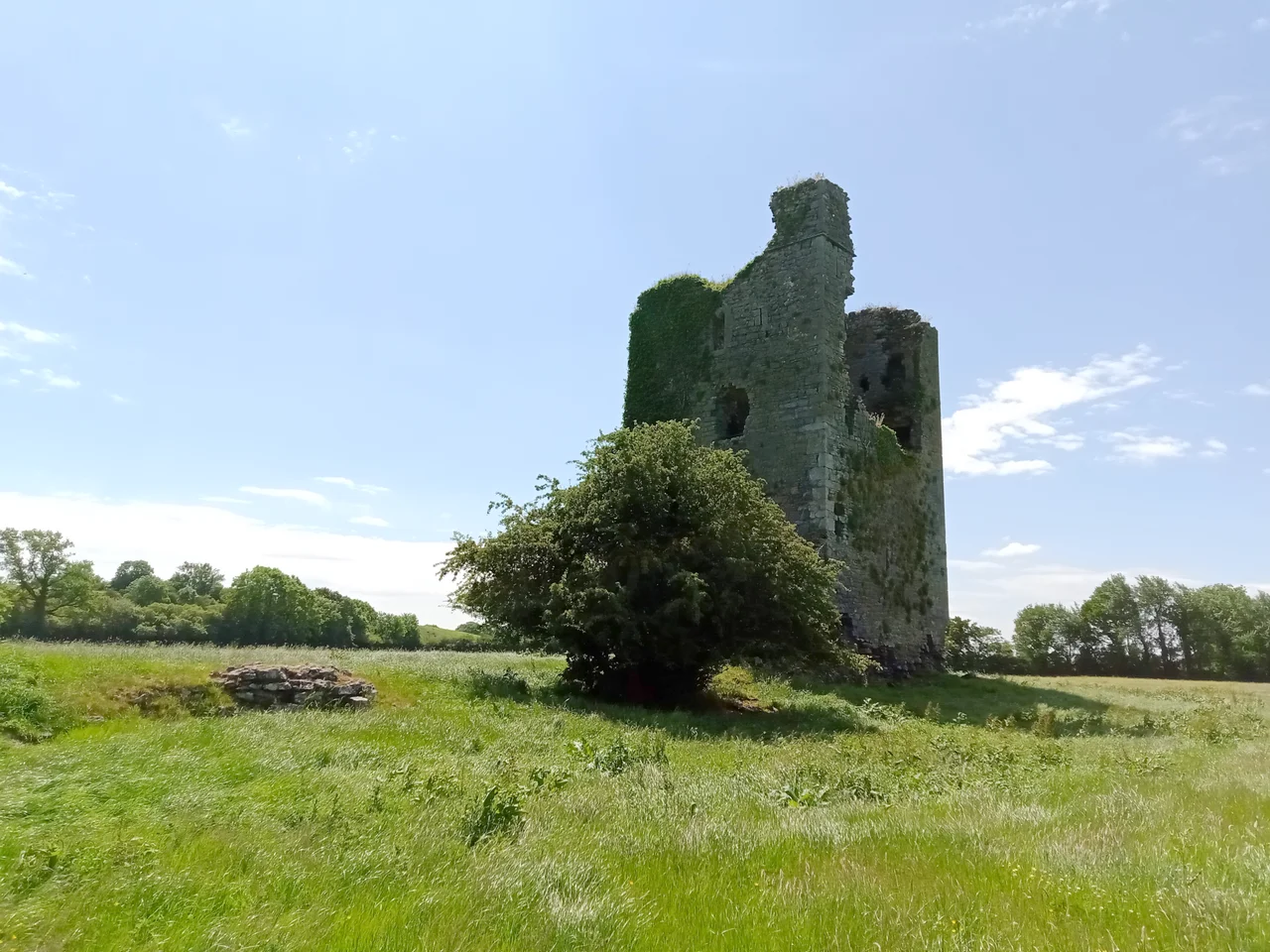

Cantwell's Castle
Walk into the lobby of Cantwell's Castle and look up. There, set into the stone vault between the ground floor and the first, gapes a small dark opening - a murder hole - through which a defender could pour boiling water or fire on whoever made it through the door. Another waits between the first floor and the second. The Cantwells, Anglo-Norman incomers who arrived with Strongbow in the late twelfth century, built this limestone tower house in the south of County Kilkenny to live in, but they built it expecting trouble. Trouble, when it finally came, wore the iron buff coat of Oliver Cromwell.
Of Suffolk, of Strongbow, of Sandfortscourt
The first Cantwell on Irish soil appears in the records in 1177 as Hugh de Cantwelle - the spelling unsettled, the family lately of Suffolk, possibly out of Kentwell Hall. Surnames in that century were still hardening into shape, and the Cantwells passed through Conteville and Cantuell before the modern form fixed itself. They took lands seven and a half kilometres from Kilkenny city, in the townland that medieval scribes called Cantwellscourt and the Down Survey would later rename Sandfortscourt. A 1381 inquisition records a good castle here, in repair, with a working water mill. The mill is gone now, lost even to the field names, but the tower stands. Around it, the fields still carry the old labels - Castle Field, Court Field, Near Court Field - the way bones keep the shape of vanished hands.
The architecture of suspicion
The castle was built for a world in which neighbours might arrive with axes. Its two ground-floor windows splay outward in the northeast and northwest walls - splays wide enough that a man with a longbow could swing his aim, which the historian William Carrigan took as evidence that archery was still standard kit when the masons worked. A yett, that distinctly Scots and Irish iron grille, once barred the door behind a heavy drawbar; the slot for that bar is still visible. Inside, a Gothic doorway between ground and first floor hides another drawbar slot, and above the upper windows there are stone seats deep enough to settle into with a view. The court wall, called the bawn in Hiberno-English, was largely dismantled in the eighteenth century by a tenant farmer named Thomas Cahill, who carted away the stones to build himself a more comfortable house.
1649: the year of the parley
In the autumn of 1649 the Cantwell castles were garrisoned by English, Welsh and Scottish officers - Royalists, by the broad and twisting allegiances of that war - and Cromwell's army was marching on Kilkenny. The defenders did the thing that small garrisons facing a larger force have always done: they sent men out to talk. Their offer was simple. They would hand over the castle if Cromwell would let them retreat from Ireland with their lives. Cromwell, calculating that an empty fortress was worth more than a costly assault, accepted. The Cantwell properties changed hands more than once after that. John Cantwell, who had served as Provost Marshal of the Confederate forces, was transplanted to Connaught with his mother and surviving relatives - the formula the Cromwellian settlement applied to thousands of Catholic landowners across the country. By the time of Griffith's Valuation in the mid-nineteenth century, the land belonged to a Mrs. Ellen Cahill. The castle itself was simply left alone, occupied by ivy and crows.
What survives, and what reads as warning
Today the building is roofless from the first floor up, its upper rooms open to weather. The view from the surviving window seats still rewards a climb. The two murder holes still look down into spaces where attackers would have come, the geometry of menace unchanged by four centuries of peace. A short distance to the north, the manor house called Cantwell's Court - the family's later, gentler residence - is gone almost without trace, except for a cobble courtyard the current owner uncovered by digging. Local tradition holds that Thomas Cahill robbed that house too, for his stones. The lesson of Cantwell's Castle is not romantic. It is that medieval Irish landowners lived with the constant calculation of how quickly they could close a door, how high they had to pour from, how long the bar would hold.
A castle in a countryside of castles
Cantwell's Castle does not stand alone. Within a few kilometres, the Purcell family's Ballyfoyle Castle and the Shortall family's Clara Castle ride the same low ridges. The Cantwells themselves built more than this one: Moycarky Castle in Tipperary, with its impressively high adjacent wall, and Kilfane Castle which became a presbytery attached to the medieval church, and the ruined Cloghscregg Castle. South-east Kilkenny was once one of the densest concentrations of tower houses in Europe - small, hard, vertical statements of who held what. Read them together and the landscape becomes legible: not as scenery but as a slow argument among families, written in stone, conducted across centuries, in which a murder hole is simply a sentence written in the appropriate idiom.
From the Air
Cantwell's Castle sits at 52.682°N, 7.195°W in the southern part of Sandfortscourt townland, about 7.5 km south-southeast of Kilkenny city. Best viewed from 1,500-2,500 ft AGL in clear conditions - the limestone tower rises from open farmland and the bawn outline is still discernible from the air. Nearest airports: Waterford (EIWF) about 50 km south, Kilkenny (EIKL) a few minutes north. The R448 and the Nore valley provide easy visual navigation; the castle is roughly mid-way between Kilkenny city and Bennettsbridge.
Nearby Stories
- 2008 Irish Pork Crisis 4 km away
- Civil Defence Ireland 6.1 km away
- Thurles 6.5 km away
- Abbeyleix 9.5 km away
- Castletown Cox 11 km away
- Ardfinnan Woollen Mills 13 km away
- Johnstown Castle 16 km away
- County Wicklow 20 km away