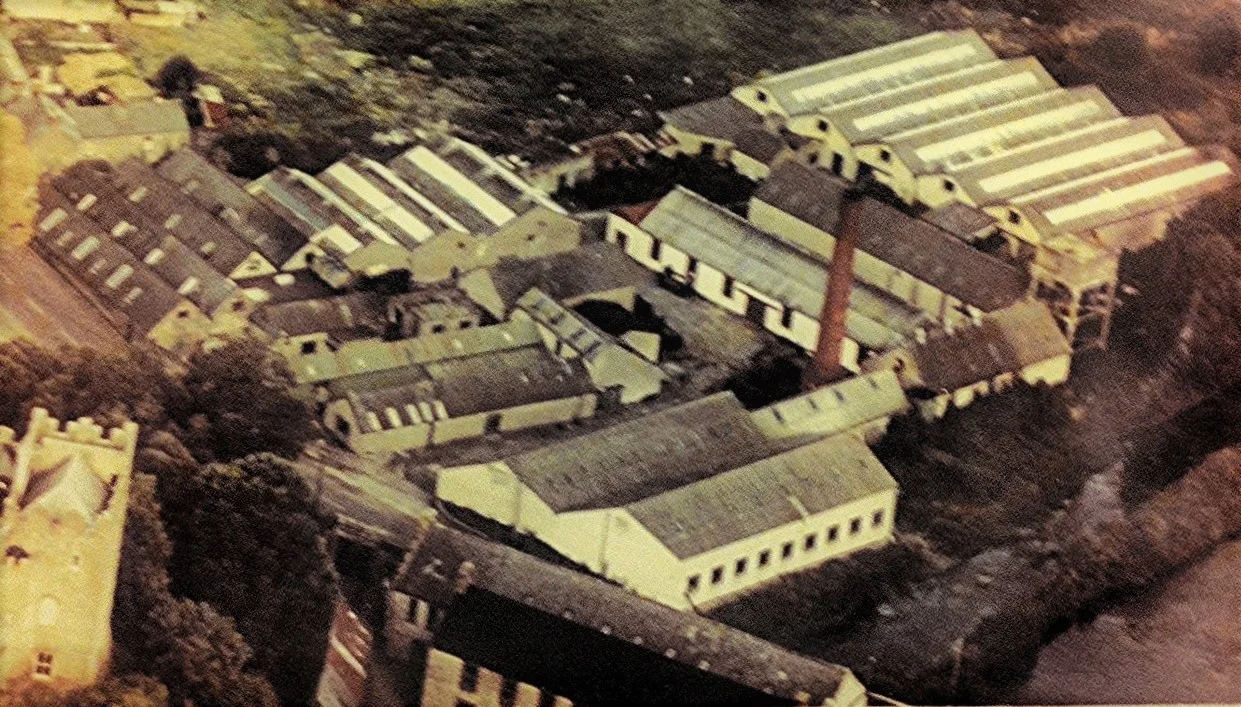

Ardfinnan Woollen Mills
When Eamon de Valera stood before the Council of the League of Nations in 1932 as its president, and again before the Assembly in 1938 as its president, the suit and overcoat he wore had been woven, fulled, dyed, and tailored at a single Tipperary mill. The cloth was Ardfinnan. The firm was Mulcahy, Redmond and Company, on the banks of the River Suir below Ardfinnan Castle, and for over a century it did something nobody else in Ireland did: it took sheep at one end of its premises and turned out finished, fitted suits at the other. From the fleeces in the receiving room to the Aer Lingus uniforms its workers stitched in the 1950s, every stage of the work happened on the same site, by the same families, in the shadow of a castle that had been milling cloth since the Knights Templar arrived in 1185.
A monastery, then knights, then a mill
There has been a mill on this watermill site since at least 632 AD, when Saint Carthage took refuge by the riverbank and founded Ardfinnan Abbey. The original mill provided parchment, vestments, and flour to the monks. After Prince John built the castle in 1185 the Knights Templar took over the riverside, established a fulling mill, and connected Ardfinnan's cloth to a 13th-century European trade in Irish woollen cloaks that ran out through Waterford. A freeman recorded in the village in 1295 carried the dye-trade name William le Teynturer. The village green became a tentering ground - where wet cloth was stretched on frames to dry - and remained one into living memory. By the time John Mulcahy founded Mulcahy, Redmond & Co. Ltd. on 5 March 1869, the mill below the bridge was rebuilding a tradition six and a half centuries deep.
Fire and turbine
On 1 October 1883 a fire gutted the six-storey watermill, damaged Mulcahy's family home at Mill House, and threw between fifty and a hundred workers out of immediate employment. The firm rebuilt. A Dublin engineering firm designed a new double-roofed mill to house a water turbine - imported from New Jersey, built by T. C. Alcott & Son. Only two other mills in Munster used water turbines at the time, both in Kerry. The new mill was "fitted on an extensive scale with the most improved machinery known in England or America for the manufacture of the very best Irish tweeds." A monastic-style bell called the workers to and from shifts. A canteen joined the building. A castellated annex with a gothic door - older than the rest, having survived the fire - kept watch over the entrance. By the 1890s Mulcahy, Redmond was advertising Irish tweeds, friezes, blankets, shawls and railway rugs to a market that stretched from Cork to London.
Galtee Motor Cloth
Frank Mulcahy was one of the first ten motorcar owners in South Tipperary. In 1906 he patented a fabric called Galtee Motor Cloth, named for the Galtees rising to the north of the mill. It was layered: traditional Irish frieze, mohair, and merino interwoven so that the weave breathed when dry but contracted and turned rainproof when wet. Drivers in the open touring cars of the day needed warmth against the cold and protection against sudden showers. Mackintoshes were rubber. Burberry was cotton. Galtee was wool engineered to work like neither. The first Galtee Motor Coats were sold at Pim Brothers on South Great George's Street in Dublin, where they were the highlight of Ireland's first motor show in 1907. R. J. Mecredy, the great Irish motoring pioneer, wrote in 1909: "I have used one of these coats for several years," and praised its scientific qualities in his book Health's Highway. Edward VII, Queen Alexandra, and Princess Victoria stopped at the mill in May 1904 while travelling between Shanbally Castle and Lismore Castle. Their hosts at both places were already Mulcahy customers.
From war contracts to de Valera
The First World War kept the looms running on back-to-back War Office contracts: khaki serge for British military uniforms, frieze for overcoats, blankets for the trenches. The mill produced cloth for the Imperial Russian Army too. After the war the firm expanded across the road, fitted out the largest boiler in the south of Ireland (imported from Glasgow), and absorbed machinery from the late Lord Waterford's woollen mills. The total investment came to £250,000 - about ten million euro in today's money. Then Irish independence changed the customer. From 1922 the new Free State commissioned Mulcahy, Redmond to clothe its public service, civil service, and Defence Forces. The exclusive commissions included Eamon de Valera's suits and overcoats for his work at the League of Nations from 1932 to 1939. The Aer Lingus uniform - that signature deep green - was Ardfinnan cloth from the 1940s until the airline switched to Donegal tweed from Magee in 1963.
Sheep to suit
In 1947, under Jack and Dick Mulcahy, the mill added a women's ready-made suit department employing over seventy women. Together with the existing men's and boys' departments, the gas and hydroelectric supply that had powered the village since before 1921, the workers' cottages the firm had built, and the tennis courts opened in 1926, the Mulcahys ran the most vertically integrated woollen operation in Ireland - the only factory on the island that took raw fleece in one door and shipped tailored garments out the other. They also ran a darning department for customers who needed their woollens repaired. Ardfinnan Thornproof Tweed won the Premier London Award and the Georgian Silver Cup at international level in both 1961 and 1962. Then Ireland's EEC accession in 1973 brought competition the firm could not match. With up to 500 people directly or indirectly dependent on the mills, Mulcahy, Redmond closed in January 1973. A great Clonmel protest by directors, workers, and the Mulcahy family followed, but the government's promised support for Irish wool did not arrive. The mill survives in the village's bones: the workers' cottages, Ardfinnan GAA founded in 1910 by mill footballers, the agricultural co-operative, and the sign Ardfinnan House on a building at 17 Trinity Street in Dublin.
From the Air
Ardfinnan Woollen Mills stood at 52.31 N, 7.88 W on the south bank of the River Suir directly below Ardfinnan Castle, between the Galtee Mountains and the Knockmealdowns. Waterford (EIWF) is 32 nm east-southeast; Cork (EICK) 35 nm southwest; Shannon (EINN) 50 nm north-northwest. Recommended viewing altitude 1,500-2,500 ft AGL. From the air the mill site sits at the river bend below the round-keep castle, with the medieval bridge and weir clearly visible. The Galtee range to the northwest - source of the fleeces the mill spun - dominates the horizon, with Galtymore at 919 m the highest peak.
Nearby Stories
- All Together Now (festival) 1 km away
- Molana Abbey 4.1 km away
- Castle Oliver 4.7 km away
- Holy Cross Abbey 9.4 km away
- Siege of Kilkenny 9.4 km away
- Waterloo Round Tower 13 km away
- Castletroy 14 km away
- Ramsey Island 141 km away