.jpg)
Castle Oliver
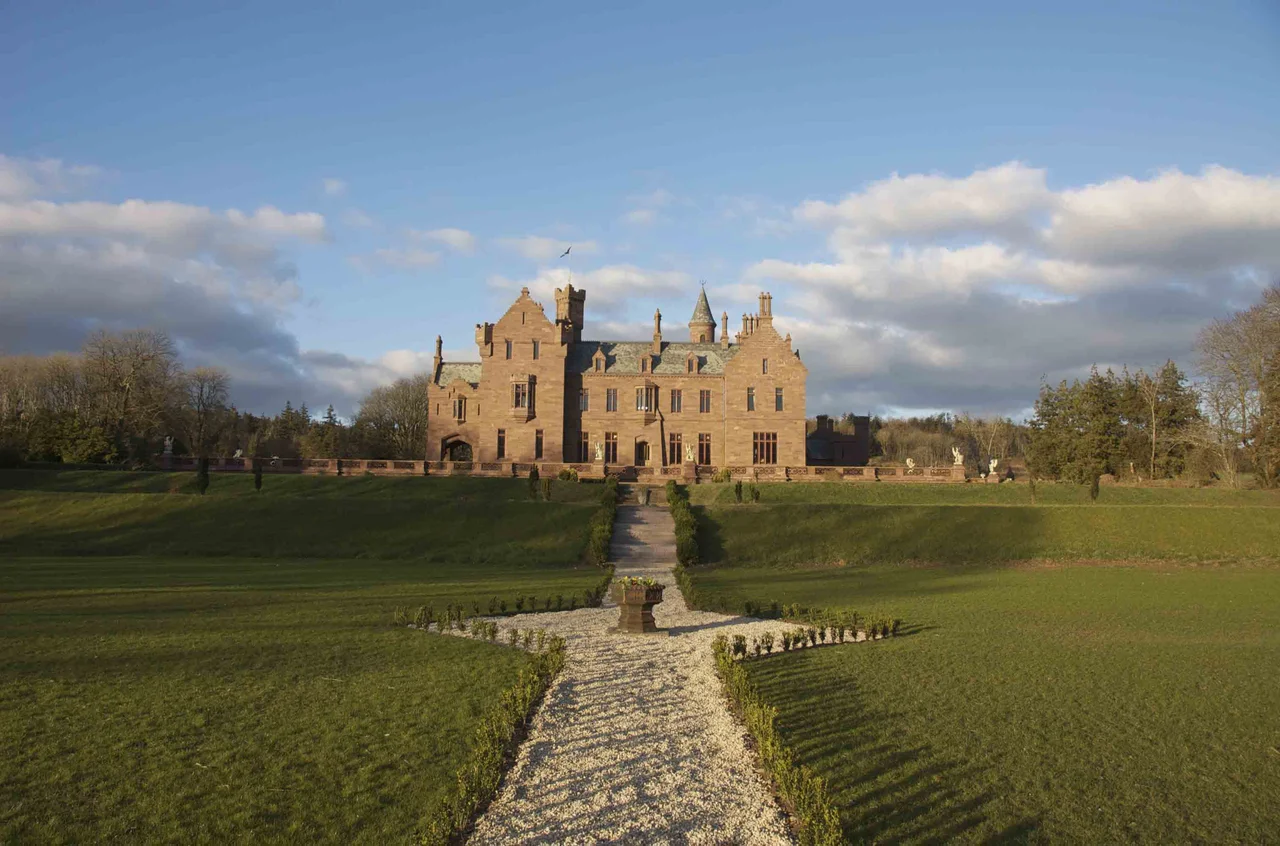
Fifty-five thousand bottles. That, supposedly, is the capacity of the wine cellar at Castle Oliver - the largest in Ireland, dug out in pink sandstone beneath a Victorian country house at the southern edge of County Limerick. The number is repeated everywhere it is mentioned, which is to say in nearly every account of the building, and it is one of those happily improbable Irish facts that may or may not be exactly right but is too good to leave out. The castle above the cellar is more verifiable. It was commissioned in 1845 by two sisters - Mary Isabella and Elizabeth Oliver Gascoigne - and designed by a York architect named George Fowler Jones in the Scottish Baronial style. Pink sandstone was quarried on the estate. The terraces are massive. The views still command twenty thousand acres that no longer belong to the house.
Cromwell's Captain, and Lola Montez's Grandmother
The Olivers came to this corner of Limerick in 1658 with the Cromwellian land settlements. Captain Robert Oliver, one of Cromwell's soldiers, took possession of the lands the Otway family had held before him - the original Irish name Cloch an Otbhaidhigh, 'the stone structure of Otway', getting anglicized over the centuries into Clonodfoy, which is what the present castle was sometimes called. The first Castle Oliver stood a thousand yards to the southwest. It is famous for one of its residents above all others: Eliza Oliver, born in that earlier house, who became the mother of Lola Montez, the Irish-born adventuress and dancer who, in the late 1840s, was the favourite and lover of Ludwig I of Bavaria. Her influence over the king contributed to his abdication in 1848. Lola Montez had a career that ran through Paris, London, New York, Australia, and the California gold fields. Her grandmother's house was a few hundred yards from where the present castle now stands.
Two Sisters, One Architect
Captain Oliver's descendant Richard Oliver married a Yorkshire heiress and inherited Parlington Hall near Leeds. He moved away, taking the Gascoigne name, and left Castle Oliver to deteriorate in the hands of a bailiff. His two daughters, Mary Isabella and Elizabeth, inherited eventually. Both married Trenches of Woodlawn in Galway; Elizabeth married Frederic Mason Trench, 2nd Baron Ashtown, in 1852. The sisters were unusually accomplished. They designed and executed both the stained glass and the verre eglomise - back-painted glass panels - on the ballroom fireplace at Castle Oliver, work that has largely survived to this day. Mary Isabella, the elder sister, was a skilled wood-turner who published, under a male pseudonym, a book called The Art of Wood-Turning that is still cited as authoritative. They commissioned the present castle from George Fowler Jones in 1845. He had already done substantial work for them in the north of England - almshouses, churches - and now he produced this Scottish Baronial fantasia on a Cromwellian site.
Pink Sandstone and Hand-Painted Ceilings
Castle Oliver was built for entertaining, not for defence. The ballroom, drawing room, library, morning room, dining room, and great hall all carry hand-painted ceilings, ornamental corbels, decorative stencil work, and the sisters' own stained glass. Gothic arched doors connect ballroom to drawing room. The cellar runs deep enough to hold its legendary 55,000 bottles. The castle was inherited by Elizabeth's step-grandson, the Honourable William Cosby Trench, and remained in the Trench family until 1978. Mrs Lynn Trench sold the property that year to the racing driver Billy Coleman. After that, the castle changed hands several times, the lands and lodges were broken up by a local bank, and the house itself fell into decay. It was featured in the Irish Georgian Society's book Vanishing Houses of Ireland. Vandals and thieves did their work.
Restored, Reoccupied, Repeating
Restoration began in 1988 when Damian Haughton bought the castle and, according to a later owner, sealed most of the worst leaks in the roof. Nicholas Browne, who acquired it in 1998, made it habitable again and later wrote a history called Castle Oliver and the Oliver Gascoignes. In 2006 the castle passed to Declan and Emma Cormack from County Antrim, who pushed the restoration to high standards - reviving the library, the St Patrick stained glass window, the wood panelling, cornices, and many of the fireplaces - and lived there with their three children Michael, Shane, and Ciara. In 2015 they sold it to the Ralph family from Australia, who use it for several months of the year. In the summer of 2014, during Limerick's year as a UNESCO City of Culture, Castle Oliver was open to the public for house tours. The fifty-five thousand bottles, if they still exist, sleep in the cellar.
From the Air
Castle Oliver lies at 52.33 degrees north, 8.48 degrees west, in the Ballyhoura hills of southern County Limerick, near Ardpatrick. The nearest commercial airport is Cork International (EICK), about 55 km south; Shannon (EINN) lies 70 km north, Kerry (EIKY) about 90 km west. From altitude, look for the Ballyhoura Mountains forming the border ridge between Limerick and Cork, with the broad Awbeg and Funshion valleys to the south. The castle stands on its massive terraces overlooking the rolling countryside, with the pink sandstone walls and Scottish Baronial turrets visible in clear weather.
Nearby Stories
- Shanbally Castle 2.9 km away
- Crescent College 8.8 km away
- Waterloo Round Tower 8.9 km away
- Ballyvourney 9.7 km away
- Castlemartyr 13 km away
- Abbeyfeale 15 km away
- Holy Cross Abbey 17 km away
- Siege of Carrigafoyle Castle 24 km away