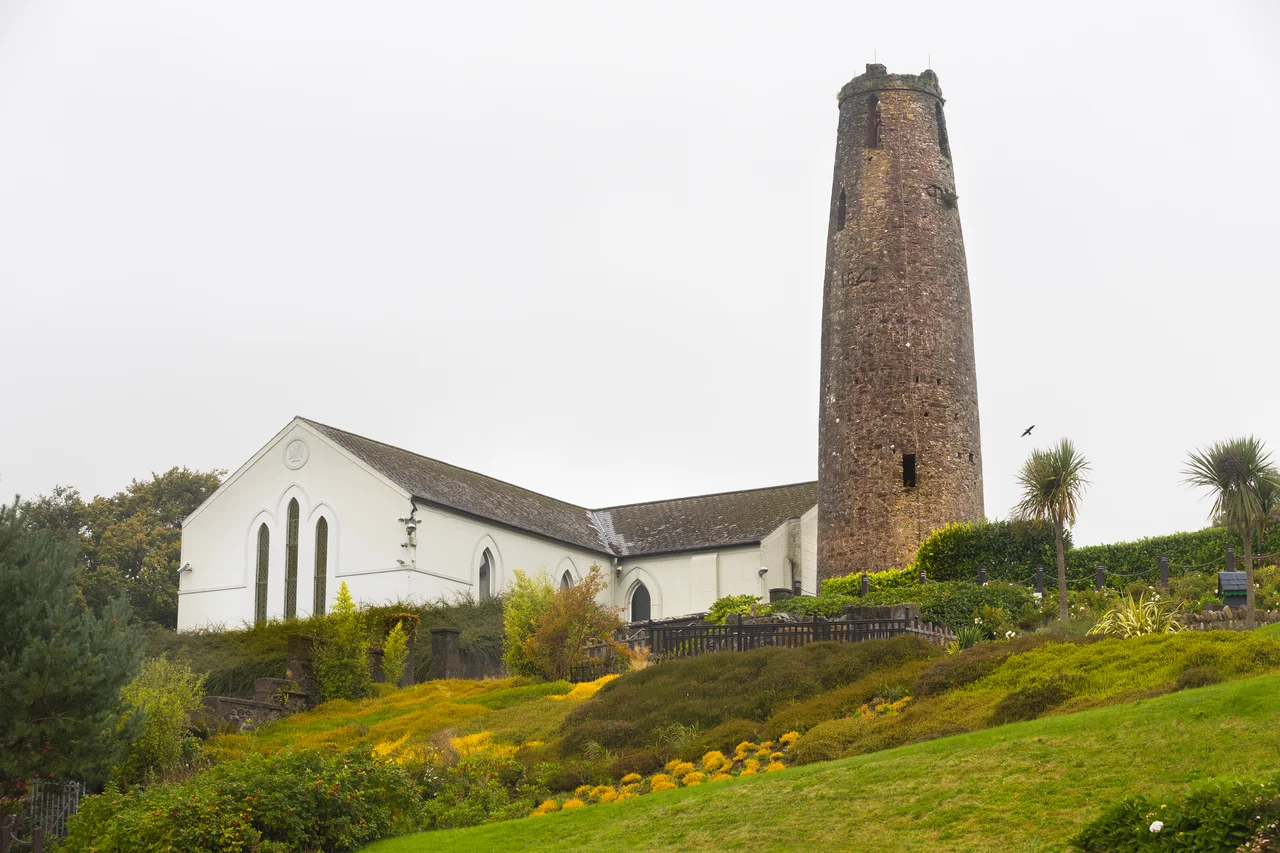

Waterloo Round Tower
Locals call it Father Matt's Butterchurn. The Waterloo Round Tower narrows as it climbs - not by clever design but, the story goes, because the parish ran out of money before the masons could reach the top. Tucked into Ballygibbon townland two kilometres north of Blarney, the tower stands beside St. Mary's Church on a low hill, overlooking the River Martin and the eighteenth-century Putland's Bridge that crosses it. It was finished in 1843, more than two decades after the Battle of Waterloo for which the surrounding village was named, and it remains one of the more eccentric specimens of Cork's nineteenth-century antiquarian enthusiasm.
A Priest, an Antiquarian, and a Landlord
The foundation stone was laid on 27 July 1836 by Father Matt Horgan, the parish priest of Whitechurch and Blarney, on land granted by the local landlord, a man named Putland whose family also lent its name to the nearby bridge. Father Horgan was no ordinary country cleric. He had spent years studying the ancient round towers that dot the Irish landscape - those slim, conical-capped survivors of early Christian monasteries whose origins were the subject of fierce nineteenth-century debate. Was Horgan settling that debate by building a new one? Not exactly. The Waterloo tower is what eighteenth and nineteenth-century gentlemen called a folly - a deliberate piece of architecture built for delight, devotion, or display, with no functional ancestor to answer to. Horgan brought in the Cork antiquarian and architectural draughtsman John Windele to draw up the plans.
The Butterchurn Shape
Round towers in Ireland are usually tall, straight cylinders, gently tapering toward a conical cap. The Waterloo Round Tower is rounder than that. It bulges in the middle and pinches toward the top, following a curve that locals likened to a butter churn - the wooden vessel in which cream was once paddled into butter, wider at the belly and narrower at the lid. The traditional explanation is financial. As construction climbed, money ran short; the builders simply tightened the diameter to use less stone. Whether that is strictly true or the kind of story a parish tells about its own quirks is harder to say, but the result is unmistakable. The four-stage construction is built of rubble stone, with a raised entrance modelled on the genuine medieval examples, slit windows for light, two incised inscriptions - the year 1843 and the name Matthew in Gaelic script - and a belfry at the top.
Father Horgan Beneath the Hill
Father Horgan did not live to see his tower used as he had hoped. He died in 1848, just five years after its completion, during the worst years of the Great Famine that emptied so much of rural Cork. He is said to be buried in the grounds of St. Mary's Church, in the shadow of the very structure he had imagined and underwritten. Whether his bones lie inside the tower itself or in the surrounding churchyard remains a matter of local lore rather than verified record. What is documented is the affection the village retained for him: the inscribed Gaelic Matthew on the tower's flank is essentially a signature in stone, and the affectionate nickname has outlived two centuries of weather.
Bringing the Bell Back
By the early 2000s the tower needed help. Mortar had failed, the bell had fallen silent, and the picturesque setting had grown overgrown. In 2009, after an eighteen-month effort, the Waterloo Renewal Group - a small community committee that included Heritage Council of Ireland grants among its funding sources - completed a renovation that cost 35,000 euro. The bell was automated and brought back into service. A climbing walkway was built up to the tower's door, and a sloping garden was planted around it. In August 2009, Archbishop Dermot Clifford of Cashel re-dedicated the structure. The tower carries the formal designation RMP CO062-200002- on the Record of Monuments and Places, but its more lasting credential is simpler: it still rings, on the same hill, beside the same church, above the same river.
The Antiquarian Imagination
Across nineteenth-century Ireland, romantic-era antiquarians built and restored monuments that tried to reach back across a thousand years of severed history. Some efforts were earnest, some scholarly, some closer to fancy dress. The Waterloo Round Tower belongs to that family - a Catholic priest, freshly emancipated by the political reforms of the 1820s, asserting a continuity with the early Christian Ireland of saints and scholars by raising something that looked like a survivor from that era. It is not a survivor. It is a tribute, sincere and slightly wonky, on a green hill in County Cork. And it still has the name Matthew carved into its side.
From the Air
Located at 51.955 degrees north, 8.575 degrees west, 2 kilometres north of Blarney village and about 7 nautical miles northwest of Cork city. Look for the small white church on a hill above the River Martin and the stone bridge crossing south of it. Cork Airport (EICK) is roughly 9 nautical miles south-southeast. The tower stands roughly 16 metres tall - visible at low altitude but easy to miss above 3,000 feet AGL. Recommended observation altitude 1,000 to 2,000 feet AGL in clear weather.
Nearby Stories
- Ballyvourney 1.6 km away
- Castlemartyr 3.9 km away
- Ballybeg Priory 4.1 km away
- Kilbrittain 5.2 km away
- Shanbally Castle 10 km away
- Skibbereen 17 km away
- Castleisland 22 km away
- SM U-27 118 km away