
Kilbrittain
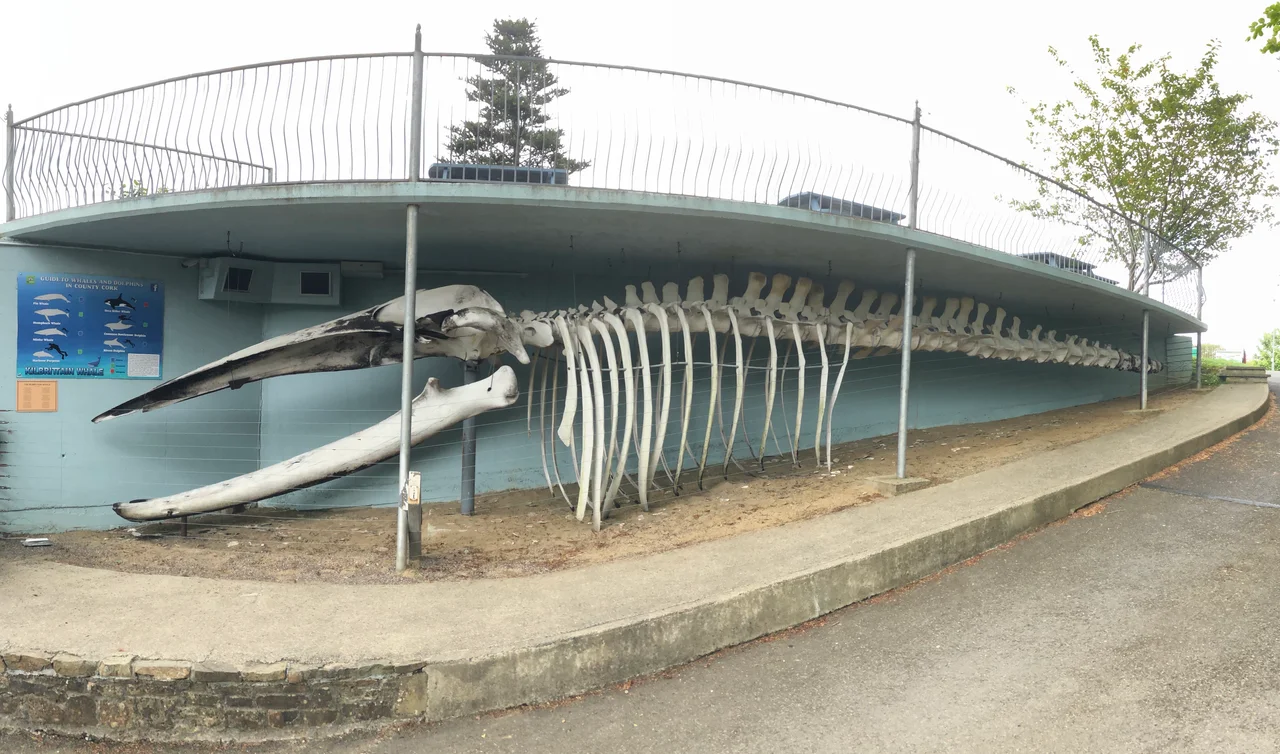
The skeleton in the park is the first thing people remember about Kilbrittain. It is 18 metres long - the bones of a fin whale that stranded on a beach in Courtmacsherry Bay on 15 January 2009 and could not be saved. The Courtmacsherry lifeboat tried, but the animal was too heavy, the tide unhelpful, and the second-largest creature ever to live died on the sand a few miles from where its skeleton is now displayed. Channel 4 sent a documentary crew. Local songwriter Michael O'Brien wrote a humorous song about whether the whale belonged to Kilbrittain or Courtmacsherry. The bones - rearticulated and weather-worn now - stand on a small green just east of the village, a sudden monumental scale in a place that otherwise hides its grandeur.
A Castle Old as the Battle of Hastings
Kilbrittain Castle is thought to date from 1035. If true, the original fortress predates the Norman invasion of Ireland by more than a century - older even than the Battle of Hastings - and was likely built by the O'Mahony clan. Norman de Courcey took it, the MacCarthy Reagh family then made it the principal seat of the Princes of Carbery and Kings of Desmond from the early 15th century onward, and the Stawell family enlarged it during the 18th and 19th centuries. The castle was partly burned in 1920 during the Irish War of Independence, then restored in 1969 by the inventor Russell Winn. A thousand years of ownership, attack, expansion, fire and revival rest in its walls. A second castle, Coolmain, sits nearby on the coast - originally a de Courcey building, lost to the MacCarthys, passed through the Earls of Cork, briefly acquired by Oliver Cromwell himself, owned in the early 20th century by the novelist Donn Byrne, and bought in the 1990s by Roy E. Disney.
Marco Polo in Irish
Kilbrittain's most extraordinary export is a book. The Book of Lismore, also called Leabhar Mhic Cárthaigh Riabhaigh, was compiled in the 15th century - it is believed - to commemorate the marriage of the Gaelic prince Finghin Mac Cárthaigh Riabhach of Kilbrittain Castle to Caitilín, daughter of the seventh Earl of Desmond. It contains 166 large vellum folios written on calfskin: a cosmological work called the Ever-new Tongue, the most extensive medieval Irish-language account of saints' lives, one of the great Fenian Cycle compositions Acallam na Senórach, and - astonishingly - an Irish translation of the travels of Marco Polo. In 1642, during a raid on Kilbrittain, Lord Kinalmeaky took the manuscript to Lismore Castle, where it disappeared behind a wall and stayed lost until 1814, when builders found it during rebuilding works. A library of medieval learning, written for the wedding of a Gaelic prince in a West Cork castle, was bricked up for nearly two centuries inside the wall of another.
Disney and the Disney Photographer
Coolmain Castle gathered an unlikely 20th-century cast. Donn Byrne, the Irish-American novelist born in New York and raised in Armagh, lived there in the early 1900s and is buried in Rathclarin churchyard - he died young in a 1928 car crash. Roy E. Disney - nephew of Walt Disney, and the man who in the 1980s engineered the rescue of the Disney company from its post-Walt slump - bought Coolmain in the 1990s and used it as an Irish family retreat until his death. And Bob Willoughby, the Hollywood photographer who shot Audrey Hepburn, Marilyn Monroe and Frank Sinatra for the great American magazines, also lived at Coolmain. A castle that had passed through Cromwell's hands ended up sheltering, across the same century, an Irish novelist, a Disney heir, and the photographer who taught the world how movie stars should look on contact sheets.
Tofu and Tractors
Modern Kilbrittain is a working West Cork village with two primary schools, a parish church, a GAA club founded in 1904, and one of the first producers of Irish-made tofu - a quirk that earns it the occasional national-paper headline. Each summer, Burren House overlooking Courtmacsherry Bay hosts an open-air opera in aid of the Courtmacsherry Lifeboat - black-tie evenings of arias drifting across the water toward Wood Point. The Kilbrittain Festival has run every August since 2004. Hundreds of tractors muster each year for the Kilbrittain Tractor Run, raising money for local causes. In 2011 a short film called The Blow-Ins was shot in the village and in nearby Courtmacsherry. None of this would matter much if Kilbrittain were a louder place. Because it is quiet - a single church, a few shops, a whale on a green - the small things stack up into something improbable: a village with a castle older than the Norman conquest, a manuscript translated from Marco Polo, a Disney connection, and bones.
From the Air
Located at 51.67 N, 8.69 W in West Cork, inland from Courtmacsherry Bay. Kilbrittain village is the inland point of a triangle with Courtmacsherry and Timoleague along the coast. Best viewed at low altitude (1,500-3,000 ft); the castle and the whale skeleton park sit east of the village core. Cork airport (EICK) lies about 25 nm to the northeast.
Nearby Stories
- Ballymaloe House 1.3 km away
- Ballincollig Castle 2.8 km away
- Skibbereen 9.8 km away
- Ballyvourney 10 km away
- Ballycotton 27 km away
- HMHS Llandovery Castle 53 km away
- Wolfpack Prien 74 km away
- SM U-27 85 km away