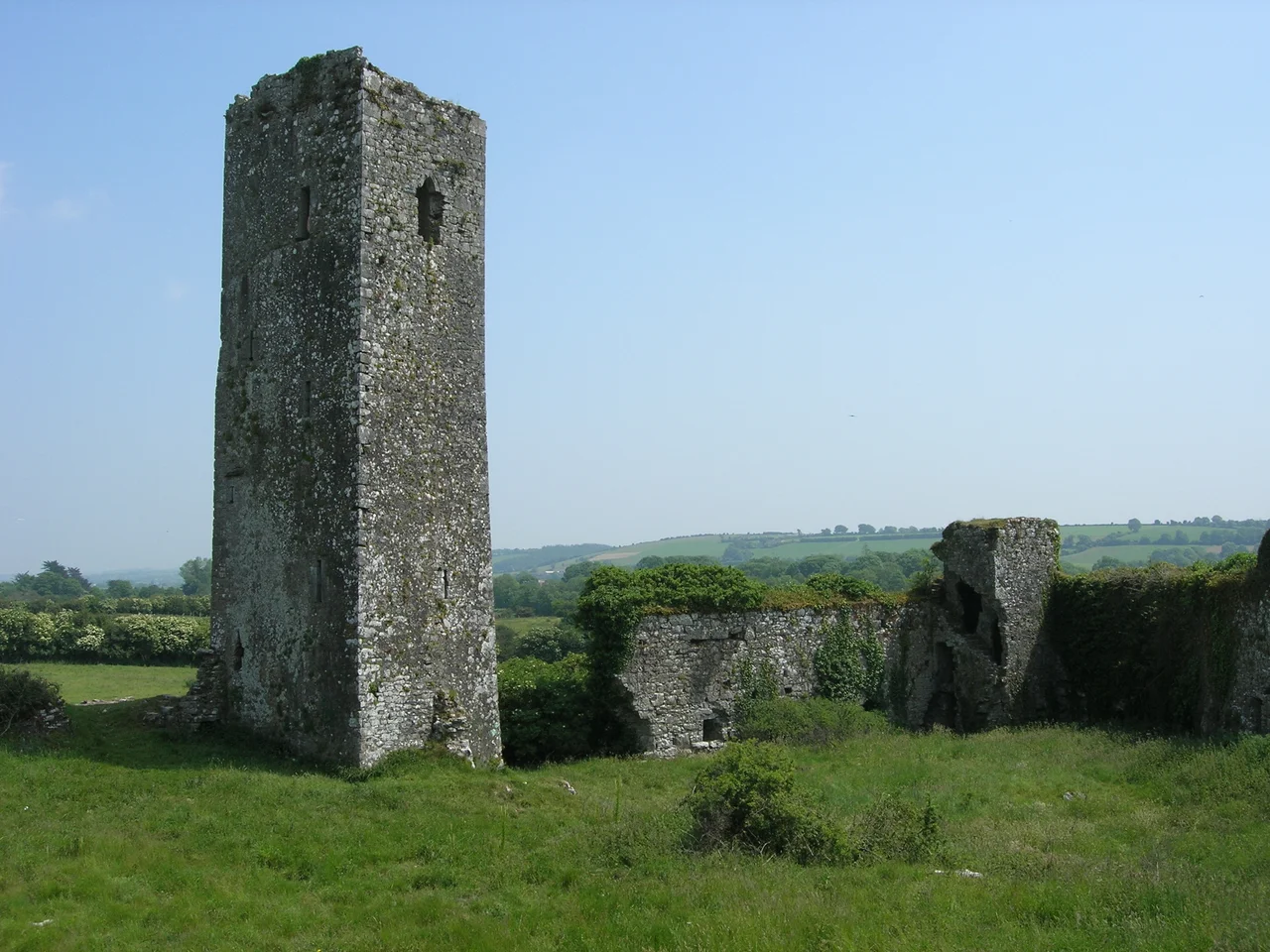

Ballincollig Castle
Ballincollig means the town of the Colls, and the Colls were one man. Sir Robert Coll, a Norman knight, raised a stronghold here some time after the Norman invasion of Ireland, and the village that grew up beneath his walls eventually took his name. Baile an Choillaigh. The town of Coll. He has been gone nearly seven centuries, but the place still remembers him in everyday speech, and his keep still stands above the rock south of the modern town.
A Norman Foothold
The keep at the centre of the castle is dated to the 13th century, which places it in the wave of Norman fortification that followed the conquest of Ireland in 1169. Robert Coll built or rebuilt the tower that survives. Some local tradition suggests an earlier castle on the same rocky site, but only the high stone keep can be securely dated. Coll's lordship did not last forever. By 1468 the Barrett family had purchased his estate at Ballincollig and were extending the works. Walls were thrown up to enclose a large bawn. Defensive towers rose on the southeast and south. The Barretts were the dominant family of the area for the following two centuries, and the castle was their seat.
Walls and Bawn
The enclosing wall, the bawn, still stretches most of the way around the rocky plateau on which the castle sits. It runs about five feet thick and fifteen feet high, with a parapet on top and stone steps climbing to it at several points - the kind of detail that quietly tells you the wall was meant to be defended by men running at speed in a fight. Two towers brace the line, one now ruined in the southeastern corner, the other holding the south wall. Inside the enclosure, the ground is broken and uneven. Archaeologists have found evidence of a large hall in the middle - a fireplace, a chimney, a window of two lights still readable in the surviving outer wall. The hall and the two towers seem to be 15th-century work, raised by the Barretts after they took the property. Everything else is older.
The Keep
The tower is 45 feet tall and built to be entered only with permission. The ground floor is vaulted and originally had no doorway at all - access was through a trap door from above. The first-floor room sat above a path on stone arches, about seven and a half feet wide. A very narrow staircase climbed from level to level, each floor laid on solid arches that demanded thick supporting walls. On the second story, you can still see the small seats cut into the embrasures where archers would have settled to wait for movement outside, the drain from a garderobe (a medieval lavatory), and a small square cupboard set into the stone above it. Upper-floor windows on every side were added much later, in the middle of the 19th century, when the Wyse family briefly cared about the place enough to renovate it.
The W and 1857
On the east wall of the keep, you can still pick out a shield carved with the letter W and the date 1857 beneath it. The Wyse family inserted it during their renovation work, a small piece of Victorian self-confidence pressed into a medieval surface. The repairs did not last forever. After the Wyses moved on, the castle returned to slow ruin. Today it sits inside the Sites and Monuments Record of the Archaeological Survey of Ireland as entry CO073-062, with the bawn and an associated cave catalogued separately. The walls are eroded but stubborn. The keep stands. From the parapets you can look out across the modern Ballincollig sprawl, the Royal Gunpowder Mills along the river to the north, and the Lee valley running down to Cork. Robert Coll's name has outlived his bones by seven hundred years. The town wears it every day.
From the Air
Ballincollig Castle sits at 51.87916667 N, 8.59944444 W, on a rocky outcrop south of the town of Ballincollig and the River Lee. Cork Airport (EICK) lies 9 km to the south-southeast. From the air the castle ruin is visible in low light as a rectangular bawn enclosure with the central keep tower still upright. The neighbouring Ballincollig Royal Gunpowder Mills run along the river just to the north. Best aerial views from 1,500-2,500 ft AGL on the western approach to Cork.
Nearby Stories
- Ballyvourney 1.6 km away
- Castlemartyr 3.9 km away
- Ballybeg Priory 4.1 km away
- Kilbrittain 5.2 km away
- Shanbally Castle 10 km away
- Skibbereen 17 km away
- Castleisland 22 km away
- SM U-27 118 km away