
Castlemartyr
The Fitzgeralds of Imokilly were not called the Dogs of Blood for nothing. The local peasantry coined the name - in Irish, Madraí na Fola - because the family that built and held this castle from 1420 onwards was bloody-minded enough to earn it. In 1581 the Earl of Ormond overran Imokilly, captured the elderly mother of the seneschal John FitzEdmund, and hanged her from the castle wall. FitzEdmund submitted to the Earl and never got the place back; the Crown handed it to Sir Walter Raleigh instead. Today the tower house is a roofless ruin in the grounds of a five-star spa hotel, on the N25 between Cork and Waterford, sixteen kilometres west of Youghal.
Three Names, Many Layers
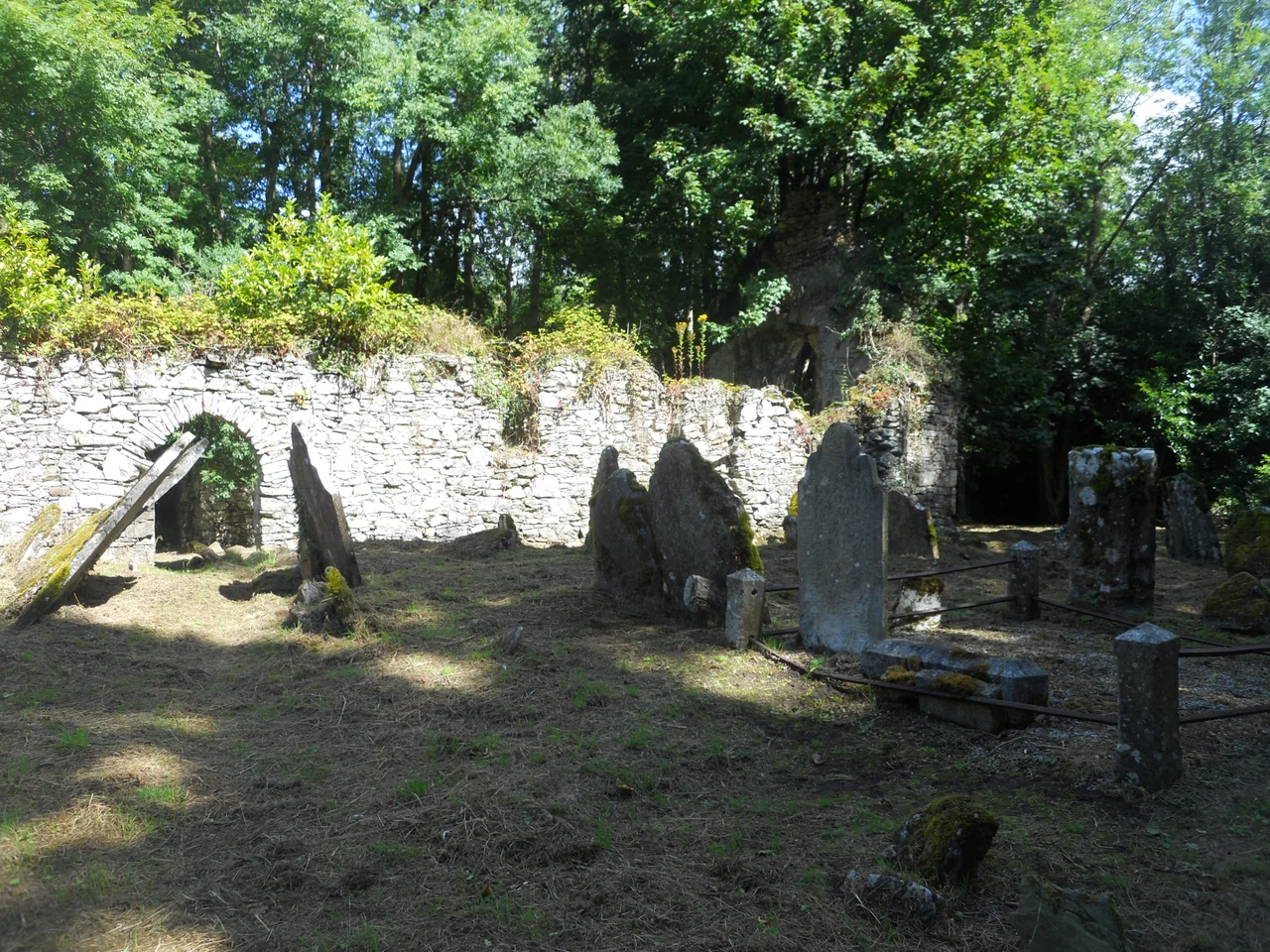
Castlemartyr has been anglicised over the centuries as Ballymarter, Ballymartyr, and finally the present spelling. The original Irish, Baile na Martra, refers to the relics or martyrs of an old church at nearby Ballyoughtera - now a ruined graveyard, but once a monastic settlement that became a Norman feudal village. The Pipe Roll of Cloyne records the parish in 1300, valued at five marks. By 1364 the documents speak of "Richard Kerdyf holds the land of the whole Ville of Martyre," implying a mill, a castle for protection, and tenant farmers paying their tithes in ground corn. James FitzGerald, 6th Earl of Desmond, built the present castle around 1420 after his appointment as Seneschal of Imokilly. The Fitzgeralds held it for a hundred and fifty years; the Boyles - Earls of Shannon - held it for two hundred more.
Raleigh's Grant, Boyle's Inheritance
After the Desmond Rebellion crushed the old Geraldine power, the Crown confiscated everything between Lismore and Castlemartyr and handed it to Walter Raleigh. He held the lands only until 1602, when Richard Boyle - the future 1st Earl of Cork - bought them for £1,000. The Boyle family would dominate Castlemartyr until Irish independence. In 1676 the town was incorporated with a charter that gave the Boyles complete control of the corporation and its parliamentary seats. In 1689 the village was a centre of Protestant resistance against James II until Justin MacCarthy's Irish Army forces overran it. Henry Boyle, raised to the peerage in 1756 as Baron Castlemartyr, Viscount Boyle, Earl of Shannon, built Castlemartyr House - the country pile that is now a 200-employee golf and spa resort. When the Act of Union dissolved the borough's parliamentary representation in 1800, the 2nd Earl received £15,000 in compensation. Old power did not lose money.
The Chauffeur
On the evening of 27 November 1920, Liam Heffernan from nearby Conna was sitting in a parked car on Castlemartyr Main Street. He was a chauffeur by trade and an IRA volunteer by night, employed to drive officers of the local battalion. Two Royal Irish Constabulary officers, recognising him, approached the car to question its occupants. Within seconds, gunfire was being traded across the street. One RIC officer died; the other was wounded. So was Heffernan. He managed to start the car and swing it over the bridge onto the Mogeely Road, but he was bleeding badly. A comrade took the wheel and they reached Conna, where the local doctor pronounced him dead. In May 1971, fifty-one years later, the village unveiled a stone monument to him near the spot where he was shot.
Tea at Mrs Farrell's
January 1965. The Rolling Stones were touring Ireland and driving from Waterford to play the Savoy Theatre in Cork. The N25 ran straight through Castlemartyr, and the band stopped here for refreshments. Bill Wyman and Charlie Watts took tea at Mrs Farrell's eating-house. Across the street, Mick Jagger, Keith Richards, and Brian Jones drank something stronger at Barry's Bar. The documentary Charlie Is My Darling captures a brief sequence of these events - the four most famous young men in Britain, anonymous on a wet Irish street for a few minutes, before the cars started again and they were gone. The village's main employer, the Castlemartyr Spa & Golf Resort hotel, did not yet exist. The castle, by then a ruin for several centuries, looked exactly the same as it does today.
The Village Now
Approximately 1,900 people live in Castlemartyr and its hinterland according to the 2016 census, most commuting under 45 minutes to school or work in Cork or Midleton. The village has a Catholic church from around 1860, a Church of Ireland church from 1731, a greengrocer, a supermarket, and several pubs. The GAA club plays hurling and football in the Imokilly division. Bronze Age tumuli still mark the surrounding townlands of Ballyvorisheen; ringforts left by the earliest defenders sit half-buried in nearby fields. Castle, ringfort, ruined church, golf resort - all within walking distance of one another, all on land that the Dogs of Blood once held, and that Sir Walter Raleigh briefly owned.
From the Air
Located at 51.92°N, 8.05°W in east County Cork on the N25 trunk road, approximately 30 km east of Cork city and 16 km west of Youghal. Best viewed from 2,500-4,000 ft AGL. The village is laid out along its main street with the castle ruin and the 18th-century Castlemartyr House (now hotel) visible to the north of the road. Look for the green of the spa resort's 18-hole golf course wrapping around the medieval ruin. Nearest airport is Cork (EICK) approximately 25 km / 14 nm to the west; Waterford (EIWF) lies roughly 60 km / 32 nm to the northeast. The N25 makes a clean east-west visual line connecting Cork, Midleton, Castlemartyr, and Youghal - a useful low-level navigation reference along the coast.
Nearby Stories
- The Glen, Cork 3.8 km away
- Liam Lynch (Irish republican) 6.1 km away
- All Together Now (festival) 9.4 km away
- Castle Oliver 14 km away
- Kilbrittain 17 km away
- 1999 Tramore helicopter crash 30 km away
- Walter Siepmann 37 km away
- SM U-27 107 km away