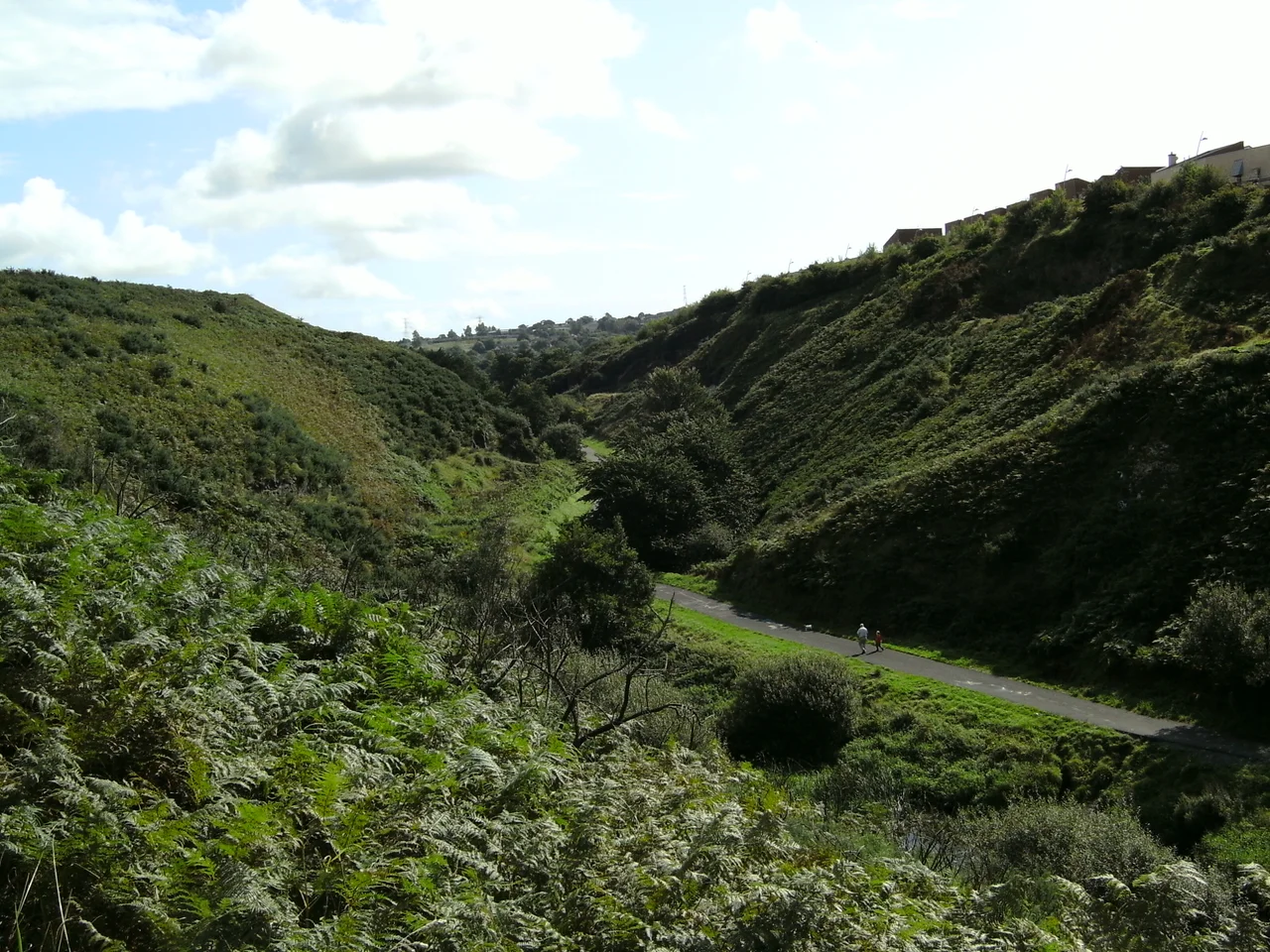

The Glen, Cork
On the night of 11 December 1920, six IRA men ran down through a Cork valley with bloodhounds on their trail. They had just ambushed a British Auxiliary convoy at Dillon's Cross - one Auxiliary dead, twelve wounded, the squad untouched - and the path through Goulding's Glen was the planned escape. The stream that runs along the valley floor was swollen with winter rain. The men crossed the bridge over it, made it into open country at Blackpool, and disappeared. The Auxiliaries' retaliation that night and the next was the Burning of Cork, which destroyed much of the city centre. The Glen is now a regenerated public park with a ski slope and a parkrun. The bloodhounds are gone. The valley remembers.
A glacier and a fertilizer factory
The Glen is what a glacier left behind. During the Late Pleistocene and early Holocene, the River Lee valley was filled with ice, and when the glacier melted the meltwater carved a ravine running east to west on the north side of the river. The Glen River still flows along that line, joining the Bride and the Kilnap in the Blackpool Valley to form the Kiln River. From the 1850s the valley filled with a different kind of industry. W. and H.M. Goulding built a large factory here that produced phosphate fertilizers, and the place became known as Goulding's Glen. Phosphate fertilizer was one of the chemical industries that quietly transformed Irish agriculture in the late 19th century. The factory closed and was demolished in the mid-20th century. Sir Basil Goulding donated the land to the people of Cork in the late 1960s, and the valley was turned into an amenity park.
The tunnel under your feet
Walk through the Glen River Park today and you will pass two strange round stone shafts rising out of the ground - one on Arderin Way, the other on Glentrasna Drive. They are ventilation chimneys for the Cork-Mallow railway tunnel, constructed between 1847 and 1855 to bring the rail line under the high ground of north Cork to a tunnel mouth in the city. The tunnel had four ventilation shafts in all; two of them are in the Glen. The tunnel itself is still in use - the modern Cork-Dublin trains roll through the same Victorian engineering on their way out of Kent Station - and the shafts ventilate the diesel exhaust the way they once ventilated steam smoke. A metallic train sculpture was added next to the Arderin Way shaft around the year 2000. It marks the strangeness of a Victorian engineering work still doing its job 170 years later, with a children's playground built around its breathing apparatus.
Dillon's Cross, and the burning
By 11 December 1920 the Irish War of Independence had reached its worst phase in Cork. The day before, martial law had been formally declared. A six-man squad of A Company of the Cork IRA - led by Sean Healy and others - chose to ambush an Auxiliary convoy at Dillon's Cross, half a mile from Victoria Barracks. The plan relied on the proximity of Goulding's Glen as an escape route. A 50-yard stone wall along Balmoral Terrace gave the ambushers cover. The plan called for bombs into the lorries, a quick volley of revolver shots, and then escape on foot, down through O'Callaghan's Field, into the Glen, across the swollen stream, and out into open country. They executed it. The Auxiliaries lost one killed and twelve wounded. The IRA squad reached Lieutenant Duggan's father's house in Blackpool by morning. The Auxiliaries, enraged, set fire to Cork city centre that night - the Burning of Cork, in which Patrick Street was destroyed and the City Hall was gutted. The Glen had given the ambushers their lives. The city paid for them.
Regeneration and the unexpected ski slope
The housing estates that fill the south side of the valley today were built in the 1970s - terraced houses with shared walls and free-standing flat blocks - and like many such estates around Irish cities they were under-resourced from the start, lacking the shops, schools and meeting spaces that a young community needs. The Glen Regeneration Project of the 2000s set out to fix that. Phase I in 2006 added new infill housing, demolished one flat block and refurbished two more, and built a day care centre overlooking the park at a cost of 26.5 million euro. Susie's Field, a large green field at the eastern end of the area, was developed into a 109-unit housing estate between 2007 and 2009. The Glen Resource and Sports Centre opened in March 2001 and offers six all-weather pitches, a zip line, yoga and karate classes. In 2014 the centre installed Ireland's first publicly owned artificial ski slope - 30 metres long, 5 metres wide, with a 14 per cent gradient and a perma-snow surface over a shock-absorbing pad. The wetlands at the heart of the park host moorhens, reed buntings, and sand martins nesting in the sand banks of what used to be Murphy's Quarry. A parkrun runs along the valley every Saturday morning. The bloodhounds are not on the trail anymore.
From the Air
The Glen lies at 51.9125 N, 8.4628 W, a steep-sided east-west glacial valley running through the north side of Cork city, about 2 km north of the city centre. The Glen River park is the green corridor at the floor of the valley; the residential estates of Glentrasna, Ardmore and Glenthorn climb the south slope. The Cork-Mallow railway tunnel runs north-south beneath the valley with its visible ventilation shafts. Cork Airport (EICK) is 8 km south. The Burning of Cork sites at Dillon's Cross and St Patrick's Street are visible to the south. Recommended viewing 1,500-3,000 ft AGL - the valley's distinctive ridged profile makes it easy to identify in clear weather.
Nearby Stories
- Ballyvourney 1.6 km away
- Castlemartyr 3.9 km away
- Ballybeg Priory 4.1 km away
- Kilbrittain 5.2 km away
- Shanbally Castle 10 km away
- Skibbereen 17 km away
- Castleisland 22 km away
- SM U-27 118 km away