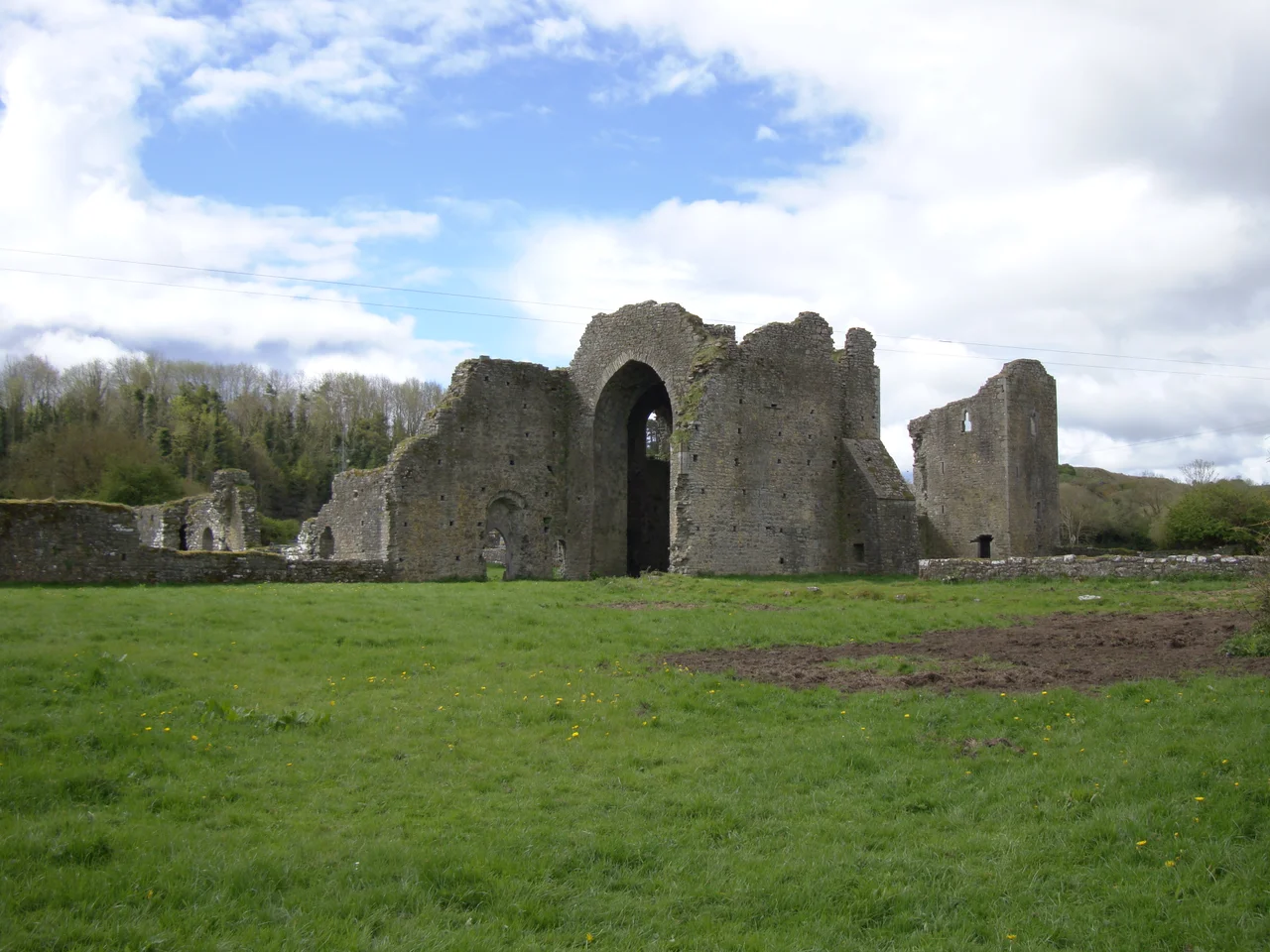

Ballybeg Priory
Three hundred and fifty-two nesting holes. Eleven tiers of square stone compartments, thirty-two niches in each tier, rising fifteen feet up the inside of a circular tower. The architectural historian Frank Keohane calls it, without hedging, 'arguably the finest medieval dovecot surviving in Ireland.' The priory it served has been quarried, scavenged, and ruined - the bell tower was once turned into a cow byre - but the columbarium at Ballybeg, on a field just outside Buttevant in north County Cork, is almost perfectly preserved. Built to produce the most valuable agricultural fertilizer of medieval Europe, it tells you almost everything about the priory it belonged to.
Founded for the Murdered Archbishop
The priory was founded in 1229, dedicated to Saint Thomas Becket - the archbishop of Canterbury murdered in his own cathedral by knights of Henry II in 1170, sixty-odd years before the foundation stone went down at Ballybeg. The founder was either Philip de Barry or his son William, two of the leading Anglo-Norman lords of the Munster conquest. An equestrian statue of de Barry reportedly once stood in the church to commemorate the foundation. Their grandson, David Og de Barry - the first Baron Barry - enlarged the priory's revenues sometime in the 1230s or 1250s. By the time he was done, the Augustinian canons of Saint Thomas held 2,060 acres of land plus the advowsons of multiple rectories, making them one of the more affluent religious communities in southern Ireland. The church was 166 feet long and 26 feet wide. The cloister was a square 90 feet on each side.
The Math of a Dovecot
The reason for the dovecot was money. Pigeon manure - guano - was worth more by weight than the equivalent from cattle, sheep, or pigs, because it was the best fertilizer available for herb gardens, kitchen plots, and any high-value crop. Dovecots were a privilege reserved to landowners, like fish ponds and deer parks; in France, the medieval ordinances controlling who could keep doves were not abolished until the Revolution in 1789. The Ballybeg dovecot is circular, with 352 niches arranged in 11 tiers of 32. The tiers do not start at ground level - they begin a few feet up, so the droppings could be collected from a clean stone floor - and they end well below the flight hole in the roof, because doves will not nest near a busily frequented entrance. A continuous string course runs around the outside of the building at mid-height, structural reinforcement that also kept weasels and martens from climbing to the openings. By comparison, the dovecot at the Trinitarian priory at Adare in Limerick is much smaller. Ballybeg was rich.
Becket's Canons Get Their Lands Back, And Then Lose Them
A residential tower was added in the mid-15th century, the medieval equivalent of upgrading the office space. Then came Henry VIII. The priory was dissolved in 1541. The endowments at the moment of suppression amounted to about 60 acres of arable demesne, 40 of pasture, the buildings, the church, the cemetery, plus 120 acres in the Ballybeg townland and the rectories of more than a dozen parishes across what had been Barry country - Kilmallock in Limerick, Carrigtwohill east of Cork city, Doneraile next door, and others. Sir George Bouchier, Master of Ordnance under Elizabeth I, received the lands. James I parcelled them out to Elizabeth Norreys, Sir John Jephson, and Sir David Norton. The Jephsons consolidated their interest in 1609 and held it for centuries. The last titular Prior of Ballybeg was John Baptist Sleyne, the Bishop of Cork and Cloyne, who died in exile in Lisbon in 1712.
Oxen Under the Arch
After the Jephsons took possession, much of the priory was quarried for stone to build other things. The bell tower was repurposed as a cow byre. In 1837, Samuel Lewis recorded that a stone coffin had at some point been excavated from the ruins - inside it, a skeleton adorned with a cross and golden chains. In 1898, a sarcophagus thought to hold one of the friars was found in a tomb near the bridge. The line that survives best from the 19th-century descriptions is the one quoted by visitors: 'Today, oxen and asses rest and ruminate under the shadow of the church of the Austins of Ballybeg, the stone coffins of the monks their watering troughs, and the tombs where rest the bones of abbots their byres.' The priory, the dovecot, and the nearby Ballybeg Tower are now National Monument 301, in State Care. The 352 nesting holes are still there, in eleven perfect tiers, in the circular tower the canons built to make sure their herb garden was the best fertilized in Cork.
From the Air
Ballybeg Priory lies at 52.22 degrees north, 8.67 degrees west, about a kilometre south of Buttevant in north County Cork. The nearest commercial airport is Cork International (EICK), about 50 km south; Shannon (EINN) lies 90 km north, Kerry (EIKY) about 75 km west. From altitude, look for the broad green valley of the Munster Blackwater running east through Mallow, with the smaller Awbeg tributary just to the north running through Buttevant. The priory ruins, including the distinctive circular dovecot, sit in a field beside the N20 road.
Nearby Stories
- Shanbally Castle 2.9 km away
- Crescent College 8.8 km away
- Waterloo Round Tower 8.9 km away
- Ballyvourney 9.7 km away
- Castlemartyr 13 km away
- Abbeyfeale 15 km away
- Holy Cross Abbey 17 km away
- Siege of Carrigafoyle Castle 24 km away