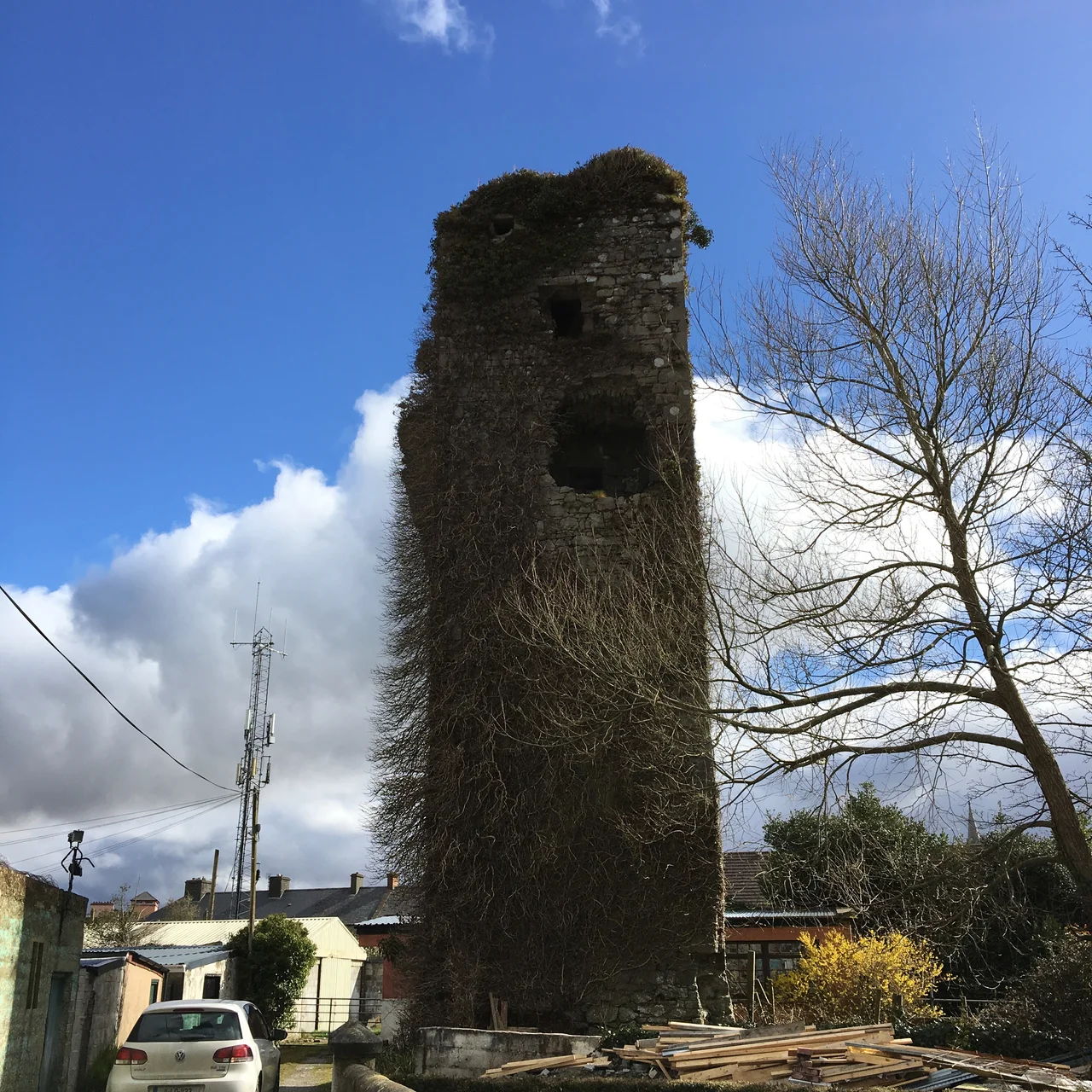

Castleisland
In 1226, a Norman called Geoffrey de Marisco - lately Lord Justice of Ireland under Henry III - did something audacious in the flat country east of Tralee. He diverted the River Maine to encircle a piece of ground, turned that ground into an artificial island, and built a castle on it. The castle gave the town its name: Castleisland, in Irish Oileán Ciarraí, the Island of Kerry. The diverted river is still there, though the castle is mostly gone. What remains is a market town of 2,536 people with one of the widest main streets in Ireland, a cave system that runs beneath the surrounding fields, and a bald eagle story that nobody ever quite believed.
Centre of Desmond Power
Geoffrey de Marisco built well. His castle on its artificial island became one of the strategic strongpoints of Norman Kerry. Within 120 years it had been taken over by the FitzGeralds - the Geraldine dynasty that would dominate Munster for the next four centuries as the Earls of Desmond. In 1345, the castle was being held for Maurice FitzGerald, 2nd Earl of Desmond, by Sir Eustace de la Poer and a garrison of knights when Sir Raoul d'Ufford, the English chief governor of Ireland, came for them. D'Ufford captured the castle. Sir Eustace and the other knights were executed - the kind of casual lethal politics that defined the long contest between Anglo-Norman lords gone native and the English crown trying to keep them obedient. Castleisland became the centre of Desmond power in Kerry, and stayed so until the catastrophic Desmond Rebellions of the late 16th century finished the dynasty off.
Crag Cave
A few miles outside Castleisland, beneath the limestone fields, runs one of Ireland's largest accessible cave systems. Crag Cave was discovered in 1983 when local engineers traced an underground river. Speleologists who explored the system found three kilometres of passages, including some of the largest cave formations in the country - the Great Stalactite Chamber alone holds the longest stalactite in the British Isles at around four metres. Crag opened to the public in 1989 with guided walking tours along boardwalks, illuminated stalactites and stalagmites, and a children's adventure attraction called Crazy Cave on the surface. The cave is the visible reminder that East Kerry sits on karst country - the same kind of limestone landscape, soluble in slightly acidic rainwater, that creates the sinkholes north of Killarney and the great cave systems of Clare's Burren further north.
The 1921 Ambush
Castleisland saw violence during the Irish War of Independence, as did most of Kerry. On 10 July 1921 - one day before the truce was declared and the war effectively ended - three IRA men and four British soldiers were killed in a gunfight in the town. The ambush was one of the last engagements of the war, fought essentially as the ceasefire was being negotiated in Dublin. The IRA dead, the British soldiers, all of them died in what would within twenty-four hours become a war that had stopped. The Carnegie Library at the eastern end of the main street had been burned the previous year, in 1920, during the wider campaign of British reprisals on premises connected to nationalist activity. It was replaced by the present library building in 1929, and the original building still stands - the function of library moved to new premises in 2008, but the old Carnegie still serves as the district court.
The Wide Street
Castleisland's main street is famously wide. The width served practical Victorian purposes: a market town needed space for cattle drives, fair days, and large gatherings, and the main street doubled as the market square. For most of the 20th century, that width was a virtue. After the 1990s, it became a problem. The N21 from Limerick and the N22 from Cork all funnelled through Castleisland's main street, with delays of half an hour or more at peak times. Trucks heading to Tralee, holidaymakers heading to Killarney, locals trying to do their shopping - all jammed up in a town built for cattle. Castleisland's community organised a formal lobbying campaign ahead of the 2007 election. Funding was allocated. Construction of the Castleisland Bypass began in May 2009. The 3.4 km dual carriageway and connecting roads opened on 22 October 2010, with then-Minister for Defence Tony Killeen cutting the ribbon. The traffic went around. The wide main street got quiet again.
The Bald Eagle
In November 1987, a juvenile bald eagle was captured near Castleisland, apparently exhausted. Local explanation: the bird had flown across the Atlantic from North America, blown off course by an autumn storm, and finally crash-landed in County Kerry. The Associated Press picked up the story. Ornithologists were sceptical - a juvenile bald eagle making 5,000 km across open ocean is implausible at best - and the most common counter-theory is that the bird had escaped from a private collection. But the story took hold in Castleisland anyway: a North American bird, lost and exhausted, found in a Kerry field. It became a small piece of local folklore. Whatever the bird's actual provenance, it was returned to North America and lived. The story made for an unusual entry in the town's history alongside Norman knights and IRA ambushes.
Goalkeepers, Bishops, and Journalists
Castleisland produces people. Charlie Nelligan, born in 1957, played goalkeeper for Kerry GAA through the 1970s and 1980s and won seven All-Ireland football medals - one of the highest tallies in the game's history. His club, Castleisland Desmonds, won the All-Ireland Senior Club Football Championship in 1985, beating St. Vincent's of Dublin in the final. Mick Doyle from nearby Currow coached Ireland to the 1985 Five Nations title. Con Houlihan, born in Castleisland in 1925, became one of Ireland's most beloved sports columnists, writing for the Evening Herald and the Irish Press with a left-wing, classically educated style that influenced generations. Denis Mary Bradley emigrated to America and became the first Catholic Bishop of Manchester, New Hampshire, and co-founded Saint Anselm College. Redmond Prendiville became Archbishop of Perth at age 32 - reputedly the youngest archbishop ever. Larry Sharpe, born 1951, became a professional wrestler and trainer in the United States. The town twinned with Bannalec in Brittany on 14 August 2007. The wide street still hosts a market. The cave still draws visitors. The eagle still gets mentioned, decades later.
From the Air
Castleisland sits at 52.23°N, 9.46°W in east County Kerry, 16 km east of Tralee and 19 km north of Killarney. From the air, look for the unusually wide main street running through the town centre and the junction of the N21 and N22 main roads. Kerry Airport (EIKY) at Farranfore is 7 km southwest. Shannon Airport (EINN) is 80 km north. The Glanaruddery Mountains rise to the north; Stack's Mountains to the west. The Vale of Tralee opens westward. Crag Cave is roughly 2 km outside town. Best viewing altitude is 2,500-4,500 feet.
Nearby Stories
- Adare Manor 0.9 km away
- Fenit Island 2 km away
- Donoughmore 5.3 km away
- Charleville 9.9 km away
- Ring of Kerry 11 km away
- Siege of Carrigafoyle Castle 12 km away
- Killarney National Park 13 km away
- Saint Macdara's Island 83 km away