
Donoughmore
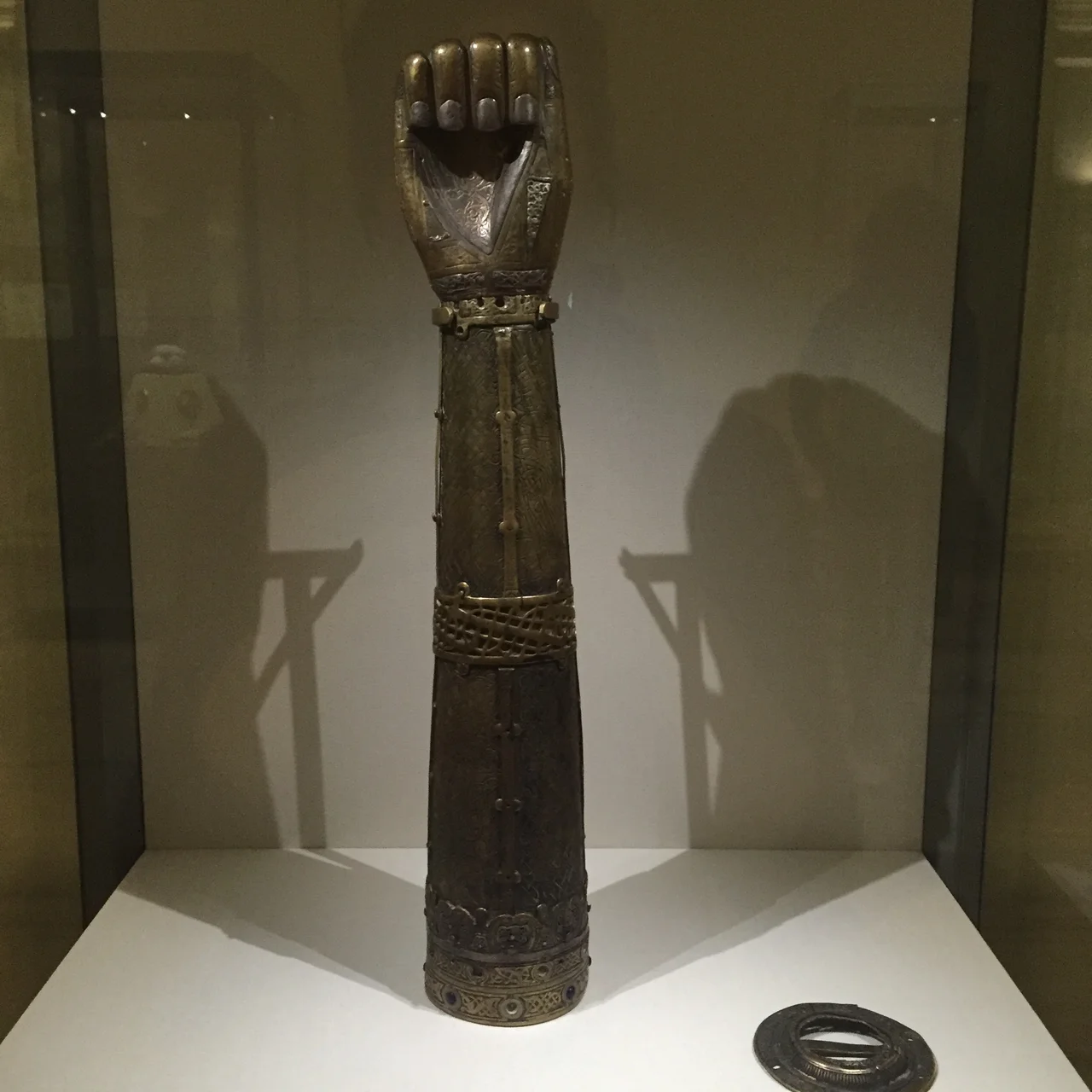
There is a small parish in the foothills of the Boggeragh Mountains, about 20 kilometres west-northwest of Cork city, where the road signs alternate between Donoughmore and Donaghmore depending on whether the Ordnance Survey or the locals are doing the spelling. Domhnach Mór is the Irish name, meaning roughly "great church." In the National Museum of Ireland in Dublin sits a remarkable hollow bronze sculpture of a forearm and hand - the Shrine of Saint Lachtin's Arm - which originated at the ruined church at Donoughmore Cross. From this same parish came two American Roman Catholic bishops, three passengers on the Titanic, an IRA Civil War battalion, and the name attached to an Anglo-Irish peerage held by people who lived in Tipperary instead. Donoughmore is small. Its outward reach is not.
Standing Stones and Saint Lachtin's Arm
The earliest residents left behind standing stones and ring forts. Some of those stones carry Ogham script, the linear alphabet of early medieval Ireland, and at least three Ogham stones found in the Donoughmore area are now on display in the National Museum of Ireland in Dublin. The most famous artefact from the parish is the Shrine of Saint Lachtin's Arm, a hollow cast-bronze reliquary in the shape of a forearm and hand, made around 1120 to hold a piece of wood that itself contained a relic of Saint Lachtin. The shrine came from the ruined church at Donoughmore Cross. It now sits in the National Museum, and a 20th-century replica is in the Metropolitan Museum of Art in New York. A small Cork parish's craftwork is studied today on two continents.
The Earl Who Lived Elsewhere
The title Earl of Donoughmore takes its name from the parish, but its holders did not live there. The story begins with Francis Hely, from neighbouring Kilshannig, who converted to the established Protestant religion and married Prudence Earbery, the daughter of a lease-owner in Donoughmore. Their son John married Christina Nixon, an heiress to Richard Hutchinson, and took the name John Hely-Hutchinson. He became a politician and Provost of Trinity College Dublin. Using his political position, he secured a peerage for his wife. She chose the title Baroness Donoughmore of Knocklofty, even though Knocklofty is in Tipperary and the Hely-Hutchinsons lived there rather than in Cork. Their son Richard later became the first Baron Donoughmore and, after backing the 1800 Act of Union, the first Earl. The title remains. The geographical link has always been a borrowed one.
Titanic Passengers and American Bishops
Three people from Donoughmore boarded the RMS Titanic in 1912: William Doherty, Hannah Naughton, and William Foley. All three died when the ship sank. Their deaths place this small inland parish, improbably, in the most famous shipwreck of the twentieth century. The same place produced two American Roman Catholic bishops in the nineteenth century. John Tuigg became Bishop of Pittsburgh. Denis J. O'Connell became Bishop of Richmond, Virginia. The pattern is the pattern of nineteenth-century Cork: a thinly populated rural parish whose sons and daughters scattered across the Atlantic and turned up in unexpected places, on the boards of dioceses and on the third-class passenger lists of ill-fated liners. A Donoughmore native was also the first person from County Cork ordained as a Minister at Cork's Trinity Presbyterian Church after it was built in 1861.
The Tram, the Butter Road, and Civil War
Donoughmore was connected to Cork City by the narrow-gauge Cork and Muskerry Light Railway, which opened in 1893 and closed in 1934. The station sat at the bottom of New Tipperary. The same parish is crossed by an older infrastructure: the Old Kerry Road, an eighteenth- or nineteenth-century specialist route built to move butter from Cork's market to County Kerry. It includes the longest continuously straight section of road in the whole parish. The twentieth century was harder. The Donoughmore Battalion fought for the anti-treaty side in the Irish Civil War. Three of its members were killed: Denis Creedon and John O'Brien died in a fight with Free State forces on 14 September 1922, and William Healy was executed in Cork Gaol on 13 March 1923. A war memorial in the parish carries their names. The Wallace sisters, IRA intelligence officers during the War of Independence, were born and raised in the same townlands.
Forty Townlands and Eight All-Ireland Medals
Forty townlands make up Donoughmore, divided across three electoral divisions: Firmount, Gowlane, and Kilcullen. The village of Stuake lies at the north end. Two primary schools serve the parish - Scoil Iósaif and St. Lachteen's. Donoughmore was finally electrified between May 1953 and January 1954. Sport is dominant. The local GAA club plays both hurling and Gaelic football in the Mid-Cork division, and the ladies' footballers won the senior All-Ireland in 2001 and 2003. Juliet Murphy, born in Donoughmore, is considered one of the greatest ladies' footballers in the history of the sport: she captained Cork to three All-Ireland victories and won eight All-Ireland medals over her career. A small parish, eight medals, two Wallace sisters, three Titanic passengers, one bronze arm in Dublin. The reach keeps going.
From the Air
Located at 51.99°N, 8.75°W in the foothills of the Boggeragh Mountains, approximately 20 km west-northwest of Cork city. Cork Airport (EICK) lies about 21 nm south-southeast. The parish covers 22,309 acres of rolling rural countryside with three small mountains rising within its bounds - Uctough, Toureen, and Knockagoun. Recommended viewing altitude 3,000-5,000 ft for tracing the dense field pattern, the village of Stuake at the north end, and the Old Kerry Road's long straight section. The R619 and R579 are the two main regional roads through the parish.
Nearby Stories
- Ballyvourney 1.6 km away
- Castlemartyr 3.9 km away
- Ballybeg Priory 4.1 km away
- Kilbrittain 5.2 km away
- Shanbally Castle 10 km away
- Skibbereen 17 km away
- Castleisland 22 km away
- SM U-27 118 km away