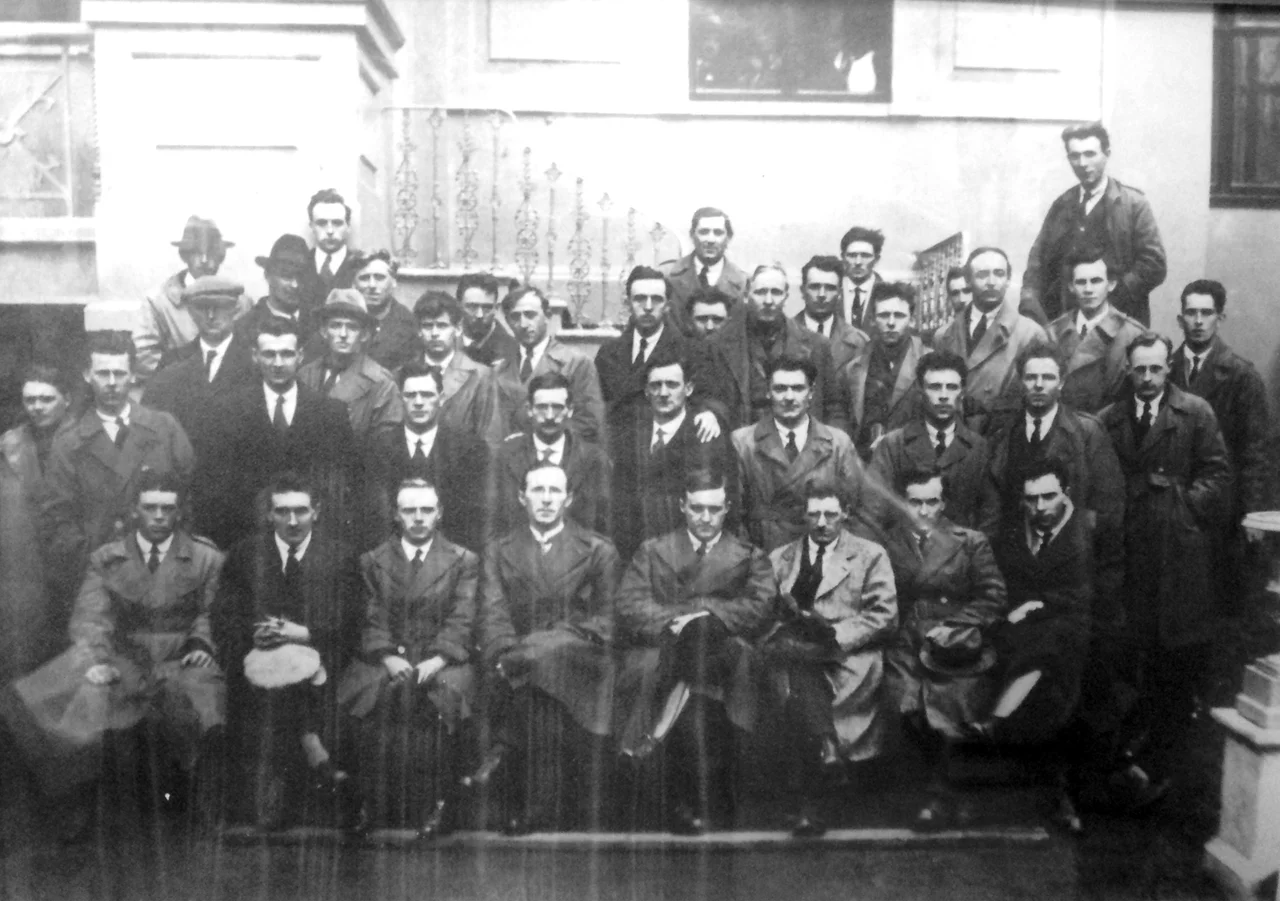

Liam Lynch (Irish republican)
"I am Liam Lynch, Chief-of-Staff of the Irish Republican Army. Get me a priest and doctor. I'm dying." The soldiers who reached him on the high ground of the Knockmealdown Mountains on 10 April 1923 had initially thought they had captured Eamon de Valera. They had not. The man bleeding on the slope was the other most-wanted republican in Ireland, the commander who had kept the Irish Civil War alive for nine months after Michael Collins's death. Twenty days later his successor, Frank Aiken, gave the order to dump arms. The war was over. The bullet that ended Liam Lynch's life - fired by Free State soldiers on a Tipperary mountainside - is sometimes called the shot that effectively ended the conflict. The bloodied tunic he wore that morning hangs today in the National Museum at Collins Barracks in Dublin.
The hardware shop in Mitchelstown
He was born William Fanaghan Lynch on 20 November 1892 at Baurnagurrahy, a townland in the Galtee foothills of County Limerick, close enough to Mitchelstown in north Cork that he later went there for work. His parents were Jeremiah and Mary Lynch, both buried in the Brigown graveyard at Mitchelstown. At seventeen he started an apprenticeship in O'Neill's hardware shop in the town and joined the Gaelic League and the Ancient Order of Hibernians. The decisive moment was 1916. Working then at J. Barry & Sons in Fermoy, he watched the Kent brothers - David and Thomas - being marched through the town under guard by the Royal Irish Constabulary after a shootout at their family home, Bawnard House. Thomas Kent was hanged. Liam Lynch decided his life's purpose. In 1917 he became First Lieutenant of the Irish Volunteer Company in Fermoy.
Commandant of the Cork No. 2 Brigade
By 1919, when the War of Independence had begun, Lynch was commandant of the Cork No. 2 Brigade. He commanded the capture of British General Cuthbert Lucas in June 1920, shooting a British colonel in the operation. Two months later he was captured himself in the British raid on Cork City Hall - the same raid that took Terence MacSwiney, who would die on hunger strike that October. Lynch gave a false name and walked out three days later. He organised a flying column. In September 1920 he and Ernie O'Malley led the famous capture of the British barracks at Mallow. Early 1921 brought further ambushes, including 13 British soldiers killed near Millstreet. When the IRA reorganised into divisions in March-April 1921, his reputation got him command of the entire 1st Southern Division - the largest in the country. He welcomed the July 1921 Truce as a respite. He believed the war would continue.
Chief of Staff against the Treaty
When the Anglo-Irish Treaty was signed in December 1921, Lynch opposed it. The Treaty had created an Irish Free State as a Dominion within the British Empire, not the Irish Republic that had been proclaimed in 1916. But Lynch was not a hardliner like the men who seized the Four Courts in Dublin in April 1922 - he tried to keep the IRA together, hoping a republican constitution might bridge the gap. When civil war finally came on 28 June 1922, he was Chief of Staff of the anti-Treaty IRA. He established his headquarters at Limerick, then at Fermoy, with the goal of creating what he called a Munster Republic defended by a Waterford-Limerick line. The line did not hold. Limerick fell on 20 July, Cork City on 8 August, Fermoy on 11 August. Michael Collins was killed at Beal na mBlath in west Cork on 22 August. By the end of summer the conventional phase of the war was lost. What remained was a brutal guerrilla campaign that would take more lives, including many young men on both sides.
Orders of frightfulness
The civil war hardened in late 1922. The Provisional Government began executing captured republicans - four IRA men on 14 November, the writer Erskine Childers on 17 November. Lynch responded on 30 November with what were called his "orders of frightfulness": general orders sanctioning the killing of Free State TDs, senators, judges, and newspaper editors in reprisal. IRA gunmen shot TD Sean Hales on 7 December outside the Dail. The next day the Free State executed four senior republican prisoners - Rory O'Connor, Liam Mellows, Dick Barrett and Joe McKelvey - without trial. The cycle continued. The official Free State execution count reached 77; an estimated 150 more captured republicans were killed unofficially. Lynch's men burned the homes of TDs. In one such attack the seven-year-old son of TD Sean McGarry was killed. The elderly father of Free State minister Kevin O'Higgins was murdered at Stradbally. Lynch wrote to de Valera that "Free State supporters are traitors and deserve the latter's stark fate." By March 1923 the executive of the IRA met in the Nire Valley to consider ending the war. Lynch insisted on continuing, and won the vote by 6 to 5. He had been trying, fruitlessly, to import mountain artillery from Germany.
The Knockmealdowns, 10 April 1923
On 10 April 1923 a Free State sweep through the Knockmealdown Mountains caught the IRA executive in the open. Lynch was shot trying to escape. The soldiers who reached him thought they had de Valera. He corrected them and asked for a priest and doctor. His last wish was to be buried beside his comrade Michael Fitzgerald, who had died on hunger strike in 1920 after 67 days without food. The soldiers carried Lynch on a stretcher made of their own rifles down to Nugent's pub - formerly Walsh's - in Newcastle, County Tipperary. He was then taken to hospital in Clonmel and died there at 8.45 pm that evening, age 30. He was buried two days later at Kilcrumper Cemetery near Fermoy. Twenty days after his death, Frank Aiken ordered the IRA to cease military operations. The war was, in practical terms, over. In 1935 the Fianna Fail government of Eamon de Valera erected a 60-foot round tower monument to Lynch on the spot where he fell. The barracks at Kilworth were named Lynch Camp in his honour in 1966. The Good Friday Agreement, which ended the Troubles in Northern Ireland, was signed on 10 April 1998 - the 75th anniversary of his death.
From the Air
Liam Lynch was killed at approximately 52.25 N, 7.86 W on the high slopes of the Knockmealdown Mountains, County Tipperary side. The 60-foot round tower monument marks the site. Waterford (EIWF) is 28 nm east; Cork (EICK) 40 nm southwest; Shannon (EINN) 55 nm north-northwest. Recommended viewing altitude 3,000-4,500 ft AGL to see the full Knockmealdown ridge, with Knockmealdown itself (the highest point at 794 m / 2,604 ft) the dominant peak. The monument tower is visible from the air on the Tipperary side of the ridge. Below to the south are Mount Melleray Abbey, Lismore, and the Blackwater Valley.
Nearby Stories
- All Together Now (festival) 1 km away
- Molana Abbey 4.1 km away
- Castle Oliver 4.7 km away
- Holy Cross Abbey 9.4 km away
- Siege of Kilkenny 9.4 km away
- Waterloo Round Tower 13 km away
- Castletroy 14 km away
- Ramsey Island 141 km away